7 Powerful Ways Childhood Patterns Can Shape Your Relationships
November 9, 2026
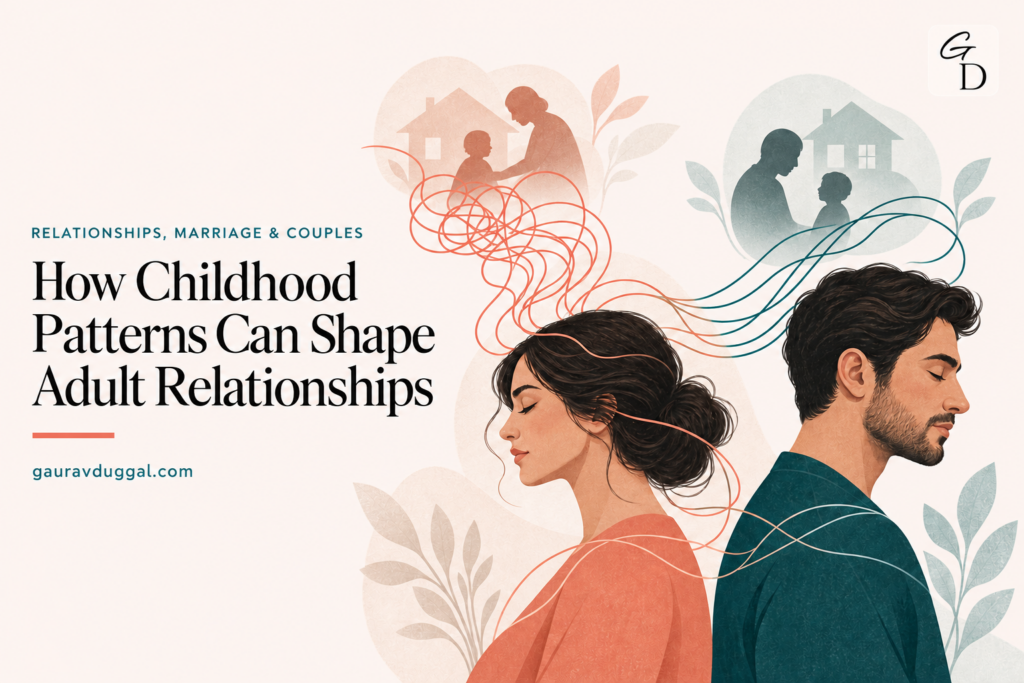
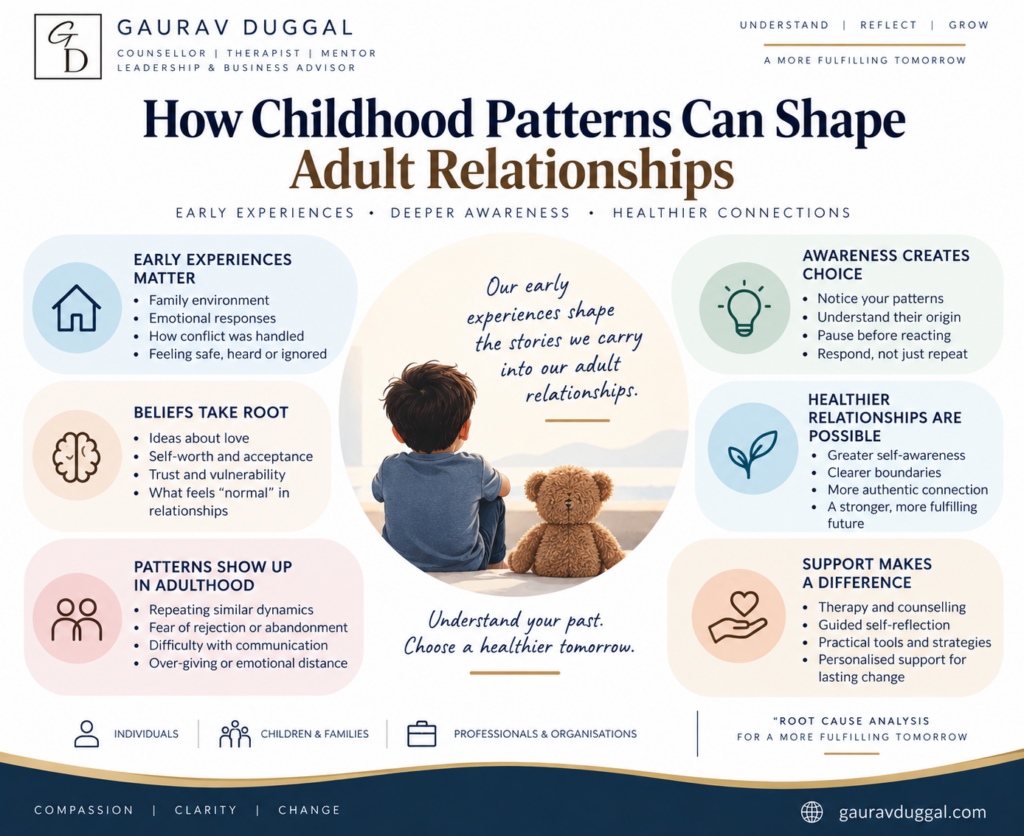
Childhood patterns in adult relationships can influence how we experience trust, closeness, conflict and reassurance long after childhood. The way we behave in adult relationships does not begin only when we meet our partner.
Long before adulthood, we begin learning what closeness feels like, how disagreements are handled, whether emotions are welcomed or dismissed, and what we need to do to feel heard, accepted, safe, or valued.
These early experiences can become childhood patterns in adult relationships. They may influence whom we trust, how we respond to conflict, how much reassurance we seek, and even what we expect love to feel like.
Understanding these patterns is not about blaming parents or living in the past. It is about
recognizing
what may still be operating in the present—and deciding whether those responses continue to serve us.
What Are Childhood Patterns in Adult Relationships?
Childhood patterns are learned emotional and
behavioral
responses that can continue into adulthood.
A child who repeatedly experiences criticism, for example, may become highly sensitive to perceived disapproval. Someone who learned that conflict resulted in withdrawal or silence may later avoid difficult conversations altogether.
Another person may have learned that affection was unpredictable and consequently seek frequent reassurance from a partner.
These reactions can become so familiar that we experience them as part of our personality rather than as learned responses.
This is one reason relationship difficulties sometimes seem disproportionate to the immediate situation. The present disagreement may be small, but it can activate an older emotional expectation.
How Early Experiences Can Influence Adult Relationships
whether asking for help brings support or criticism;
whether affection is consistent or unpredictable;
whether personal boundaries are respected;
and whether mistakes can be repaired without rejection.
None of these experiences automatically determines what our adult relationships will become. Human development is far more complex than that.
Temperament, later relationships, culture, education, significant life experiences, self-awareness and supportive interventions can all influence how patterns develop or change.
The useful question therefore is not simply: What happened to me?
It is also: What did I learn from those experiences, and how is that learning affecting my relationships today?
Common Childhood Patterns That May Appear in Relationships
1. Fear of Rejection
Someone who experienced inconsistent attention or repeated rejection may become particularly alert to signs that a partner is pulling away.
A delayed message, change in tone or request for personal space may feel more threatening than the situation warrants. This can lead to repeated reassurance-seeking, overthinking or attempts to restore closeness immediately.
2. Avoiding Conflict
If arguments in childhood felt frightening, humiliating or unresolved, avoiding disagreement may once have been an effective way of staying emotionally safe.
In an adult relationship, however, persistent avoidance can prevent important concerns from being discussed. Healthy relationships do not require the absence of disagreement. They require ways of navigating disagreement without destroying respect.
3. People-Pleasing and Over-Accommodation
Some children learn that approval comes from being cooperative, useful or undemanding.
As adults, they may find themselves saying yes when they want to say no, suppressing their preferences, or assuming responsibility for another person’s emotions. Over time, this can produce resentment, exhaustion and an unequal relationship dynamic.
4. Difficulty Trusting Others
When reliability was uncertain earlier in life, trusting another person can feel risky.
The adult may look for evidence of betrayal, question a partner’s intentions or maintain emotional distance even when the relationship itself provides little reason for suspicion.
5. Becoming Defensive Around Criticism
For someone who grew up experiencing frequent criticism, even constructive feedback can feel like a judgment of their worth.
Instead of hearing that a
behavior
affected their partner, the person may internally hear that there is something wrong with them. Defensiveness then becomes protection rather than deliberate hostility.
Recognizing
this distinction can change the way a couple approaches the problem.
Why Partners Can Trigger Each Other’s Patterns
Relationships bring two histories into the same room.
One partner may respond to uncertainty by moving closer and asking for reassurance. The other may respond to emotional pressure by withdrawing and seeking space.
The first person experiences withdrawal as rejection and pursues harder. The second experiences pursuit as pressure and retreats further.
Soon, both people are responding not only to each other but also to what the interaction represents emotionally.
This is why repeatedly deciding who is right often fails to resolve recurring relationship conflicts.
A more productive question can be: What pattern are we creating together?
Awareness Is Different From Blame
Understanding childhood influence should never become a permanent explanation for harmful
behavior
.
Awareness is valuable when it increases responsibility. A person can
recognize
that a reaction makes sense considering what they learned earlier while also accepting responsibility for how they respond today.
That shift creates room for change. It also prevents relationship work from becoming an exercise in blaming parents, partners or circumstances.
Can Childhood Relationship Patterns Change?
Yes. Learned patterns are not necessarily permanent patterns.
Change usually begins with
recognizing
the sequence:
Trigger → Interpretation → Emotional Response →
Behavior
→ Relationship Consequence
Consider a partner who does not respond to a message for several hours. The trigger is the delayed response. The interpretation might become: They are losing interest.
That interpretation creates anxiety. Anxiety leads to repeated messages or confrontation. The partner then feels pressured and withdraws—which appears to confirm the original fear.
Once the sequence becomes visible, there is an opportunity to interrupt it. Instead of reacting automatically, the person can learn to examine the interpretation, regulate the emotional response and communicate the underlying need more clearly.
From Automatic Reaction to Conscious Response
Meaningful change does not usually come from simply promising not to repeat a
behavior
. It requires understanding why the response keeps appearing.
This is where a root-cause approach can be useful.
Rather than looking only at the latest argument, I often encourage individuals and couples to examine the pattern surrounding it:
What repeatedly triggers the reaction?
What meaning is being attached to the partner’s
behavior
?
Is the response primarily about the present situation?
What does each person do next?
How does the other person react?
What keeps the cycle alive?
This moves the conversation beyond isolated incidents toward understanding the system producing them.
Building Healthier Relationship Patterns
Changing longstanding patterns takes practice.
A useful starting point is to notice your reaction before trying to change your partner’s
behavior
.
What am I feeling?
What am I assuming?
What am I afraid might happen?
What do I actually need to communicate?
Couples can also learn to separate a person’s intention from the impact of their
behavior
.
A partner requesting space may not be rejecting the relationship. A partner seeking reassurance may not be attempting to control the other person.
Understanding the need beneath a
behavior
does not mean accepting every
behavior
. It allows boundaries and communication to become more precise.
Looking Beyond Labels
My work across
counseling
, family systems, special education, leadership and
organizational
environments has repeatedly reinforced one principle:
behavior
becomes more understandable when we examine the context in which it developed and the function it is serving.
My earlier academic work at the University of
Hawaii
on disability awareness similarly strengthened my commitment to looking beyond labels and simplistic assumptions about people.
The same principle matters in relationships.
Calling someone needy, cold, controlling, or emotionally unavailable may describe how
behavior
feels to another person, but a label alone rarely explains what maintains the
behavior
.
Understanding the underlying pattern gives us something more useful to work with.
When Professional Support May Help
Consider seeking professional support when the same conflict keeps returning despite repeated attempts to resolve it, when communication consistently becomes hostile or withdrawn, when trust remains difficult to rebuild, or when earlier experiences appear to be strongly affecting present relationships.
Support does not need to begin only when a relationship reaches crisis. Sometimes the most productive work begins when individuals or couples
recognize a recurring pattern and want to understand it before it causes greater damage.
The Past Can Inform the Present Without Controlling It
Our childhood experiences can influence the emotional maps we carry into adulthood. But influence is not destiny.
The goal is not to erase the past. It is to understand enough of it that we are no longer responding automatically to situations that belong to the present.
When people learn to
recognize
their triggers, question old interpretations, communicate needs more clearly and take responsibility for their responses, relationships can become less reactive and more intentional.
Sometimes the most important relationship question is not why a partner keeps doing something. It is: What pattern are we both participating in—and what can we do differently next time?
Need Support Understanding a Recurring Relationship Pattern?
If the same disagreements, emotional reactions or communication difficulties keep returning in your relationship, a structured conversation can help identify what may be maintaining the cycle.
Gaurav Duggal —
Counselor
• Therapist • Mentor • Leadership & Business Advisor
Individual, couple and family consultations are available by appointment, online and in person.
This article is educational in nature and is not a substitute for medical, psychiatric or emergency care.
Follow Me for More Insights
Some Thoughts on Life, Growth, and Everything In-Between
Sometimes, all it takes is a little insight or a different perspective to get unstuck. This is my space to share some of my thoughts, provide a bit of guidance, and offer practical tips on mental health, relationships, and personal growth. Think of it as a place to gather some clarity before we even talk.
Expert Counselling, Therapy & Mentoring for Every Stage of Life
Providing a bridge between human understanding, multidisciplinary support and personal or professional growth. Whether you need counselling for emotional wellness and life transitions, therapy for mental health or neurodevelopmental disorders, or mentoring for academic and business success—I offer specialized support tailored to your unique journey. From special education to executive strategy, find the path that is right for you.
Collaborative Network | versatile advisor | Inclusive Care | Online & In-Person Sessions | Serving India & Globally
Not sure where to start?
Book an initial consultation to understand the right support for your situation.
I offer flexible session formats tailored to your schedule and location—providing online (video/audio), hybrid, and in-person sessions across India and internationally. As a tech-savvy and globally accessible practitioner, I work across all time zones and am available for urgent support when your situation requires immediate attention.
Select the format that works best for you and take the first step toward clarity, growth, and emotional wellbeing.
Get in
touch
today
Select a time in my calendar to book your session, or simply call me or send a message - I'll respond promptly, whichever feels easiest for you.
Please fill in the form below
Message Sent!
Thank you for reaching out. I'll get back to you as soon as possible.
Get in touch: Call /
WhatsApp / SMS
Ready to talk? A simple call is the quickest step toward clarity. You’re welcome to enquire 24/7. I offer meetings by appointment across time zones. Please share your time zone and preferred time so we can agree a slot. Sessions are by appointment and subject to availability. I respond to enquiries during working hours. This service is not an emergency or crisis-response service; if you are in immediate danger, contact local emergency services.