7 Powerful Early Intervention Signs Every Parent Should Know
November 23, 2026
Early intervention support is not about rushing to label a child. It is about noticing development carefully, understanding what is affecting everyday functioning, and deciding whether timely support could make learning, communication, behaviour, participation or family life easier.
In my work across special education, child development and human behaviour, I have found that parents often notice small differences long before they know what those differences mean. The useful starting point is curiosity: What are we observing, how often is it happening, and how much is it affecting the child’s everyday life?
Understanding Early Intervention Support in Context
Children develop at different rates, and one isolated difficulty does not automatically indicate a developmental condition. What deserves attention is a pattern: a concern that persists, appears across situations, affects participation, or creates a growing gap between what a child wants or needs to do and what they are currently able to manage.
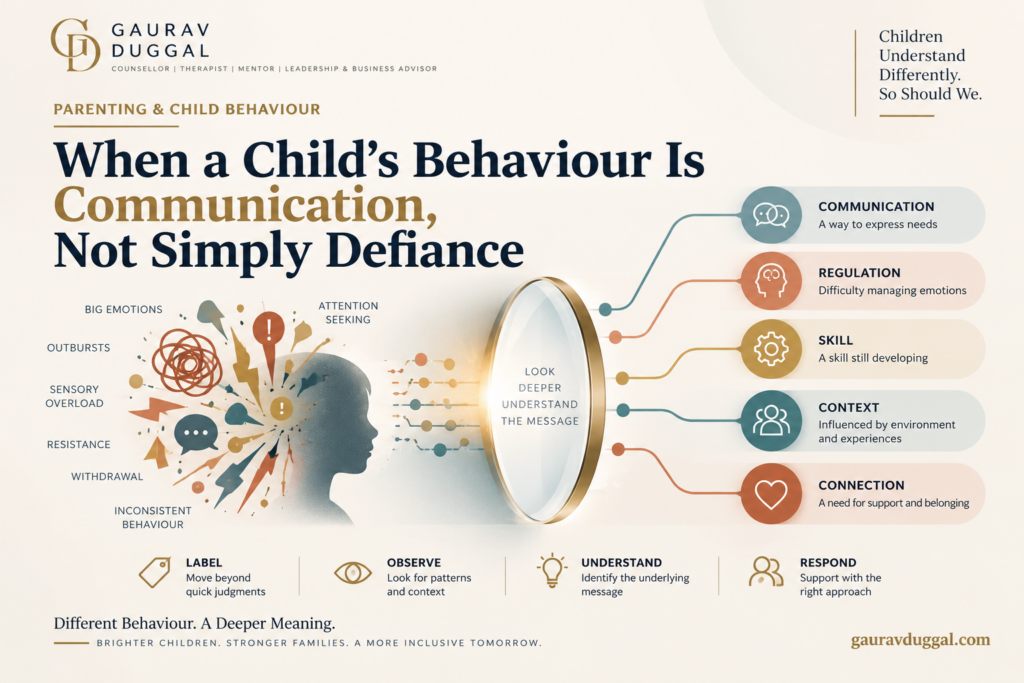
Parents may notice concerns involving communication, attention, social interaction, play, learning, movement, sensory responses, emotional regulation, independence or behaviour. These observations are information; they are not automatic diagnoses.
When Should Parents Look More Closely?
Rather than relying on a broad label, describe the concern precisely. For example, “does not respond consistently to simple instructions” provides more useful information than “doesn’t listen.” “Uses very few words to communicate needs” is more informative than “speech problem.” Specific observations help parents, educators and professionals understand what is actually happening.
Also ask whether the concern is changing over time. Is it improving with ordinary support? Is it becoming more frequent? Does it happen only in one environment?
What are we observing, and how often is it happening? How much is it affecting the child’s everyday life? Consider whether the pattern is becoming more frequent or appears only in certain environments. Notice what helps, what makes the situation harder, and which strengths emerge when the demands change.
A Practical Early Intervention Support Framework
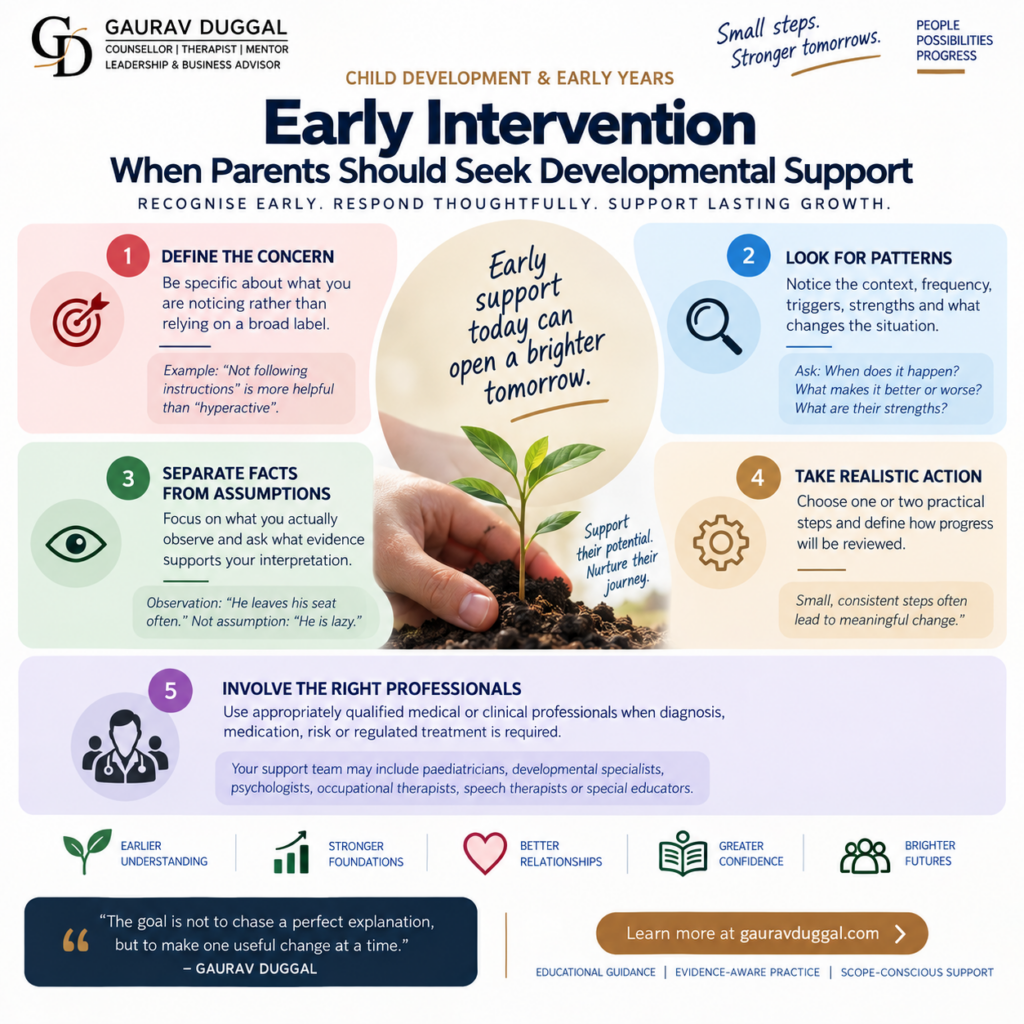
1. Define the concern precisely
Write down what you can actually see or hear. Avoid beginning with a diagnosis or character judgment.
2. Look for patterns
Notice context, frequency, triggers, strengths and what changes the situation. A short observation log across several days can be more useful than relying on memory after a difficult moment.
3. Separate facts from assumptions
Ask what evidence supports your interpretation. “Leaves the activity after two minutes” is an observation. “Is lazy” is an assumption. This distinction matters because different explanations lead to very different support plans.
4. Take one or two realistic actions
Choose practical steps that can be repeated consistently, then define what progress would look like. The aim is not to change everything at once.
5. Involve the right professionals when needed
When concerns involve diagnosis, medication, medical risk or regulated treatment, appropriately qualified medical or clinical professionals should be involved. Depending on the child’s needs, a support team may also include developmental specialists, occupational therapists, speech and language professionals, special educators or other appropriately qualified practitioners.
A Parent Quick Check Before Seeking Support
Ask yourself: Has this concern persisted over time? Is it affecting communication, learning, relationships, participation or independence? Does it appear in more than one setting? Have teachers or caregivers noticed something similar? Is the child becoming frustrated because they cannot do or communicate something they need? Have simple environmental or routine changes helped?
You do not need every answer before asking for guidance. The purpose of the quick check is to help you bring clearer observations into the conversation.
What Early Support Can Actually Do
Early support is most useful when it is individualized. It may help adults understand the child better, adjust environments, build communication opportunities, strengthen everyday skills, establish supportive routines and monitor whether specific strategies are producing meaningful progress.
The objective is not to make every child develop in exactly the same way. It is to reduce avoidable barriers and help the child participate, communicate, learn and grow with appropriate support.
When Structured Support May Help
Structured support may be useful when a developmental concern begins to affect learning, relationships, family functioning or day-to-day wellbeing over time. It can also be useful earlier, before the concern becomes a crisis.
If a child loses previously acquired skills, shows significant changes in functioning, or there are concerns about health or safety, parents should seek appropriately qualified professional assessment rather than waiting for the pattern to resolve on its own.
Early intervention support works best when observations are translated into practical strategies that can be reviewed across home, school and everyday environments.
Closing Perspective
The goal is not to chase a perfect explanation. It is to understand the child more clearly, make one useful change at a time, monitor what happens and know when another professional perspective is appropriate.
Earlier understanding can create stronger foundations. Support works best when it respects the whole child: their strengths, difficulties, environment, relationships and developmental needs. Parents can also refer to established developmental milestones when observing how their child is progressing across different areas.
Educational guidance only. This article is not medical treatment and does not replace assessment or treatment by a psychiatrist, clinical psychologist, physician or other appropriately qualified healthcare professional.
Follow Me for More Insights
Some Thoughts on Life, Growth, and Everything In-Between
Sometimes, all it takes is a little insight or a different perspective to get unstuck. This is my space to share some of my thoughts, provide a bit of guidance, and offer practical tips on mental health, relationships, and personal growth. Think of it as a place to gather some clarity before we even talk.
Expert Counselling, Therapy & Mentoring for Every Stage of Life
Providing a bridge between human understanding, multidisciplinary support and personal or professional growth. Whether you need counselling for emotional wellness and life transitions, therapy for mental health or neurodevelopmental disorders, or mentoring for academic and business success—I offer specialized support tailored to your unique journey. From special education to executive strategy, find the path that is right for you.
Collaborative Network | versatile advisor | Inclusive Care | Online & In-Person Sessions | Serving India & Globally
Not sure where to start?
Book an initial consultation to understand the right support for your situation.
I offer flexible session formats tailored to your schedule and location—providing online (video/audio), hybrid, and in-person sessions across India and internationally. As a tech-savvy and globally accessible practitioner, I work across all time zones and am available for urgent support when your situation requires immediate attention.
Select the format that works best for you and take the first step toward clarity, growth, and emotional wellbeing.
Get in
touch
today
Select a time in my calendar to book your session, or simply call me or send a message - I'll respond promptly, whichever feels easiest for you.
Please fill in the form below
Message Sent!
Thank you for reaching out. I'll get back to you as soon as possible.
Get in touch: Call /
WhatsApp / SMS
Ready to talk? A simple call is the quickest step toward clarity. Your conversation is always 100% confidential and pressure-free.