7 Powerful Ways Couples Communication Can Build Trust and Stop Mind-Reading
October 7, 2026
Couples communication often breaks down not because partners do not care, but because each person begins expecting the other to know what they need without saying it clearly. A delayed reply, a change in tone or an unfinished task can quickly become evidence for an assumption. The problem is that assumptions feel convincing even when they have not been checked.
In my work across counselling, family systems and human behaviour, I often encourage people to separate what they observed from what they interpreted. That small distinction can make difficult conversations more workable.
Couples Communication Works Better When Needs Are Clear
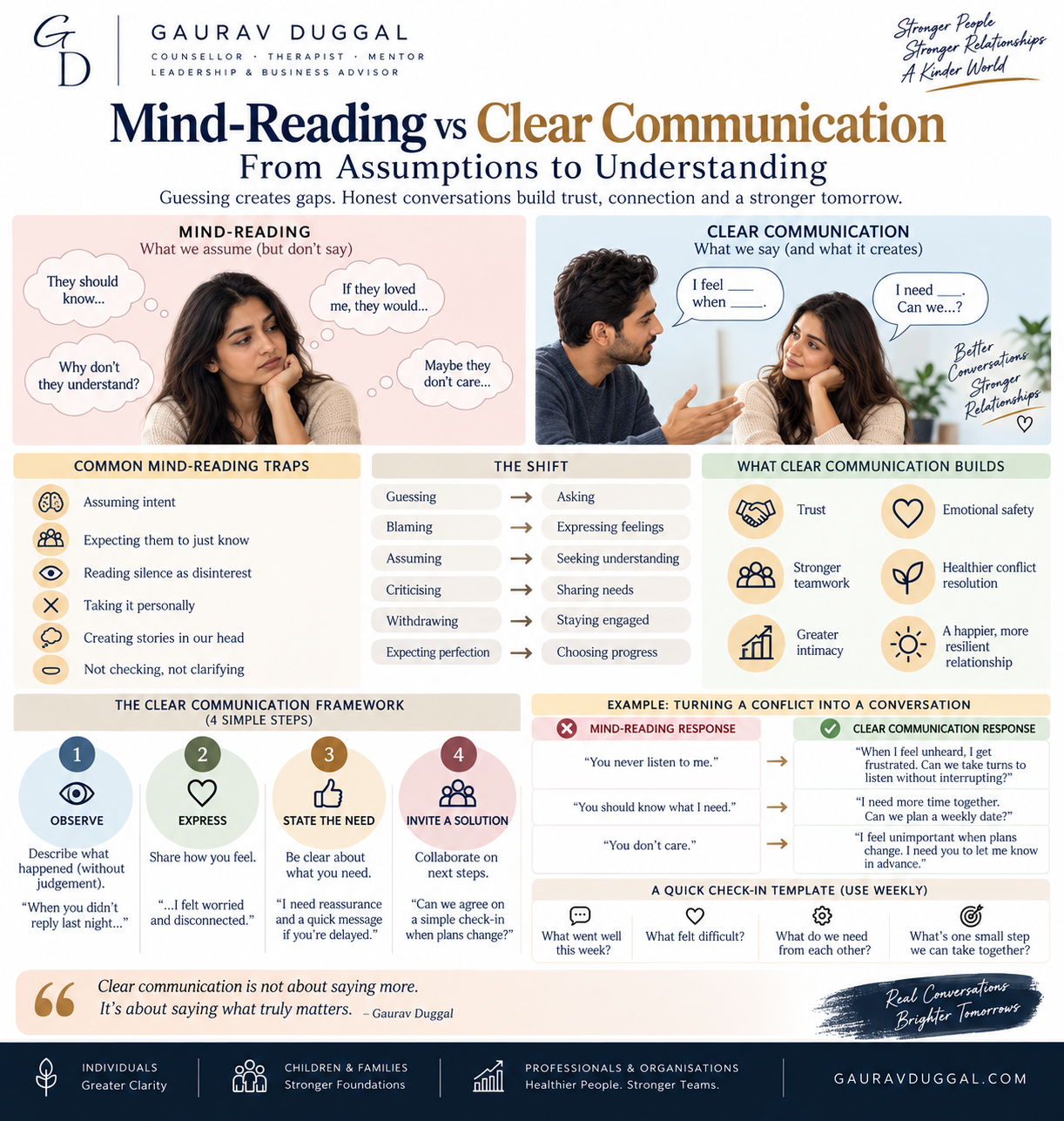
Clear communication does not mean demanding agreement. It means making the concern understandable enough for the other person to respond. Instead of saying, “You never care,” a partner might say, “When plans change, please tell me earlier because uncertainty leaves me unsettled.” The second statement gives the relationship something concrete to work with.
The American Psychological Association notes that open communication, listening and constructive approaches to disagreement are important parts of maintaining healthy relationships.
Where Mind-Reading Creates Conflict
Mind-reading appears when we treat an interpretation as a fact: “If you loved me, you would know,” “You are quiet, so you must be angry,” or “You did not call, therefore I am not important.” Sometimes an interpretation is correct. Sometimes it is not. The safer practice is to check.
Useful couples communication asks: What happened? What meaning did I give it? What do I actually need? What specific request can I make? What does my partner understand differently?
A Practical Framework for Stating Needs
Describe the observable situation. Start with what happened rather than a character
judgment
.
Name the impact. Explain what the situation creates for you emotionally or practically.
State the need. Be specific enough that your partner can understand what matters.
Make a realistic request. Ask for one behaviour rather than a complete personality change.
Check understanding. Invite your partner to explain what they heard and what they need too.
Research on intimate relationship conflict also shows that the effects of communication depend on context; there is no single communication style that fits every disagreement. A review indexed by the U.S. National Library of Medicine highlights the importance of considering the seriousness of the problem, responsiveness and the form of communication used.
Replace Accusations With Information
Compare “You never make time for me” with “I miss having uninterrupted time together. Can we protect one evening this week?” The first invites a debate about whether “never” is true. The second identifies the need and creates a possible next step.
This does not mean suppressing anger, disappointment or disagreement. It means expressing them in a form that gives both people a better chance of understanding what needs attention.
When Couples Communication Needs More Support
If conversations repeatedly become hostile, circular, avoidant or emotionally overwhelming, structured support can help the couple slow the pattern down and examine what is happening. Support may also be useful before a relationship reaches crisis.
A short weekly conversation can prevent small assumptions from becoming larger stories. Each partner can answer three questions: What felt supportive this week? What felt unclear or difficult? What is one specific request for the coming week? Keep the discussion focused on behaviour and needs rather than character
judgments
.
This check-in is not about forcing agreement. It creates a predictable place for information that might otherwise emerge only during conflict. When both people know there will be an opportunity to speak and listen, concerns can become easier to raise earlier and more calmly.
Closing Perspective
A partner cannot reliably respond to a need that remains unspoken. Better couples communication begins when assumptions become questions, complaints become clearer information and expectations become realistic requests. The aim is not perfect communication. It is a more accurate, respectful way of understanding one another.
Scope note: This article is educational and supportive in nature. It does not replace assessment or treatment by an appropriately qualified healthcare professional when clinical care is required.
Follow Me for More Insights
Some Thoughts on Life, Growth, and Everything In-Between
Sometimes, all it takes is a little insight or a different perspective to get unstuck. This is my space to share some of my thoughts, provide a bit of guidance, and offer practical tips on mental health, relationships, and personal growth. Think of it as a place to gather some clarity before we even talk.
Expert Counselling, Therapy & Mentoring for Every Stage of Life
Providing a bridge between human understanding, multidisciplinary support and personal or professional growth. Whether you need counselling for emotional wellness and life transitions, therapy for mental health or neurodevelopmental disorders, or mentoring for academic and business success—I offer specialized support tailored to your unique journey. From special education to executive strategy, find the path that is right for you.
Collaborative Network | versatile advisor | Inclusive Care | Online & In-Person Sessions | Serving India & Globally
Not sure where to start?
Book an initial consultation to understand the right support for your situation.
I offer flexible session formats tailored to your schedule and location—providing online (video/audio), hybrid, and in-person sessions across India and internationally. As a tech-savvy and globally accessible practitioner, I work across all time zones and am available for urgent support when your situation requires immediate attention.
Select the format that works best for you and take the first step toward clarity, growth, and emotional wellbeing.
Get in
touch
today
Select a time in my calendar to book your session, or simply call me or send a message - I'll respond promptly, whichever feels easiest for you.
Please fill in the form below
Message Sent!
Thank you for reaching out. I'll get back to you as soon as possible.
Get in touch: Call /
WhatsApp / SMS
Ready to talk? A simple call is the quickest step toward clarity. Your conversation is always 100% confidential and pressure-free.