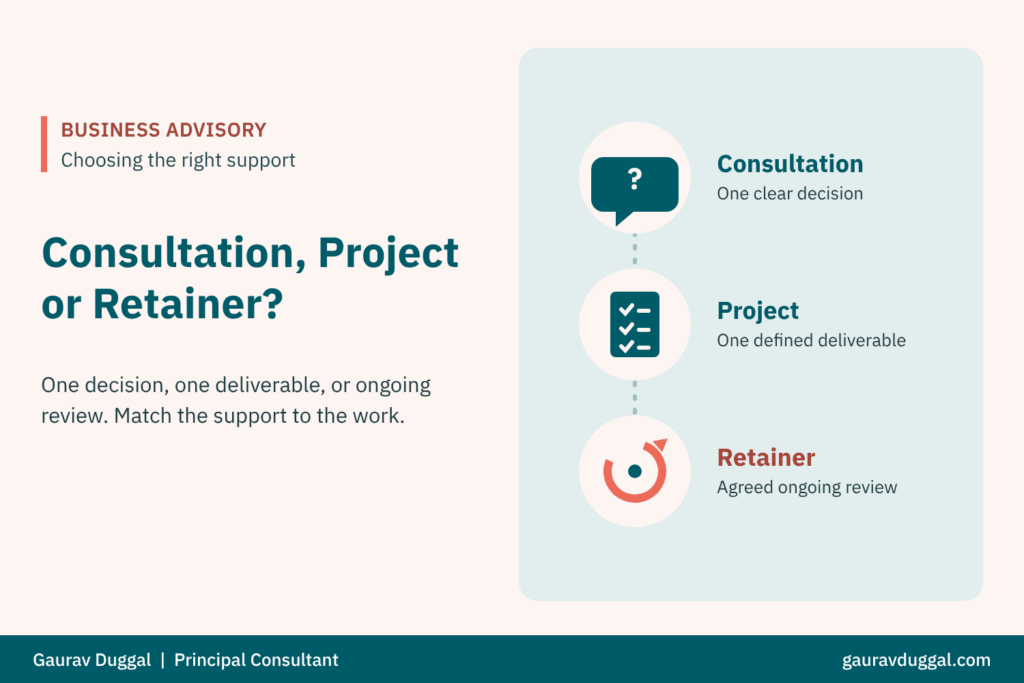
A useful advisory engagement starts with a clear question: what needs to change, and what kind of support will help you work on it? A consultation, a defined project and a retainer serve different purposes. Choosing between them becomes easier when the decision, deliverables and review points are clear.
Begin with the work you need to do
Consider a founder who is making every operating decision personally. One conversation might help identify the main bottleneck. A project could clarify decision rights, meeting routines and follow-through. Ongoing advisory support could help the founder review how those changes are working as new situations arise. These are illustrative options, not a client case or a promise of results.
Which kind of support fits your situation?
Open the statement that sounds most like your situation. Each option shows what to agree upfront and what the request might sound like in practice.
I need to make one decision
Consultation. A specific question, decision or situation that needs focused discussion.
Agree upfront. The question, relevant background and what you want to leave clearer about.
For example. “Which decision can I hand over first, and what would tell me the team is ready?”
I can name the deliverable
Project. A defined piece of work with an identifiable deliverable.
Agree upfront. Scope, deliverables, responsibilities, milestones and acceptance criteria.
For example. “We need a decision-rights map that names who owns each approval and when an issue should be escalated.”
I need to review progress over time
Retainer. Recurring advisory needs that benefit from agreed continuity and review.
Agree upfront. Availability, deliverables, communication arrangements, exclusions and review points.
For example. “We need regular reviews while the team tests the new approval process and deals with exceptions.”
Use a consultation to clarify the next decision
A consultation can help you examine an operating concern, prepare for a difficult leadership conversation or decide where a wider assignment should begin. Bring a short account of the situation, the decision you face and the information already available. The next step may be an action you can take yourself, further information to gather, or a separately scoped engagement.
Choose a project when the deliverable can be named
A project gives the work a boundary. Examples might include reviewing a workflow, developing an operating framework or preparing a defined learning intervention. “Improve our organisation” is too broad to guide delivery. A clearer brief names the problem, the output, the people involved and how the work will be reviewed.
It also makes dependencies visible. An advisor may need access to relevant information, timely decisions or a named internal contact. Agreeing those responsibilities early helps both parties understand what progress requires.
Use a retainer for agreed ongoing support
A retainer is an agreed scope of ongoing support with defined availability, deliverables and review points. It can suit business and institutional advisory where questions recur and continuity is useful. The duration is agreed according to the scope, objectives and review points.
A retainer does not mean unlimited access or an open-ended list of tasks. Define how requests are raised, which work is included, who makes decisions and what needs a separate agreement. Review whether the arrangement still fits the work rather than allowing the scope to expand silently.
A short brief you can use
- What is happening now, and which decision or outcome matters?
- What have you already tried?
- Do you need a focused discussion, a defined deliverable or recurring support?
- Who will provide information and implement agreed actions?
- When and how will you review progress?
Scope and fees should be confirmed before paid work begins. An advisory engagement supports clearer decisions and practical follow-through; it does not guarantee business outcomes.
Explore business advisory and organisational consulting, or the wider ways to work with Gaurav. To discuss a suitable starting point, send a consultation enquiry.