By Gaurav Duggal | Principal Consultant
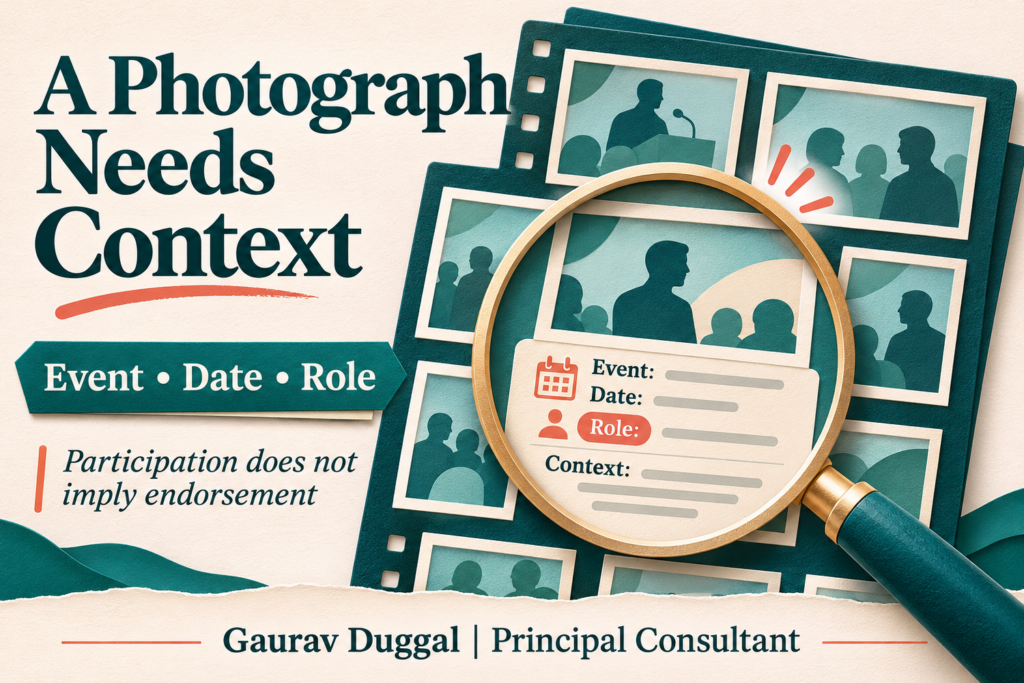
Photographs preserve moments, but they can also flatten complex professional experiences into a row of faces. A picture at an event can demonstrate attendance and provide context. It does not automatically prove an endorsement, an appointment or an ongoing professional relationship.
Why I am revisiting older photographs now
Much of my work in schools, businesses, community groups and institutional programmes happened before every event became a social-media campaign. The growing professional gallery is a way to recover context: who the event served, the responsibility I actually held, and what participants could take away.
I have shared public-event spaces and met people from literary, sporting, business, academic and cultural life. Recognisable names—including authors, sports figures and public speakers—may help a reader identify an event. However, a photograph or proximity is not proof those individuals invited, trained, appointed or endorsed me. Captions should identify the event and my specific role, not suggest more.
Five kinds of evidence worth distinguishing
1. Invitation
A programme letter or organiser email can establish that I was asked to speak, judge, moderate or contribute. An invitation is not the same as an event having taken place.
2. Participation
Photographs, attendance documentation and event programmes can show involvement. They need accurate dates, venue and the role performed.
3. Responsibility
Leading a session, designing a learning programme, evaluating speakers or advising organisers calls for different skills. The strongest account explains deliverables and scope rather than reciting titles.
4. Outcome
Did participants learn a technique, start a useful conversation, clarify a decision or leave with a tool? These details explain the value of an engagement.
5. Follow-through
The work often continues after the event: an institution needs a report, a team requests a workshop or the initial conversation leads to a broader programme. Where a later arrangement is confidential or unconfirmed, it should not be claimed.
How institutions can engage me
My speaking and facilitation work can serve industry chambers, universities, schools, nonprofit groups and professional associations. I can contribute as a guest speaker, moderator, facilitator, workshop designer or programme adviser, in person or online. The topic and format should follow the audience’s needs, not a pre-packaged list of famous names.
Review speaking and institutional engagements, invite me to a programme, or explore broader consulting options.
Evidence policy: A public photograph is presented as event context, not an endorsement. Before naming an individual or elevating a claim of appointment, I match the photograph against event records and appropriate permissions.