Child Behaviour Support: 7 Powerful Ways to Respond, Not React
November 16, 2026
Child behaviour support becomes more useful when we stop asking only,
how
do I make this behaviour stop?’ and also ask,
what
is happening around this behaviour, what might the child be struggling to express, and what response will actually teach a better skill?’
From my work in special education, child development, counselling, family systems and human behaviour, I have repeatedly seen how quickly adults can interpret a visible behaviour as attitude, stubbornness or defiance. Sometimes limits and consequences are necessary. But behaviour also gives us information. The task is to understand that information without excusing unsafe or harmful actions.
Child Behaviour Support Begins With Context, Not Labels
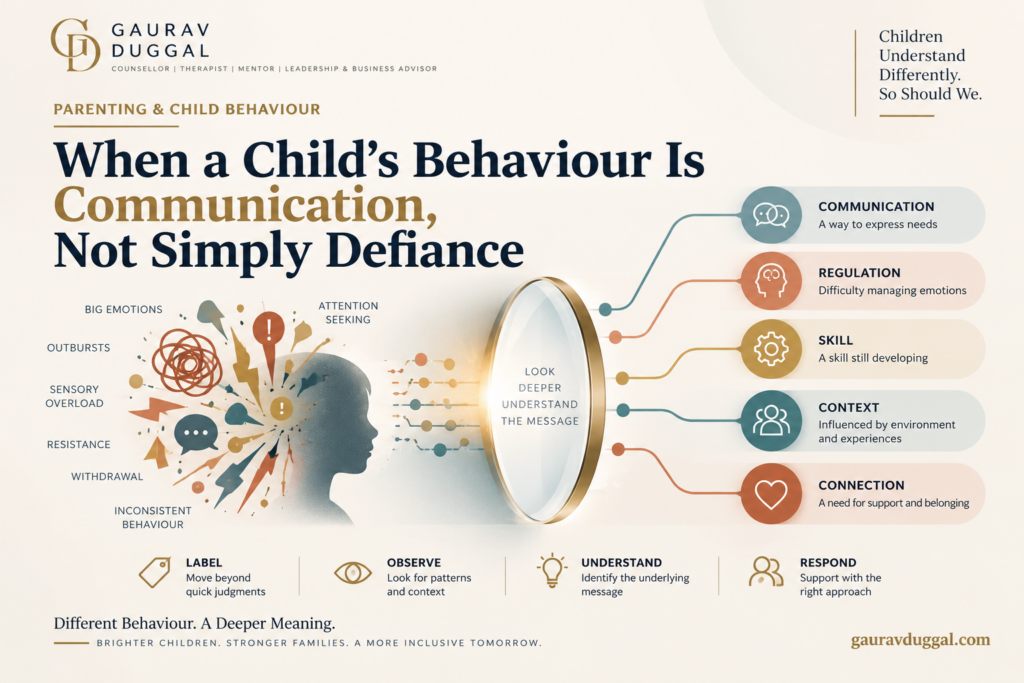
A child who refuses a task, leaves a room, shouts, hits, withdraws or repeatedly ignores an instruction may be communicating many different things through the same visible behaviour. The child may not understand the demand, may lack a skill, may be overwhelmed, may be seeking attention, may be avoiding something difficult, or may have learned that a particular response changes what happens next.
That does not mean every behaviour has a hidden psychological explanation. It means adults should describe what they can actually observe before deciding what the behaviour means.
Behaviour Is Information — Not an Automatic Diagnosis
The CDC’s current parenting guidance explicitly describes behaviour as communication and an opportunity for connection, while also
emphasizing
clear expectations, consistent consequences and follow-through. The American Academy of Pediatrics similarly recommends calm teaching, clear limits, age-appropriate expectations and consistent consequences rather than relying on harsh discipline.
This combination matters. Understanding behaviour is not the same as removing boundaries. A child can need empathy and accountability at the same time.
Move From “Defiant” to a Precise Description
Labels compress a complicated situation into one word. Instead of saying, “He is defiant,” describe the event: “When mathematics begins after lunch, he pushes the worksheet away, leaves his chair and refuses to return for about ten minutes.”
That description gives us something we can examine. We can ask what happens before the behaviour, whether it occurs in other subjects, whether task difficulty matters, what adults do immediately afterward and what helps the child return successfully.
The difference is important: a label tends to end inquiry; a precise description begins it.
Look at What Happens Before, During and After
For practical child behaviour support, I often encourage adults to observe three parts of an episode.
Before
What was happening immediately before the behaviour? Consider the instruction, transition, noise level, task difficulty, peer interaction, hunger, fatigue, unexpected change or loss of access to something preferred.
During
Describe exactly what the child did rather than interpreting intention. “Cried for five minutes and pushed the book away” is more useful than “became manipulative.”
After
What changed after the behaviour? Did the demand disappear? Was intense attention provided by an adult? Perhaps the child gained a break, escaped a difficult task or received something preferred. These observations can help adults notice patterns without assuming motive.
Child behaviour support: look beyond the visible behaviour to understand patterns, needs and teachable skills.
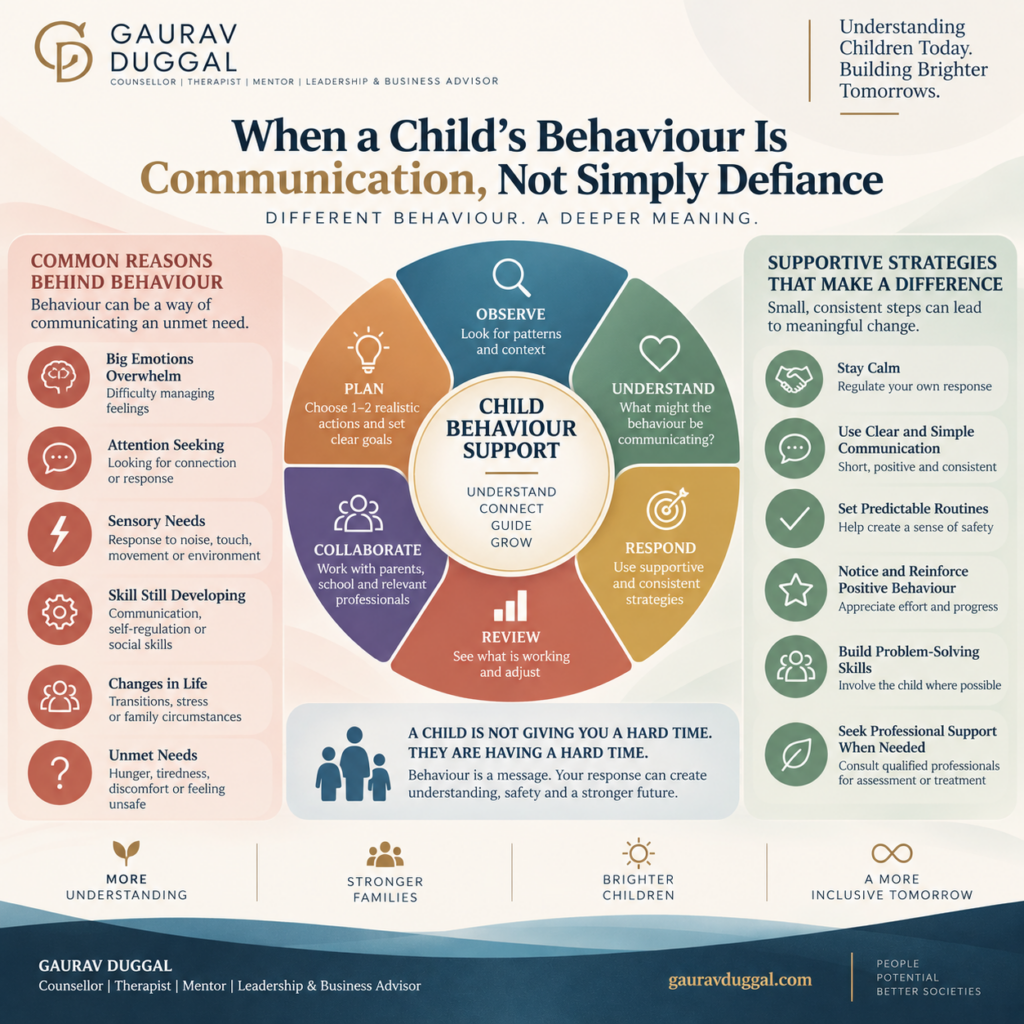
A Practical Five-Step Framework for Child Behaviour Support
1. Define the concern precisely
Replace broad descriptions such as naughty, difficult or disobedient with observable actions. Define when, where and how often the behaviour occurs.
2. Look for patterns
Track context, frequency, triggers, strengths and exceptions. Ask when the child manages the same situation successfully. The exception may reveal an environmental support or skill that can be repeated.
3. Separate observation from assumption
Ask what evidence supports your interpretation. A child who does not start a task may be refusing it, but may also be confused about the instruction. Test the assumption before building an intervention around it.
4. Choose one or two realistic actions
Change a small number of variables and define what progress will look like. This might include simplifying an instruction, preparing the child for a transition, teaching an alternative phrase, reinforcing a specific desired behaviour or creating a more predictable routine.
5. Review rather than react
Observe whether the intervention changes the pattern. If it does not, reconsider the hypothesis instead of simply increasing intensity.
What Parents Can Change in the Environment
Structure often matters. CDC guidance notes that predictable routines and consistent rules help children know what to expect. Clear expectations also work better when caregivers respond consistently rather than changing the rule according to mood or circumstance.
For younger children especially, keep instructions concrete and manageable. Tell the child what to do, not only what to stop doing. “Feet stay on the floor” gives more information than repeated “Don’t climb.”
Notice and Strengthen the Behaviour You Want
Adults naturally notice problems because problems demand attention. Yet specific positive attention can be an important teaching tool. CDC guidance recommends
labeled
praise—telling a child exactly what they did well—because it makes the expected behaviour clearer.
Instead of only correcting, “Stop interrupting,” notice the alternative: “You waited until I finished speaking. That helped me hear you.” The objective is not constant reward. It is to make successful behaviour visible enough for the child to learn what works.
Consequences Still Have a Place
Interpreting behaviour as communication should never be confused with allowing dangerous or harmful behaviour. Limits protect the child and others. Consequences are most useful when they are clear, proportionate, predictable and connected as closely as possible to the behaviour.
The CDC recommends immediate, consistent follow-through for young children and a return to positive communication after a consequence. The AAP similarly recommends calm, firm limits and consequences as part of healthy discipline.
When Behaviour May Be Signalling a Skill Gap
Sometimes the question is not “Will the child comply?” but “Can the child do what we are asking under these conditions?” Skills involved may include communication, waiting, shifting attention, tolerating frustration,
organizing
materials, understanding social cues or recovering after disappointment.
If a child repeatedly fails at the same point, teaching the missing skill can be more productive than repeating the same instruction more loudly.
Home and School Need a Shared Description
When behaviour occurs across settings, parents and educators benefit from comparing observations rather than exchanging labels. Ask: Does it happen at the same time of day? With similar demands? In large groups but not one-to-one? After particular transitions? What strategies have already worked?
A shared, observable description gives families, teachers and support professionals a common starting point and makes progress easier to measure.
When Structured Professional Support May Help
Structured support may be useful when behaviour is persistent, escalating, unsafe, significantly affecting learning or relationships, or creating substantial strain in family functioning. It can also be appropriate when caregivers and school teams have tried reasonable strategies but the pattern remains unclear.
Where diagnosis, medication, significant mental-health risk, developmental or medical assessment, or regulated treatment is required, appropriately qualified medical or clinical professionals should be involved.
From Reaction to Understanding
The goal is not to find a perfect explanation for every difficult moment. It is to become more accurate. Define what happened. Look for patterns. Distinguish observation from assumption. Teach a realistic alternative. Review whether the response helped.
When adults become more curious without becoming permissive, child behaviour support can move from repeated confrontation toward clearer teaching, safer boundaries and measurable progress.
Need Help Understanding a Repeating Behaviour Pattern?
If your child’s behaviour is repeatedly affecting home, school, relationships or everyday functioning, a structured consultation can help clarify patterns and practical next steps.
Scope note: This article is educational and supportive in nature. It is not medical treatment and does not replace assessment or treatment by a psychiatrist, clinical psychologist, physician or other appropriately qualified healthcare professional.
Follow Me for More Insights
Some Thoughts on Life, Growth, and Everything In-Between
Sometimes, all it takes is a little insight or a different perspective to get unstuck. This is my space to share some of my thoughts, provide a bit of guidance, and offer practical tips on mental health, relationships, and personal growth. Think of it as a place to gather some clarity before we even talk.
Expert Counselling, Therapy & Mentoring for Every Stage of Life
Providing a bridge between human understanding, multidisciplinary support and personal or professional growth. Whether you need counselling for emotional wellness and life transitions, therapy for mental health or neurodevelopmental disorders, or mentoring for academic and business success—I offer specialized support tailored to your unique journey. From special education to executive strategy, find the path that is right for you.
Collaborative Network | versatile advisor | Inclusive Care | Online & In-Person Sessions | Serving India & Globally
Not sure where to start?
Book an initial consultation to understand the right support for your situation.
I offer flexible session formats tailored to your schedule and location—providing online (video/audio), hybrid, and in-person sessions across India and internationally. As a tech-savvy and globally accessible practitioner, I work across all time zones and am available for urgent support when your situation requires immediate attention.
Select the format that works best for you and take the first step toward clarity, growth, and emotional wellbeing.
Get in
touch
today
Select a time in my calendar to book your session, or simply call me or send a message - I'll respond promptly, whichever feels easiest for you.
Please fill in the form below
Message Sent!
Thank you for reaching out. I'll get back to you as soon as possible.
Get in touch: Call /
WhatsApp / SMS
Ready to talk? A simple call is the quickest step toward clarity. Your conversation is always 100% confidential and pressure-free.