Seeing Ability in Disability: Mentoring That Builds Participation and Confidence
November 2, 2026
By Gaurav Duggal · Principal Consultant
Not every disability is visible. No person is one limitation.
Appearance does not reveal every barrier a person faces, or every strength they bring. Disability may be non-visible, and a difficulty in one area does not establish inability in every area. Equally, being capable at one task does not mean someone needs no support elsewhere. Begin with the person, ask about the task and the support they prefer, and leave decisions about personal disclosure with them.
A person can struggle with one part of an assignment and still have something valuable to contribute. The difficulty for a mentor or manager is to recognise both facts at once: the work needs a dependable standard, and the person deserves a fair opportunity to demonstrate what they can do.
In my approach to mentoring and institutional advisory, I prefer to examine the design of an engagement before reducing someone to a judgement about ability. Was the brief clear? Did the person have an example? Was the task too broad? Were feedback and responsibility agreed? These questions matter when supporting disabled people, people experiencing mental health difficulties, and anyone learning unfamiliar work. Those groups are not interchangeable, and a missed deadline or communication difficulty does not establish a diagnosis.
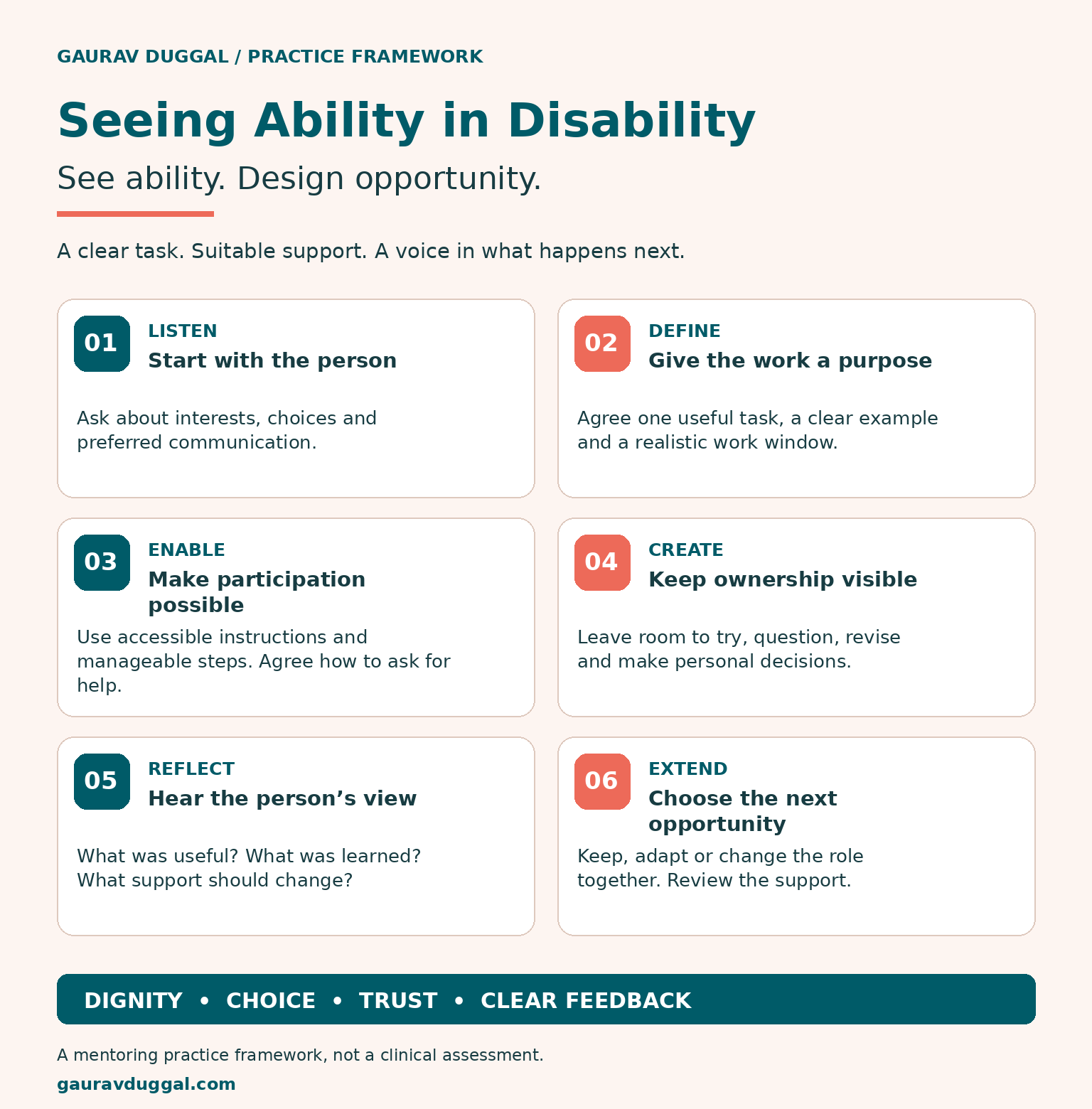
See ability. Design opportunity. Select the infographic to view it at full size.Read the accessible text version and practical prompts
GAURAV DUGGAL / PRACTICE FRAMEWORK
See ability. Design opportunity.
A practical sequence for mentoring, inclusive learning and meaningful work. Follow the numbered steps, then revisit the person’s choices before the next task.
01 → LISTEN
Start with the person
Ask about interests, choices, preferred communication and the work they want to try.
02 → DEFINE
Give the work a purpose
Agree one useful task, a clear example, a realistic work window and what good looks like.
03 → ENABLE
Make participation possible
Use available devices, accessible instructions and manageable steps. Agree how to ask for help.
04 → CREATE
Let ownership stay visible
Make, question, try and revise. Leave room for humour, initiative and the person’s own decisions.
05 → REFLECT
Let the person interpret
What felt useful? What was learned? What should change? Pair their voice with observable work.
06 → EXTEND
Choose the next opportunity
Keep, adapt or change the role together. Review the support and carry strengths into the next task.
A practice framework, not a clinical assessment or a claim of measured outcomes. The questions are prompts for reflection, not a diagnostic score.
Use it in your next mentoring conversation
Agree one task together. Ask: What would you like to make or contribute? What support would help? How will we know the task is ready? At review, ask: What did you enjoy or learn, and what would you change?
Record one example of work, the person’s own reflection and one adjustment to the opportunity. Keep personal health information private.
The phrase “seeing ability in disability” should lead to more than praise. It should lead to access, choice and useful work. A person should not have to display an exceptional talent to deserve respect or an opportunity. Equally, a mentor should not assume that a diagnosis tells them which task a person will enjoy, what support they need or how much responsibility they can carry.
I would begin with a conversation: What interests you? What feels manageable? Where do you become uncertain? How do you prefer to receive instructions? What would you like to learn? The answers help shape a working arrangement with the person, rather than an arrangement imposed on them.
Turn goodwill into a defined assignment
An open invitation to “help with everything” can create confusion. I prefer an assignment with a visible beginning, a small set of deliverables and a review date. Instead of combining research, writing, publishing and reporting into one vague responsibility, identify the contribution being tested and describe what completion looks like.
For example, a short learning assignment might ask someone to organise source material and explain what they understood. A later assignment might involve practical production support. This is an illustrative work-design example, not a report of an individual’s health, disability or performance.
Use reflection to understand the learning
At the end of an initial period, I find a short reflection more useful than a long questionnaire. Four questions can open a productive conversation: What did you enjoy? What did you learn? What was difficult? What would you like to practise next?
Reflection is not a substitute for reviewing the work. It adds the learner’s perspective to the evidence. Someone may have completed a task without understanding it, or understood an idea but struggled to express it in the requested format. The next step should respond to that distinction.
Adapt the method while keeping the purpose clear
Support might mean written steps after a conversation, a demonstration, a checklist, shorter work stages or a predictable feedback time. These are possibilities to discuss, not a universal prescription. Ask the person which adjustment would help and review whether it does.
The World Health Organization identifies workplace adjustments and supportive supervision among ways to help people with mental health conditions participate in work. The International Labour Organization also provides practical guidance on reasonable adjustments across the employment cycle. Neither source turns a mentor into a clinician or supplies one method for every individual.
A change of role can be a thoughtful decision
Sometimes a broad assignment reveals that a narrower contribution would be a better fit. I would rather discuss that openly than keep repeating an arrangement that leaves both people uncertain. Name what has been learned, recognise the contribution, explain the new scope and agree the next review.
A production role, a research role and a client-facing role require different combinations of skills. Moving between them should not become a judgement about someone’s worth. The practical question is whether the revised responsibility is meaningful, agreed and supported. Working hours, fees or payment, ownership and expectations should be clear; encouragement does not replace fair terms.
Mental health support includes boundaries
A supportive professional relationship leaves room to ask for help without making personal disclosure the price of participation. Feedback should address the work rather than assign a label to the person. Private health information belongs to the individual, and should not become promotional material.
Mentoring can support routines, communication and reflection. Where someone needs assessment or treatment, appropriate qualified healthcare professionals should be involved. A work assignment should not be presented as therapy or as proof of clinical improvement.
Measure opportunity as well as output
I would review whether the brief became clearer, whether the person could describe their own learning, whether agreed work was completed and whether they needed less assistance with a familiar task. These observations can guide the next assignment. They do not justify claiming that someone has been “fixed” or that a method works for everyone.
Recognising ability becomes practical when a person has a real task, a clear agreement, appropriate support and a voice in what happens next. The aim is to build a working environment in which contribution can be seen—and developed—without making difficulty a person’s entire identity.
Some Thoughts on Life, Growth, and Everything In-Between
Sometimes, all it takes is a little insight or a different perspective to get unstuck. This is my space to share some of my thoughts, provide a bit of guidance, and offer practical tips on mental health, relationships, and personal growth. Think of it as a place to gather some clarity before we even talk.
Expert Counselling, Therapy & Mentoring for Every Stage of Life
Providing a bridge between human understanding, multidisciplinary support and personal or professional growth. Whether you need counselling for emotional wellness and life transitions, therapy for mental health or neurodevelopmental disorders, or mentoring for academic and business success—I offer specialized support tailored to your unique journey. From special education to executive strategy, find the path that is right for you.
Collaborative Network | versatile advisor | Inclusive Care | Online & In-Person Sessions | Serving India & Globally
Not sure where to start?
Book an initial consultation to understand the right support for your situation.
I offer flexible session formats tailored to your schedule and location—providing online (video/audio), hybrid, and in-person sessions across India and internationally. As a tech-savvy and globally accessible practitioner, I work across all time zones and am available for urgent support when your situation requires immediate attention.
Select the format that works best for you and take the first step toward clarity, growth, and emotional wellbeing.
Get in
touch
today
Select a time in my calendar to book your session, or simply call me or send a message - I'll respond promptly, whichever feels easiest for you.
Please fill in the form below
Message Sent!
Thank you for reaching out. I'll get back to you as soon as possible.
Get in touch: Call /
WhatsApp / SMS
Ready to talk? A simple call is the quickest step toward clarity. Your conversation is always 100% confidential and pressure-free.