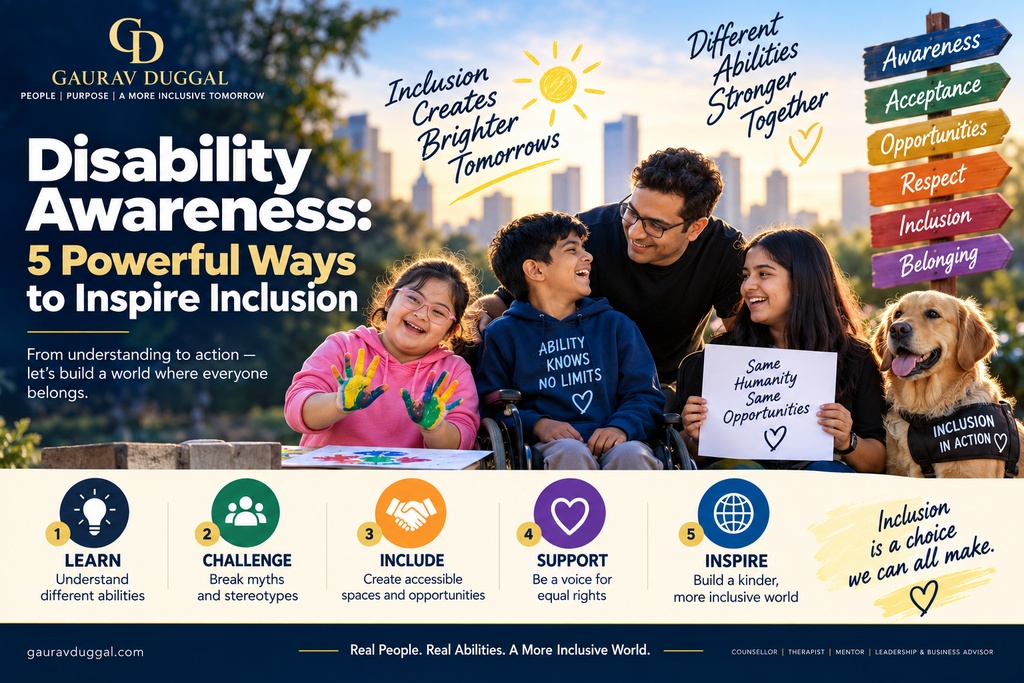
Disability Awareness: 5 Powerful Ways to Inspire Inclusion
September 18, 2026
Disability awareness involves more than learning respectful terminology. It asks us to notice how language, expectations, environments and systems affect everyday life. Words matter. Yet awareness becomes meaningful only when it improves access, participation, relationships and opportunity.
on Disability Studies. That experience still shapes my approach to inclusion. Awareness has the greatest value when it helps people question assumptions, notice barriers and act.
Disability Awareness Must Move Beyond Labels
Labels can sometimes help professionals, families and institutions communicate about a recognised need. Nevertheless, a label cannot explain the whole person. It does not automatically describe an individual’s strengths, preferences, communication style, support requirements, aspirations or changing circumstances.
Disability awareness should move the conversation beyond “What is wrong with this person?” We can ask better questions. What is the person experiencing? Which barriers limit participation? What support could help? Which strengths can we develop? This shift does not deny difficulty. It places difficulty within a fuller human and environmental context.
Why Disability Awareness Begins with Language and Listening
Language influences whether someone is reduced to a diagnosis or recognised as a complete individual. At the same time, disability communities do not always prefer identical terminology. Some people prefer person-first language, while others identify strongly with disability-first language. Therefore, good practice is not to police language mechanically. It is to listen, ask respectfully, follow self-identification and avoid expressions that diminish dignity or agency.
Listening also prevents professionals and family members from assuming that they already understand what another person needs. A well-intended intervention can still become unhelpful when it is designed without the individual’s participation. Consequently, respectful communication should include the person wherever possible and recognise the family’s perspective without allowing either voice to erase the other.
How Disability Awareness Becomes Access and Participation
Inclusion becomes visible through practical decisions in schools, workplaces, healthcare settings, families and public spaces. Start with access: can the person enter safely? Consider communication: can they understand the information and express a preference? Then examine participation, suitable accommodations and expectations that remain both fair and ambitious.
Disability awareness also asks us to distinguish access from belonging. A ramp may provide physical entry, but it cannot guarantee meaningful participation. Written instructions may exist, yet someone may need visual, simplified or assisted communication. A compliance checklist alone cannot create inclusion. The person’s actual experience provides the real measure.
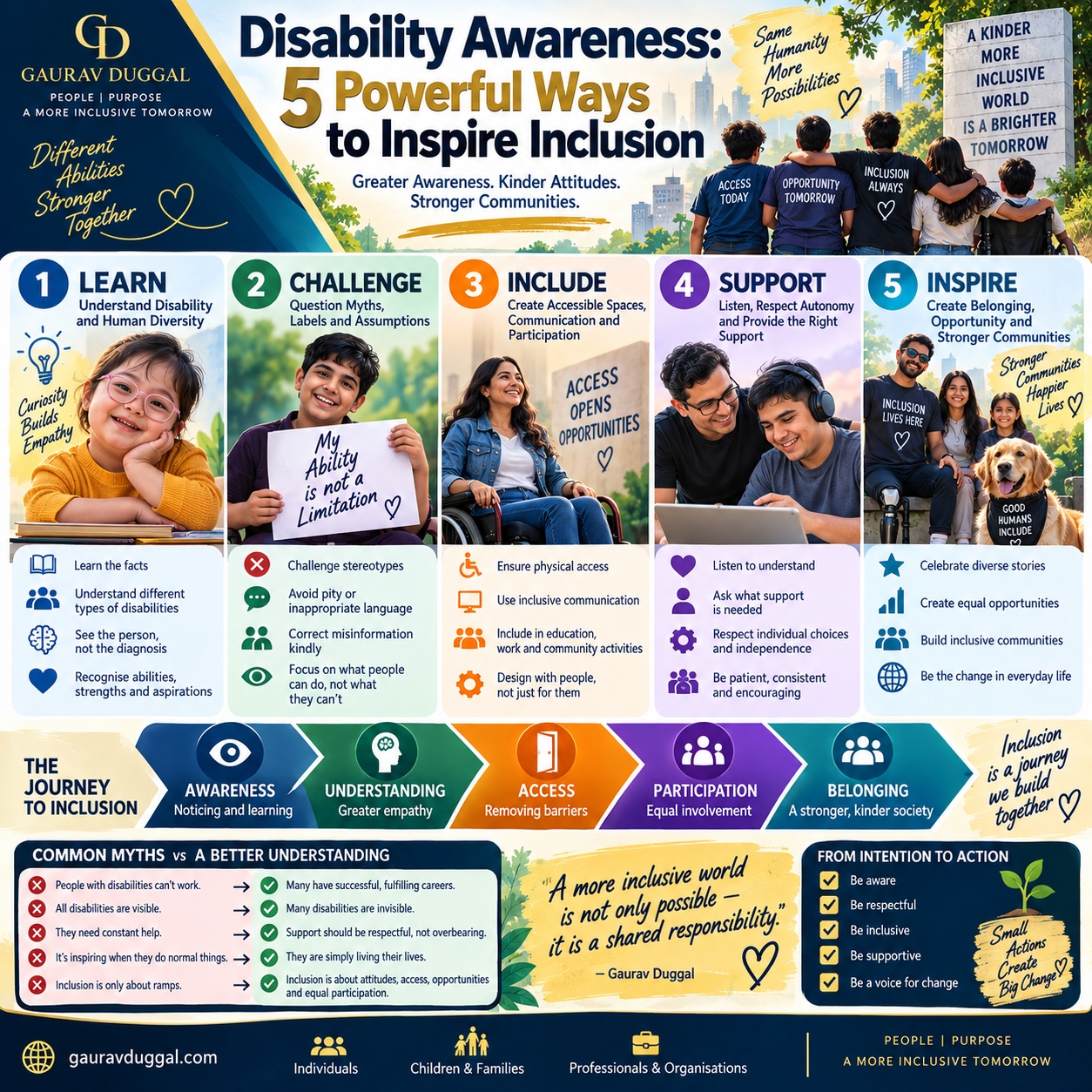
Disability awareness five-point framework for inclusion, access and participation
A practical five-point framework for moving disability awareness from language to inclusion.
A Five-Point Disability Awareness and Inclusion Check
The following questions can help families, educators, counsellors, organisations and multidisciplinary teams move from general concern to practical support:
Define the barrier: What difficulty is the person actually encountering, and in which situations does it appear?
Ask before assuming: What does the individual or family identify as useful support?
Review expectations: Are expectations respectful, realistic and sufficiently ambitious?
Examine the environment: Is the setting creating an avoidable physical, social, communication or procedural barrier?
Measure participation: Did the support improve involvement, independence, understanding or belonging, rather than merely complete a checklist?
This framework puts observation before interpretation. It also helps teams compare different settings. Familiarity, sensory demands, communication styles, relationships and available support can all change how a person participates.
Why Disability Awareness Requires Collaboration
Disability connects with education, psychology, healthcare, employment, family systems, law, technology and community design. No single professional can answer every question. Collaboration works best when each participant understands both their contribution and their professional boundaries.
My role is not to replace doctors, psychiatrists, clinical psychologists, educators, therapists or other regulated professionals. I contribute where my training and experience in special education, disability studies, counselling, child development, human behaviour, family systems and organisational work can help people understand patterns and coordinate practical support. Readers exploring this area may also find Special Education Support: Moving Beyond Labels and IEPs useful.
Turning Disability Awareness into Everyday Inclusion
The strongest disability awareness work does not ask people to feel sorry for someone who is different. Instead, it asks us to recognise dignity, remove unnecessary barriers, understand individual needs and create conditions in which participation becomes ordinary rather than exceptional.
Progress can begin with one practical change. Revise an instruction, adjust the environment, ask a better question or include the person in a decision. Then review whether the accommodation genuinely helps. Over time, these choices build cultures that understand difference without lowering expectations or denying support.
To learn more about my interdisciplinary background, visit About Gaurav Duggal. If you would like to discuss support for an individual, family, school or organisation, visit Consult with Gaurav Duggal.
This article is educational and supportive in nature. It is not medical treatment and does not replace assessment or treatment by a psychiatrist, clinical psychologist, physician or another appropriately qualified healthcare professional.
Explore special education and institutional advisory
See support options for families, educators and institutions, including inclusive practice and staff development.
Some Thoughts on Life, Growth, and Everything In-Between
Sometimes, all it takes is a little insight or a different perspective to get unstuck. This is my space to share some of my thoughts, provide a bit of guidance, and offer practical tips on mental health, relationships, and personal growth. Think of it as a place to gather some clarity before we even talk.
Expert Counselling, Therapy & Mentoring for Every Stage of Life
Providing a bridge between human understanding, multidisciplinary support and personal or professional growth. Whether you need counselling for emotional wellness and life transitions, therapy for mental health or neurodevelopmental disorders, or mentoring for academic and business success—I offer specialized support tailored to your unique journey. From special education to executive strategy, find the path that is right for you.
Collaborative Network | versatile advisor | Inclusive Care | Online & In-Person Sessions | Serving India & Globally
Not sure where to start?
Book an initial consultation to understand the right support for your situation.
I offer flexible session formats tailored to your schedule and location—providing online (video/audio), hybrid, and in-person sessions across India and internationally. As a tech-savvy and globally accessible practitioner, I work across all time zones and am available for urgent support when your situation requires immediate attention.
Select the format that works best for you and take the first step toward clarity, growth, and emotional wellbeing.
Get in
touch
today
Select a time in my calendar to book your session, or simply call me or send a message - I'll respond promptly, whichever feels easiest for you.
Please fill in the form below
Message Sent!
Thank you for reaching out. I'll get back to you as soon as possible.
Get in touch: Call /
WhatsApp / SMS
Ready to talk? A simple call is the quickest step toward clarity. Your conversation is always 100% confidential and pressure-free.