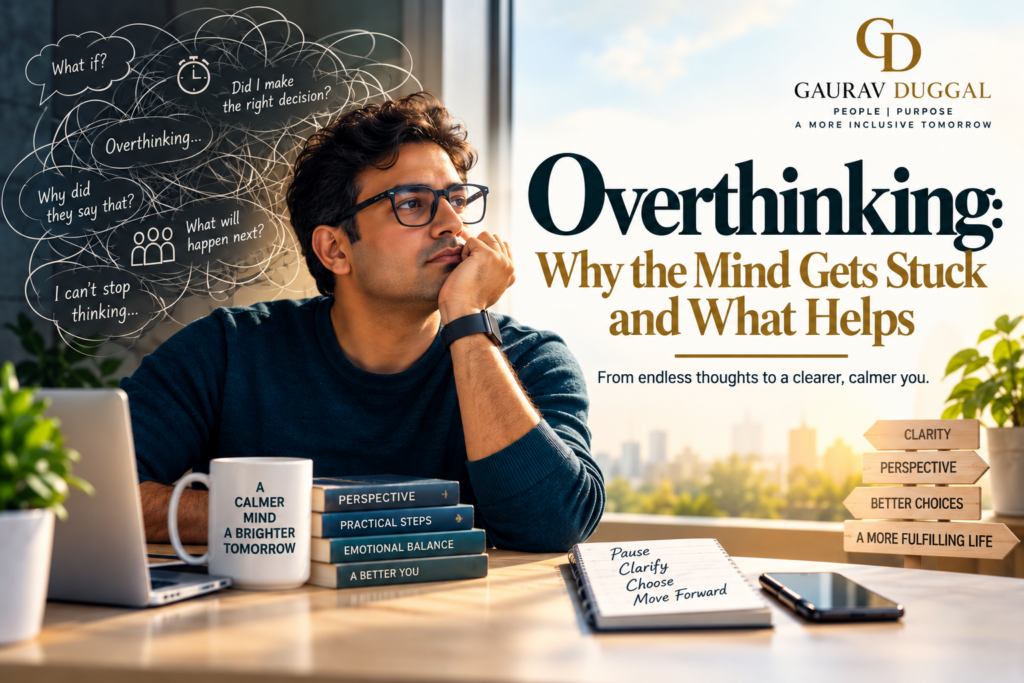
Learning how to stop overthinking begins with noticing when thinking stops being useful and starts becoming repetitive. For example, we may replay a conversation or worry about what could go wrong. We may reconsider a decision or mentally rehearse tomorrow. Yet after all that thinking, we may be no closer to clarity.
In my work across counselling, human behaviour and family systems, I find one distinction useful. Some thinking helps us understand a problem. By contrast, some thinking simply keeps us circling around it.
Learning how to stop overthinking does not mean learning how to stop thinking. Instead, notice when reflection stops producing useful information. Then move towards perspective, a decision or a practical action.
Why Is It So Hard to Stop Overthinking?
There is usually a reason the mind keeps returning to something. For example, we may be looking for certainty or fear making the wrong decision. At other times, an unresolved conversation, relationship difficulty, work pressure or anticipated consequence keeps demanding our attention. Therefore, identifying the underlying concern can help us respond more deliberately.
The original concern may therefore be real. However, the difficulty begins when repeatedly examining it no longer improves our understanding. In that situation, another round of analysis can add mental noise rather than useful information.
How to Stop Overthinking by Separating Facts From Interpretation
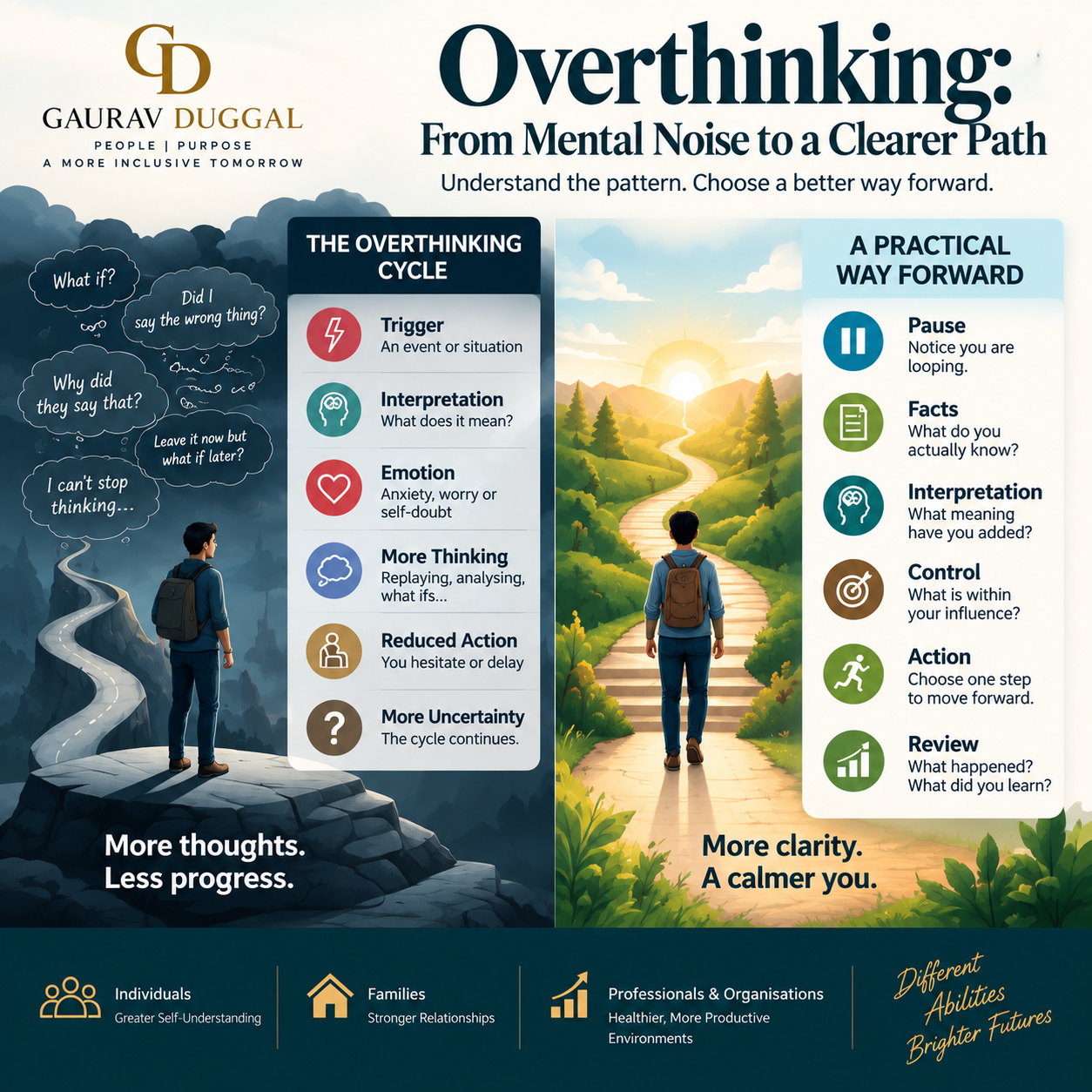
One useful emotional regulation skill is separating three things: what happened, what I think it means, and what I fear may happen next. Importantly, these are not necessarily the same. This distinction can reduce the tendency to treat an assumption as established fact.
If somebody has not replied to your message, the observable fact is simply that you have not received a reply. “They are deliberately ignoring me” is an interpretation. “Our relationship is deteriorating” may be a prediction.
A useful question is: What do I actually know—and what has my mind added?
Overthinking Often Tries to Create Certainty
Human beings naturally want to reduce uncertainty. Thinking ahead can be useful before an important meeting, examination, financial decision or relationship discussion. It helps us prepare. However, additional thinking eventually reaches a limit: it cannot guarantee the certainty we are seeking.
Notice the Overthinking Cycle
Instead of only asking, “Why do I overthink?”, examine the pattern.
Trigger → Interpretation → Emotion → More Thinking → Reduced Action → More Uncertainty
A difficult email arrives. You interpret it negatively. Anxiety or irritation increases. You reread the email repeatedly. You postpone responding because you want the perfect answer. The unresolved email then creates even more uncertainty. The cycle has reinforced itself.
Five Practical Ways to Interrupt Overthinking
1. Define the actual question
Replace a broad concern such as “Everything is going wrong” with a more precise question. What exactly needs my attention?
2. Separate what you can influence from what you cannot
Directing energy towards what remains within your influence reduces unnecessary mental expenditure. Similarly, the NHS guidance on tackling worries distinguishes practical problems from worries that are outside our control.
3. Give reflection a purpose
Ask: What am I trying to achieve by thinking about this again? Reflection should ideally lead towards understanding, preparation, decision or action.
4. Choose one proportionate next step
Send the email. Write down the questions. Have the conversation. Collect the missing information. Take a break before responding. A small action can sometimes produce information that hours of speculation cannot.
5. Review what happened
After acting, compare what you feared with what actually occurred. This helps develop a more evidence-aware relationship with your own predictions.
Overthinking Is Not the Same as Emotional Processing
Fear, anger, disappointment and sadness can all contain useful information. However, emotional regulation creates space between a feeling and an automatic reaction. As a result, that space gives us more choice about what to do next.
When Overthinking Begins Affecting Everyday Life
Occasional overthinking is part of ordinary human experience. However, pay closer attention when the pattern repeatedly affects sleep, relationships, work, learning, decisions or everyday well being.
Structured counselling support may help a person examine recurring triggers, assumptions, behaviour patterns and practical alternatives. In addition, learning to pause before reacting can create space for clearer choices. Where symptoms raise questions involving diagnosis, medication, significant psychological risk or regulated treatment, assessment should involve an appropriately qualified psychiatrist, clinical psychologist, physician or other relevant healthcare professional.
The objective is not to eliminate uncertainty. It is to prevent uncertainty from controlling the entire thinking process.
A Closing Perspective
The ability to think deeply is valuable. Reflection helps us learn, anticipate consequences and make thoughtful decisions. But thinking becomes less useful when it repeatedly returns us to exactly the same place.
If you are trying to understand how to stop overthinking, do not begin by fighting your thoughts. Begin by asking whether the next round of thinking is likely to produce new information, better understanding or useful action. If not, the next step may not be another thought. It may be a decision.
Scope note: This article provides educational and supportive information. It is not medical treatment and does not replace assessment or treatment by a psychiatrist, clinical psychologist, physician or another appropriately qualified healthcare professional.
Some Thoughts on Life, Growth, and Everything In-Between
Sometimes, all it takes is a little insight or a different perspective to get unstuck. This is my space to share some of my thoughts, provide a bit of guidance, and offer practical tips on mental health, relationships, and personal growth. Think of it as a place to gather some clarity before we even talk.
Expert Counselling, Therapy & Mentoring for Every Stage of Life
Providing a bridge between human understanding, multidisciplinary support and personal or professional growth. Whether you need counselling for emotional wellness and life transitions, therapy for mental health or neurodevelopmental disorders, or mentoring for academic and business success—I offer specialized support tailored to your unique journey. From special education to executive strategy, find the path that is right for you.
Collaborative Network | versatile advisor | Inclusive Care | Online & In-Person Sessions | Serving India & Globally
Not sure where to start?
Book an initial consultation to understand the right support for your situation.
I offer flexible session formats tailored to your schedule and location—providing online (video/audio), hybrid, and in-person sessions across India and internationally. As a tech-savvy and globally accessible practitioner, I work across all time zones and am available for urgent support when your situation requires immediate attention.
Select the format that works best for you and take the first step toward clarity, growth, and emotional wellbeing.
Get in
touch
today
Select a time in my calendar to book your session, or simply call me or send a message - I'll respond promptly, whichever feels easiest for you.
Please fill in the form below
Message Sent!
Thank you for reaching out. I'll get back to you as soon as possible.
Get in touch: Call /
WhatsApp / SMS
Ready to talk? A simple call is the quickest step toward clarity. Your conversation is always 100% confidential and pressure-free.