Professional Counselling Support for Stress, Anxiety & Life Challenges
September 16, 2026
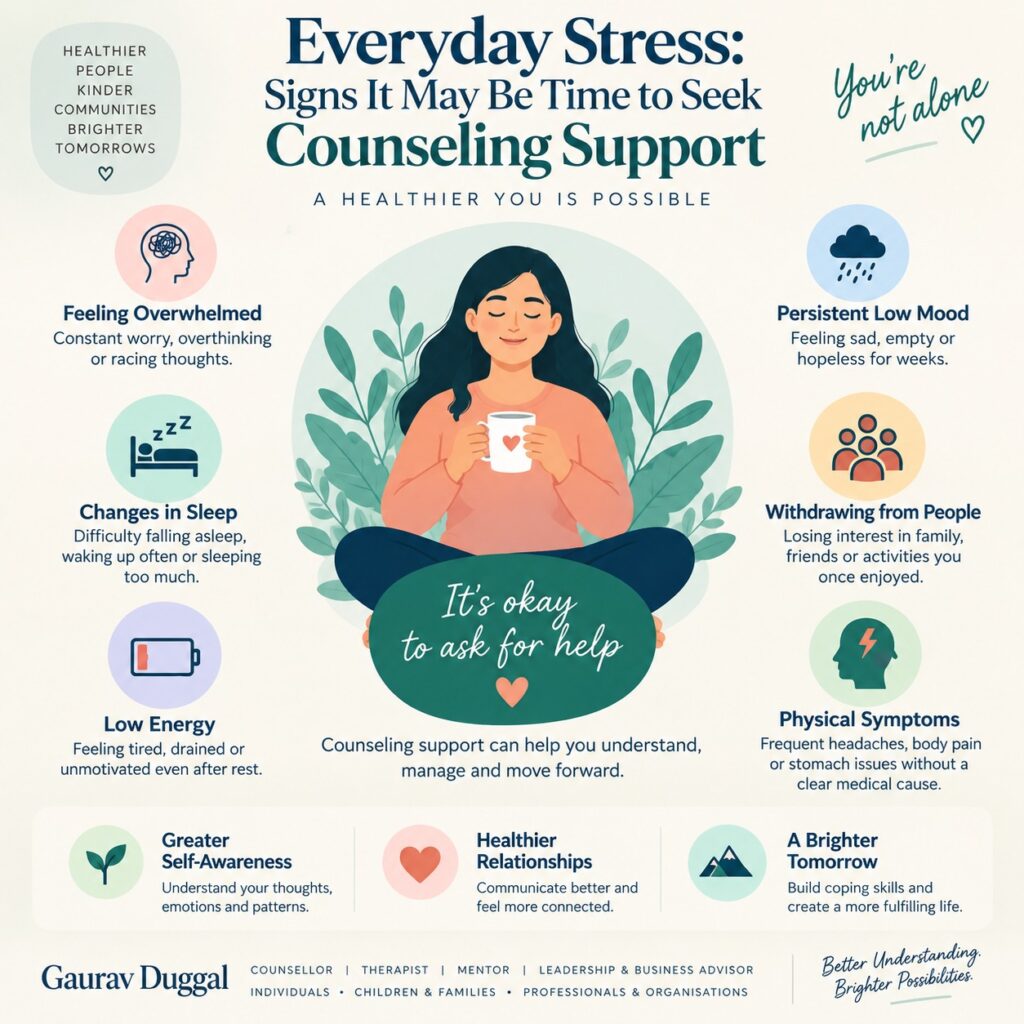
Counselling support can be helpful when everyday stress becomes increasingly difficult to manage. Work, relationships, parenting, finances, health concerns and major life changes can all leave us feeling stretched. Counselling Support helps by providing a safe, supportive space with emotional guidance, practical coping tools and perspective. It helps you gain clarity, build resilience, restore balance, and feel more in control again.
Often, the pressure reduces when the situation improves. We rest, reorganize, talk to someone we trust and gradually begin feeling more like ourselves.
But what happens when that does not happen?
Sometimes stress continues for weeks. Sleep changes, concentration becomes difficult, patience reduces or ordinary responsibilities start requiring far more effort than before.
At that point, counselling support may provide an opportunity to understand what is happening rather than simply continuing to push through it. provides a safe space to talk and be heard without judgment. We give you practical tools to cope with stress and anxiety, helping you build resilience for long-term balance. Whether you need support for work stress and burnout, support for relationships and parenting challenges, or guidance through major life changes — our experienced team is here to help. That’s why so many clients choose our counselling support team to restore balance and feel in control again.
The important question is not whether your difficulty is “serious enough.” A more useful question may be:
Is what I am experiencing beginning to affect the way I live, work, relate to people or manage everyday life?
What Does Everyday Stress Look Like?
Stress is a natural response to pressure, uncertainty or change. The World Health Organization’s information on stress similarly describes stress as a natural human response to difficult situations and notes that it can affect both mind and body.
You may experience stress before an important meeting, during examinations, while managing family conflict or when dealing with financial or professional uncertainty.
Stress can affect thoughts, emotions and behaviour. You may become more irritable, feel physically tired, sleep differently or find yourself repeatedly thinking about the same problem.
However, everyday stress often changes when the circumstances causing it begin to settle.
Rest, supportive relationships, exercise, recreation, problem-solving or simply having enough time to recover may help restore balance.
That recovery pattern gives us useful information.
When Does Stress Deserve Closer Attention?
Instead of immediately trying to label an experience, I find it useful to examine four things:
Duration. Intensity. Frequency. Impact.
Duration
How long has this been happening?
Feeling unsettled for several days after a difficult event is different from experiencing the same difficulty consistently for several weeks.
Intensity
How strongly is the experience affecting you?
There is a difference between feeling uncomfortable while continuing with everyday life and feeling that emotional pressure is beginning to dominate the day.
Frequency
How often is this happening?
An occasional difficult day may be part of ordinary life. A pattern that repeatedly returns deserves greater attention.
Impact
What areas of life are being affected?
Consider your sleep, appetite, work, studies, relationships, communication, motivation, concentration and ability to manage ordinary responsibilities.
One difficult day does not define emotional wellbeing. Patterns provide more useful information.
No single sign automatically means that something is seriously wrong. Nevertheless, several changes occurring together—or continuing over time—may indicate that it would be useful to talk with someone.
1. Your Sleep Has Changed
Perhaps you struggle to fall asleep, wake repeatedly during the night or sleep considerably more than usual.
You may also sleep for an adequate number of hours but still wake feeling tired.
2. Your Energy or Motivation Remains Low
Ordinary tasks may begin requiring disproportionate effort.
Work gets postponed. Decisions feel tiring. Activities you previously managed without much thought may start feeling difficult.
3. Your Emotions Feel Harder to Manage
You may notice persistent worry, irritability, sadness, frustration or emotional exhaustion.
The important observation is not simply that an emotion exists. Consider whether its intensity or persistence is interfering with everyday functioning.
4. You Are Withdrawing From People or Activities
You may communicate less with family, avoid meeting friends or lose interest in activities you normally value.
Sometimes withdrawal happens gradually enough that we do not immediately recognize the pattern.
5. Your Usual Ways of Coping Are No Longer Helping
Exercise, rest or talking with family may have helped before.
Now those same strategies may feel insufficient.
That does not necessarily establish a diagnosis. It may simply indicate that the situation deserves more careful attention.
How Counselling Support Helps You Manage Daily Stress
Building Resilience for Long-Term BalanceYou Don’t Have to Wait Until There Is a Crisis
A Safe Space to Talk and Be Heard
Practical Tools to Cope with Stress and Anxiety
A common misconception is that counselling is something people should consider only when circumstances have become unbearable.
It does not always need to begin there.
Sometimes an earlier conversation can be more useful. You may already recognize that something is changing while still having enough space to understand the pattern and respond thoughtfully.
Counselling support can create space to explore questions such as:
What has changed recently?
What may be contributing to the difficulty?
Which patterns keep repeating?
Which responsibilities or expectations are creating pressure?
What strengths and resources are already available?
What practical changes might help?
The purpose is not simply to make an uncomfortable feeling disappear.
Compassionate Counselling Support to Find Clarity, Strength & Control
Support for Work Stress and Burnout
Support for Relationships and Parenting Challenges
Guidance Through Major Life Changes
Understanding what may be contributing to it can help determine what needs attention next
Why Context Matters
Two people can experience the same circumstances very differently.
A career transition may energize one person and overwhelm another. Family responsibility may feel meaningful during one period of life and exhausting during another.
Similarly, a relationship difficulty that appears relatively small from outside may carry years of history for the people involved.
Therefore, context matters.
From my work in special education, child development and human behaviour, I have repeatedly seen the value of understanding the person, relationships, environment and circumstances together, rather than looking only at the difficulty presented at the beginning.
That broader understanding can help clarify what kind of support may actually be useful.
What Can Counselling Support Help You Understand?
A conversation does not need to begin with a diagnosis.
It can begin with something much simpler:
“Something has changed, and I want to understand what is happening.”
The conversation may explore what you are feeling and what has changed. It may also look at relationships, daily routines, communication, decisions, home life or work.3
Sometimes structured counselling may be appropriate.
In other situations, practical mentoring, family involvement, changes in routines or communication, or support from another qualified professional may be more suitable.
Where concerns require medical, psychiatric or another specialized clinical assessment, the appropriate qualified professional should lead that part of the care.
Compassionate Counselling Support to Find Clarity, Strength & Control
Support for Work Stress and Burnout
Support for Relationships and Parenting Challenges
Guidance Through Major Life Changes
A Simple Self-Check
Before moving on, consider these questions:
Has this difficulty continued longer than I expected?
Is it affecting my sleep or energy?
Has my motivation noticeably changed?
Am I withdrawing from people or activities?
Is it affecting work, studies or relationships?
Are my usual coping strategies becoming less effective?
Have people close to me noticed a change?
This is not a diagnostic checklist.
It is simply a way of noticing whether a temporary difficulty may be developing into a pattern worth discussing.
When Seeking Support May Be Worth Considering
You do not need to wait until you can perfectly explain what is happening.
Consider seeking appropriate support when difficulties are persistent, becoming more intense or increasingly interfering with everyday functioning.
Support can also be useful during transitions—before circumstances reach crisis point.
If there is an immediate safety concern, medical emergency, risk of self-harm or another urgent situation, appropriate emergency or medical services should be contacted rather than relying on a routine counselling appointment.
One Question Worth Asking Yourself
Instead of asking:
“Is my problem serious enough to deserve help?”
try asking:
“Is this affecting my ability to live, work, relate or function in the way I would like?”
If the answer is increasingly yes, a conversation may be worthwhile.
You do not need to arrive with everything figured out.
Understanding the problem can itself be part of the work.
Counselling Support With Gaurav Duggal
I work as a Counsellor, Therapist, Mentor and Leadership & Business Advisor, supporting individuals, children and families, and professionals and organizations.
My approach focuses on understanding patterns, context and contributing factors rather than looking only at the presenting difficulty.
Consultations are available in person by prior appointment and online across locations.
Professional disclaimer: My counselling and advisory services are not a substitute for medical or psychiatric treatment. I am not a doctor, psychiatrist or clinical psychologist. Where medical or specialized clinical assessment is appropriate, consultation with the relevant qualified professional is recommended.
Follow Me for More Insights
Some Thoughts on Life, Growth, and Everything In-Between
Sometimes, all it takes is a little insight or a different perspective to get unstuck. This is my space to share some of my thoughts, provide a bit of guidance, and offer practical tips on mental health, relationships, and personal growth. Think of it as a place to gather some clarity before we even talk.
Expert Counselling, Therapy & Mentoring for Every Stage of Life
Providing a bridge between human understanding, multidisciplinary support and personal or professional growth. Whether you need counselling for emotional wellness and life transitions, therapy for mental health or neurodevelopmental disorders, or mentoring for academic and business success—I offer specialized support tailored to your unique journey. From special education to executive strategy, find the path that is right for you.
Collaborative Network | versatile advisor | Inclusive Care | Online & In-Person Sessions | Serving India & Globally
Not sure where to start?
Book an initial consultation to understand the right support for your situation.
I offer flexible session formats tailored to your schedule and location—providing online (video/audio), hybrid, and in-person sessions across India and internationally. As a tech-savvy and globally accessible practitioner, I work across all time zones and am available for urgent support when your situation requires immediate attention.
Select the format that works best for you and take the first step toward clarity, growth, and emotional wellbeing.
Get in
touch
today
Select a time in my calendar to book your session, or simply call me or send a message - I'll respond promptly, whichever feels easiest for you.
Please fill in the form below
Message Sent!
Thank you for reaching out. I'll get back to you as soon as possible.
Get in touch: Call /
WhatsApp / SMS
Ready to talk? A simple call is the quickest step toward clarity. Your conversation is always 100% confidential and pressure-free.