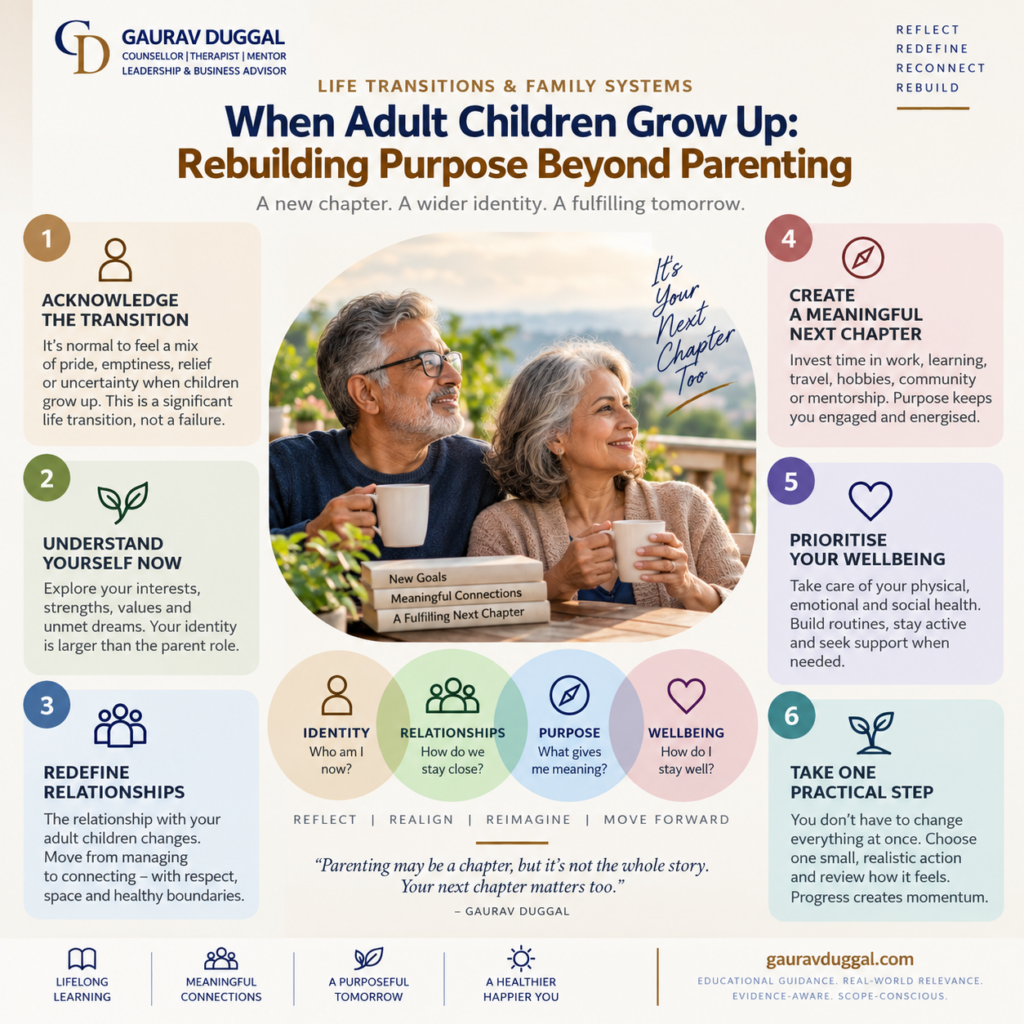
When adult children grow up and become more independent, parenting does not end—but its everyday shape changes. For many parents, this transition brings pride and relief alongside an unexpected question: Who am I when so much of my daily life is no longer organized around raising children?
When Adult Children Grow Up: Why the Transition Can Feel Bigger Than Expected
When adult children grow up, parenting does not end, but its everyday shape changes. Years of parenting can influence routines, friendships, work decisions, finances, relationships and a person’s sense of usefulness. When children need less day-to-day involvement, the resulting space can feel freeing, unfamiliar or both. The goal is not to stop being a parent. It is to allow identity to become broader than one important role.
Rebuilding Identity Beyond the Parenting Role
When adult children grow up, this stage can become an opportunity to rediscover interests that were postponed, reconnect with abilities that received less attention, learn something new or reconsider what feels meaningful now.
Allow Relationships to Evolve
Relationships with adult children often work better when connection gradually shifts from constant supervision toward respect, availability and appropriate boundaries. Couples may also discover that they need to get to know each other again outside the routines of active parenting. Single parents and people whose lives have centered heavily on caregiving may face a different but equally significant adjustment.
Five Areas Worth Reviewing
- Identity: What parts of yourself would you like to rediscover?
- Relationships: Which connections deserve renewed attention?
- Purpose: What work, service, learning or creativity feels meaningful now?
- Wellbeing: Which routines support your physical and emotional health?
- Future: What would you like the next three to five years to contain?
A Five-Minute Purpose Reset
Write down one part of yourself you want to rediscover, one relationship you want to nurture differently, one interest you postponed while raising a family and one contribution you still want to make. You do not need to redesign your entire life at once. One meaningful change can become the beginning of a new rhythm.
Purpose Does Not Have to Look Impressive
A fulfilling next chapter may involve professional work, mentoring, community participation, friendships, travel, learning, hobbies, caring for health or simply building a calmer everyday life. Meaning is personal. It does not need to resemble someone else’s retirement, career or family story.
If the transition repeatedly creates conflict, prolonged distress, loss of functioning or concerns that extend beyond reflective guidance, appropriate qualified health or mental-health professionals should be involved. Mentoring and counselling-oriented conversations can support reflection and practical adjustment within their appropriate scope.
Scope note: Educational guidance; evidence-aware and scope-conscious. Gaurav Duggal is not a doctor, psychiatrist or clinical psychologist, and this content is not medical treatment.
As family roles change, support can sometimes feel like pressure. I explore this in my Psychreg article on family support, pressure and changing the conversation. Explore counselling and personal development.