Supporting a Child With Dual Needs: 7 Practical Ways to Help
November 6, 2026
A child can appear capable in one environment and struggle significantly in another. At school, the difficulty may show up as attention problems, incomplete work, withdrawal, impulsive behaviour or difficulty following classroom expectations. At home, the same child may show exhaustion, emotional outbursts, resistance to routines, homework conflict or a need for much more support.
This does not automatically mean that one environment is right and the other is wrong. It may mean that the demands, supports, relationships, sensory load and expectations are different. The useful question is not simply
what is wrong with the child?’ but what changes across settings, and what can those differences teach us?’
One Child, Two Environments
For a broader international perspective, UNICEF explains how inclusive education can remove barriers to participation and learning for children with diverse needs.
School and home see different parts of the same developmental picture. A classroom may reveal how a child manages group instructions, transitions, peers, academic demands and sustained attention. Home may reveal recovery after school, sleep and morning routines, emotional regulation, homework demands and the child’s behaviour in a familiar environment.
Neither view should automatically cancel the other. When adults compare observations carefully, the contrast itself can become useful information.
Look Beyond the Label
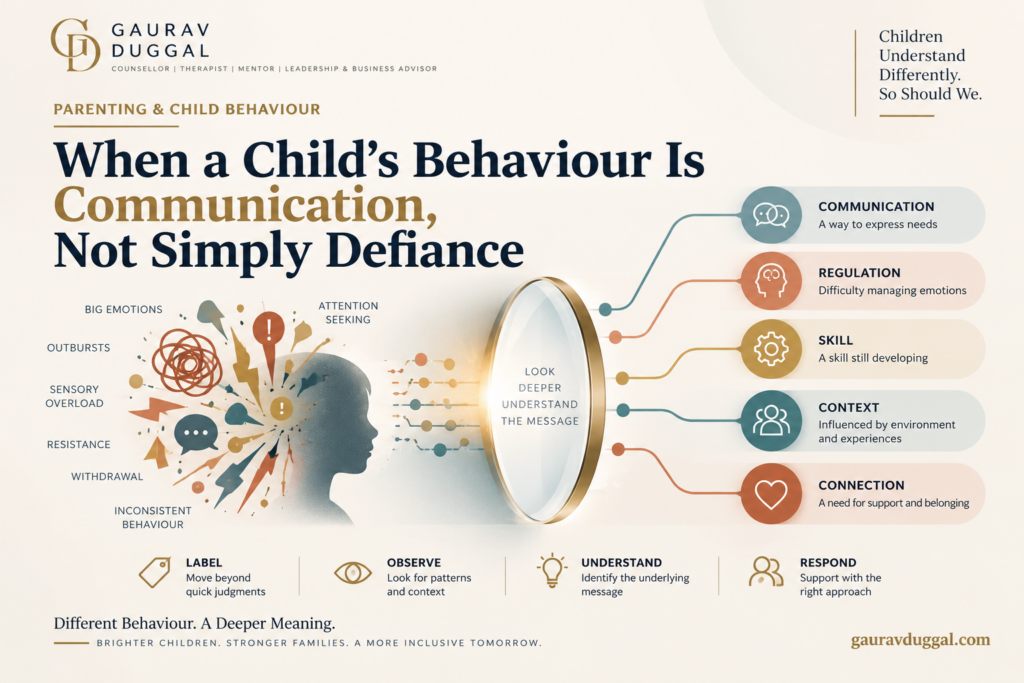
Broad labels can hide important differences. Instead, define what is actually happening. Is the child struggling to begin work, sustain attention, understand instructions, tolerate frustration,
organize materials, communicate needs, regulate emotion or move between activities?
Then ask where, when and how often it occurs. A difficulty that appears mainly during writing tasks may require a different response from one that appears during noisy transitions or unstructured social time.
What School Can Observe
Useful school observations include the type of task, time of day, group size, level of noise, clarity of instructions, peer context, transitions, amount of adult prompting required and what helps the child re-engage. Strengths matter too: when does the child participate confidently, work independently or recover successfully?
What Home Can Observe
Families can notice patterns around sleep, mornings, meals, screen use, homework, fatigue after school, transitions, emotional recovery and the difference between structured and unstructured time. The purpose is not to monitor every behaviour. It is to identify repeatable patterns that can guide practical support.
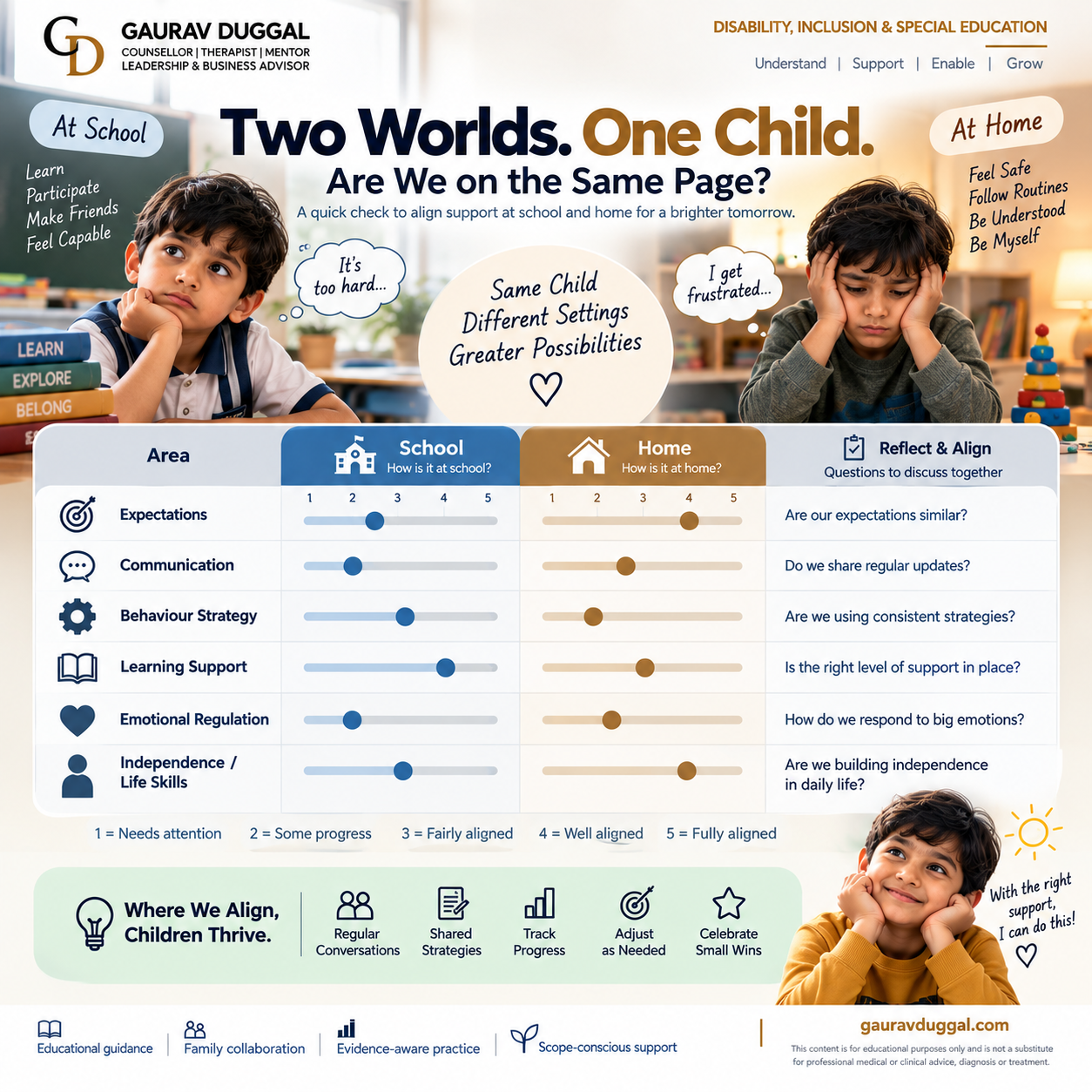
Two Worlds, One Child: Are We on the Same Page?
Use this School–Home Alignment tool to compare expectations, communication, learning support, regulation and progress across both environments.
The aim is not to make school and home identical. The aim is alignment where consistency matters. Compare what each environment expects, which strategies work, how adults communicate, what support is available and how progress is being judged.
Build a Shared Support Plan
When concerns continue across settings, families can also consider professional counselling and guidance to understand the pattern and plan appropriate next steps.
Choose one or two priorities rather than trying to correct everything simultaneously. Define the concern in observable terms, agree on a realistic strategy for each setting and decide what improvement would look like. Review after a defined period and adjust based on evidence rather than assumption.
For example, if transitions are difficult, school may use advance warning and a visual sequence while home uses a predictable preparation routine. The tools do not need to be identical, but the underlying objective can remain consistent.
Educational and developmental support should remain within appropriate professional scope. When concerns involve diagnosis, medication, significant clinical risk or regulated treatment, families should consult appropriately qualified medical or clinical professionals. School teams, special educators, therapists and families can then coordinate around the recommendations relevant to their roles.
Progress Should Travel With the Child
The strongest support is not defined by how many adults are involved. It is defined by whether the child experiences greater clarity, participation, confidence, regulation, independence and meaningful progress across everyday environments.
When school and home exchange specific observations instead of competing interpretations, the child is less likely to become caught between two different stories. The goal is one coherent understanding of the child, with support adapted intelligently to each environment.
Educational guidance | Evidence-aware practice | Scope-conscious support
Gaurav Duggal is not a doctor, psychiatrist or clinical psychologist. This content is educational and is not a substitute for medical diagnosis or regulated clinical treatment.
Follow Me for More Insights
Some Thoughts on Life, Growth, and Everything In-Between
Sometimes, all it takes is a little insight or a different perspective to get unstuck. This is my space to share some of my thoughts, provide a bit of guidance, and offer practical tips on mental health, relationships, and personal growth. Think of it as a place to gather some clarity before we even talk.
Expert Counselling, Therapy & Mentoring for Every Stage of Life
Providing a bridge between human understanding, multidisciplinary support and personal or professional growth. Whether you need counselling for emotional wellness and life transitions, therapy for mental health or neurodevelopmental disorders, or mentoring for academic and business success—I offer specialized support tailored to your unique journey. From special education to executive strategy, find the path that is right for you.
Collaborative Network | versatile advisor | Inclusive Care | Online & In-Person Sessions | Serving India & Globally
Not sure where to start?
Book an initial consultation to understand the right support for your situation.
I offer flexible session formats tailored to your schedule and location—providing online (video/audio), hybrid, and in-person sessions across India and internationally. As a tech-savvy and globally accessible practitioner, I work across all time zones and am available for urgent support when your situation requires immediate attention.
Select the format that works best for you and take the first step toward clarity, growth, and emotional wellbeing.
Get in
touch
today
Select a time in my calendar to book your session, or simply call me or send a message - I'll respond promptly, whichever feels easiest for you.
Please fill in the form below
Message Sent!
Thank you for reaching out. I'll get back to you as soon as possible.
Get in touch: Call /
WhatsApp / SMS
Ready to talk? A simple call is the quickest step toward clarity. Your conversation is always 100% confidential and pressure-free.