Developmental Differences: What Parents Can Observe Before They Panic
November 25, 2026
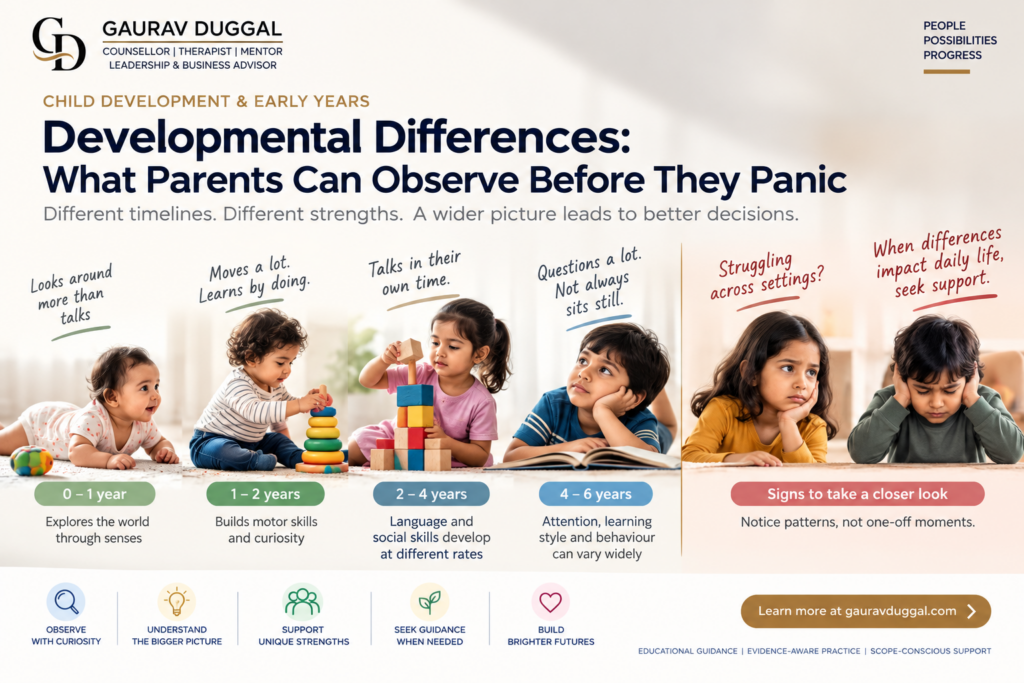
Child development support begins with observation, not panic. When a child develops differently from siblings, classmates or an expected timeline, parents can understandably worry. But a difference does not automatically tell us what it means. The more useful starting point is to look carefully at what is happening, how often it happens, where it happens, what changes it and how much it affects everyday functioning.
From my work across special education, child development and human behaviour, I have found that context matters. Children do not all learn, communicate, move, regulate themselves or participate in exactly the same way or at exactly the same pace. The task is not to ignore a concern or rush toward a label. It is to build a clearer picture.
Understanding Child Development Support in Context
Useful child development support starts by describing the concern precisely. A parent saying, “My child is behind,” gives us less useful information than observations such as, “My child uses very few words to communicate at home and school,” or, “My child can complete this task independently in a quiet setting but struggles in a busy group.”
Specific observations help us distinguish a one-off moment from a repeated pattern. They also make conversations with teachers, therapists and other professionals more meaningful because everyone is discussing observable behaviour rather than a broad assumption.
Developmental Differences: What Is Worth Observing?
Parents can pay attention to areas such as communication, movement, play, learning, attention, social participation, independence, emotional regulation and everyday routines. The purpose is not to turn home life into a constant assessment. It is to notice whether a pattern is persistent, whether it appears across settings and whether it is beginning to interfere with participation or wellbeing.
Repeated strain, avoidance, communication difficulty, changes in routine, reduced follow-through or a growing gap between what a child wants to do and what they can currently manage may deserve a closer look. These observations are information, not automatic diagnoses.
A Practical Parent Observation Framework
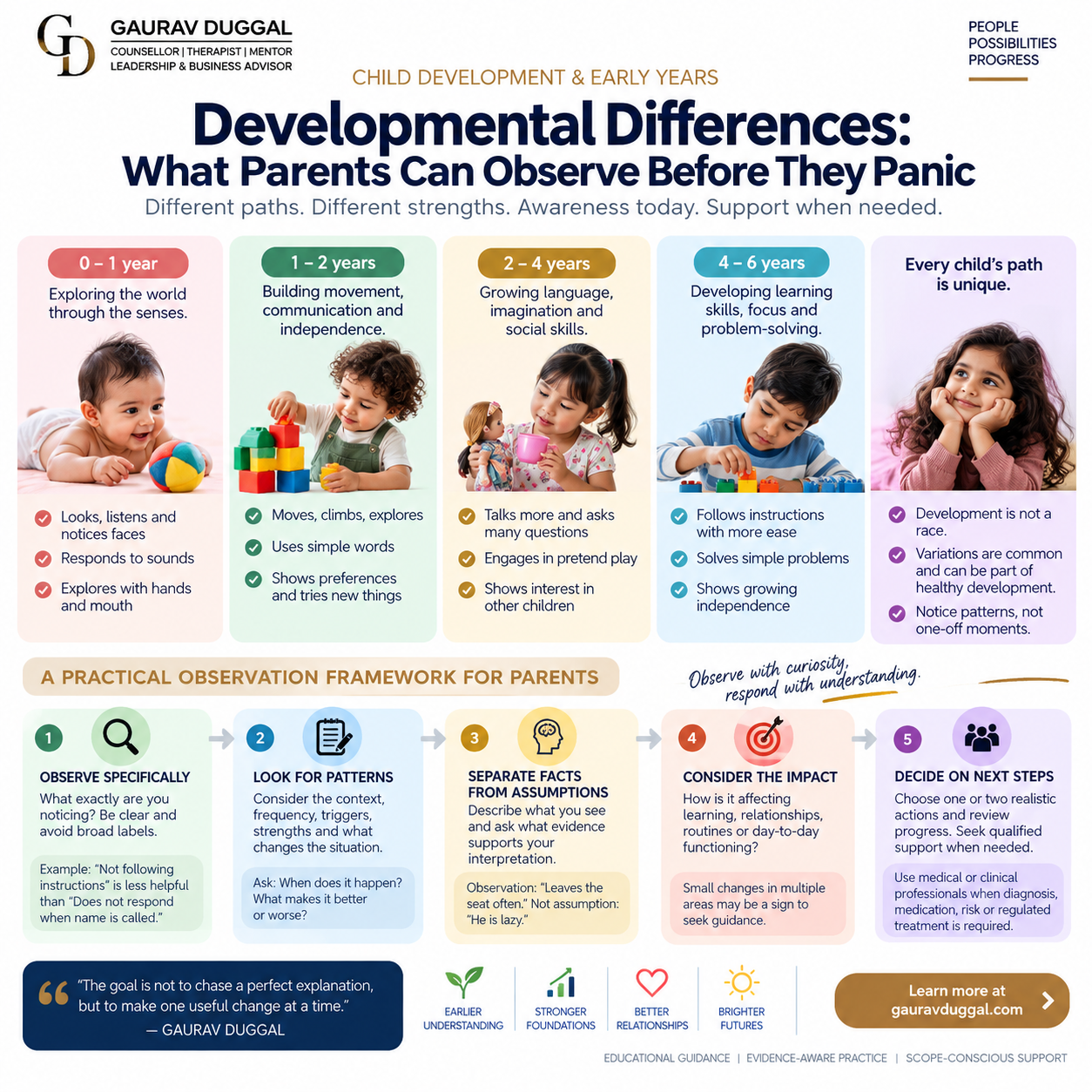
1. Define what you actually see
Avoid starting with a broad label such as “lazy,” “difficult,” “slow” or “not listening.” Describe the behaviour. What happened? What did the child do or say? How long did it last?
2. Look for patterns
Consider context, frequency, triggers, strengths and what changes the situation. Ask when the concern is most visible and when it becomes easier. A child who struggles in one environment but functions differently in another gives us useful information about demands and context.
3. Separate observation from assumption
“Leaves the seat repeatedly during group work” is an observation. “Does not care about learning” is an interpretation. Before accepting an interpretation, ask what evidence supports it and what other explanations may need consideration.
4. Consider everyday impact
Ask whether the difference is affecting learning, relationships, communication, independence, routines, family functioning or the child’s ability to participate in everyday activities. Impact over time can be more informative than comparison with another child.
5. Choose the next useful step
Select one or two realistic actions and decide how progress will be reviewed. This could mean observing for a defined period, adjusting an environment, speaking with the school, seeking developmental guidance or involving an appropriately qualified professional where assessment is indicated.
Parents can also refer to the CDC’s developmental milestones for age-based guidance on how children typically play, learn, speak, act and move.
Different Does Not Automatically Mean Something Is Wrong
Children have strengths as well as areas in which they need support. A useful developmental picture includes both. If adults focus only on what a child cannot yet do, they may miss the conditions under which the child communicates, learns or participates successfully.
This is why comparison alone can create unnecessary alarm. The more meaningful question is whether the child’s current pattern is limiting functioning, participation or progress in ways that require additional support.
When Structured Child Development Support May Help
Structured support may be useful when concerns persist over time or begin to affect learning, relationships, communication, family routines or day-to-day wellbeing. It can also be useful earlier, before the concern becomes a crisis.
Parents do not need to wait until every question has an answer before seeking guidance. A
well-organized set of observations can itself become a valuable starting point for discussion.
Know When Another Professional Perspective Is Appropriate
Educational, behavioural and developmental observations can help clarify patterns, but they should not be presented as diagnoses. Appropriately qualified medical or clinical professionals should be involved when diagnosis, medication, risk assessment or regulated treatment is required.
The aim is not to chase a perfect explanation. It is to understand the child more clearly, make one useful change at a time and know when another professional perspective is appropriate.
Before You Panic, Ask Five Questions
What exactly am I observing?
Is this a one-off event or a repeated pattern?
Where and when does it become better or worse?
How much is it affecting everyday functioning?
What is the most useful next step?
Those questions turn worry into information. And better information can lead to more thoughtful child development support.
Educational guidance only. This article is supportive in nature and is not medical treatment. It does not replace assessment or treatment by a psychiatrist, clinical psychologist, physician or other appropriately qualified healthcare professional.
Follow Me for More Insights
Some Thoughts on Life, Growth, and Everything In-Between
Sometimes, all it takes is a little insight or a different perspective to get unstuck. This is my space to share some of my thoughts, provide a bit of guidance, and offer practical tips on mental health, relationships, and personal growth. Think of it as a place to gather some clarity before we even talk.
Expert Counselling, Therapy & Mentoring for Every Stage of Life
Providing a bridge between human understanding, multidisciplinary support and personal or professional growth. Whether you need counselling for emotional wellness and life transitions, therapy for mental health or neurodevelopmental disorders, or mentoring for academic and business success—I offer specialized support tailored to your unique journey. From special education to executive strategy, find the path that is right for you.
Collaborative Network | versatile advisor | Inclusive Care | Online & In-Person Sessions | Serving India & Globally
Not sure where to start?
Book an initial consultation to understand the right support for your situation.
I offer flexible session formats tailored to your schedule and location—providing online (video/audio), hybrid, and in-person sessions across India and internationally. As a tech-savvy and globally accessible practitioner, I work across all time zones and am available for urgent support when your situation requires immediate attention.
Select the format that works best for you and take the first step toward clarity, growth, and emotional wellbeing.
Get in
touch
today
Select a time in my calendar to book your session, or simply call me or send a message - I'll respond promptly, whichever feels easiest for you.
Please fill in the form below
Message Sent!
Thank you for reaching out. I'll get back to you as soon as possible.
Get in touch: Call /
WhatsApp / SMS
Ready to talk? A simple call is the quickest step toward clarity. Your conversation is always 100% confidential and pressure-free.