7 Powerful Ways to Understand School Refusal and Help Your Child
November 13, 2026
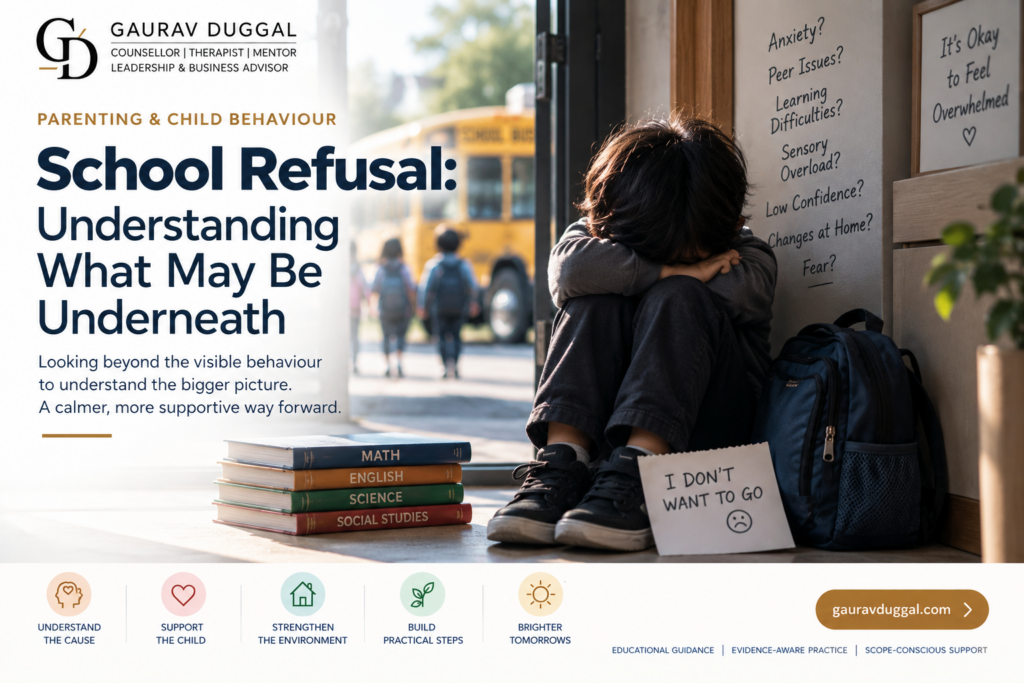
School refusal support begins by looking beyond the visible behaviour. When a child repeatedly says they do not want to go to school, becomes distressed before leaving home, complains of physical discomfort around school time, or struggles to enter the school environment, it can be tempting to see the problem only as non-compliance.
But school refusal can have different underlying contributors. The useful question is not simply, How do we make the child go? It is also: What may the child be communicating through this pattern?
School Refusal Is a Pattern to Understand, Not a Label to Apply
Parents and educators benefit from describing what is actually happening before drawing conclusions. Notice when the difficulty occurs, how often it occurs, what happens immediately before it, what the child says, what makes the situation easier, and whether the pattern changes across days or settings.
Observation gives us information. It does not automatically provide a diagnosis.
What May Be Underneath School Refusal?
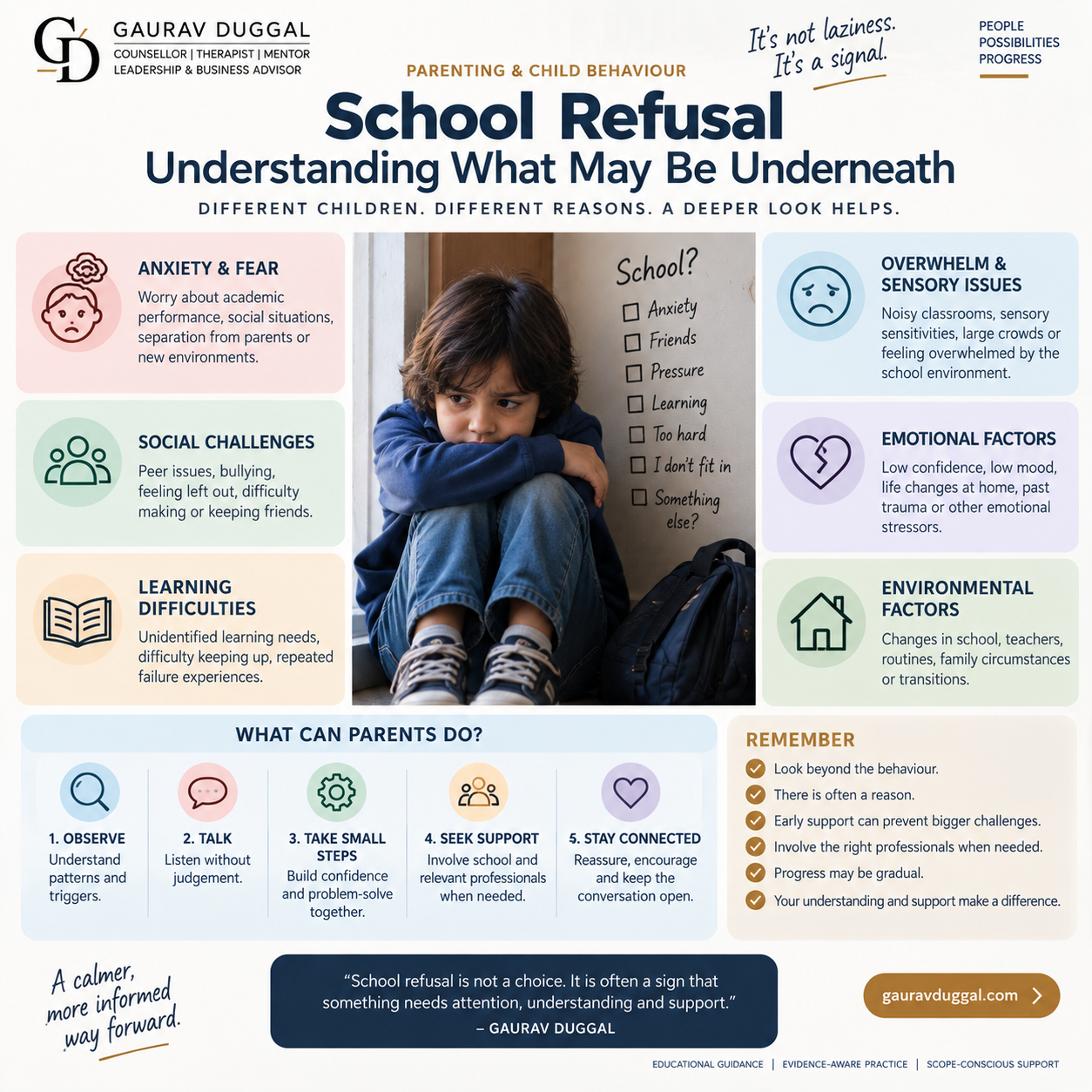
Different children may avoid school for very different reasons. Possible contributors can include anxiety or fear, peer difficulties, bullying, feeling left out, academic pressure, unidentified learning needs, difficulty keeping up, sensory overwhelm, low confidence, changes at home or school, transitions, and other emotional stressors.
Sometimes several factors influence the child at the same time. That is why a single explanation such as laziness, stubbornness or attention-seeking can prevent adults from seeing the larger picture.
A Parent Investigation Tool: Look for Patterns
Use the
info graphic
above as a starting point for observation rather than as a diagnostic checklist. Over several days, record what happens around school preparation, travel, entry into school and return home.
1. Observe the timing
Does distress begin the night before, on waking, while dressing, during the journey, at the school gate or only around a particular lesson or activity?
2. Listen to the child’s language
Instead of immediately correcting the child, listen for clues. Ask whether performance, friendships, a teacher, separation, noise, crowds, embarrassment, difficulty completing work, or something they cannot yet explain clearly is worrying them.
3. Compare difficult and easier days
When considering school refusal support, ask what is different on days when attendance is easier. A different timetable, particular teacher, smaller group, adequate sleep, predictable morning routine or supportive peer may provide useful information.
4. Check across environments
Where appropriate, compare observations from home and school. Parents may see distress before departure while teachers see a child who settles later. Alternatively, school may observe difficulties that are not visible at home. Both perspectives matter.
What Parents Can Do Without Turning Mornings Into a Battle
Remain calm and curious while keeping expectations clear. Listen without interrogation. Avoid repeatedly debating the entire school day during a distressed morning. Break the challenge into smaller steps and reinforce movement toward participation rather than demanding an immediate emotional transformation.
For example, the first goal may involve getting dressed and leaving home calmly. The next step may involve reaching the school gate, meeting a trusted adult, or attending for a manageable part of the day while the family and school follow an agreed support plan.
School Refusal Support: Work With the School, Not Around the School
Persistent school refusal often benefits from communication between parents and relevant school personnel. Share specific observations rather than broad conclusions. Ask what the school is seeing, whether there are patterns around particular classes or social situations, and what support is realistically available.
Parents and school staff can achieve greater consistency when they coordinate their response instead of applying unrelated strategies.
When Broader Professional Support May Be Needed
If school refusal is persistent, significantly affecting functioning, accompanied by substantial emotional distress, or connected with concerns about development, learning, mental health or safety, appropriately qualified professionals may need to provide further assessment or support.
Seek support from medical or clinical professionals when the situation requires diagnosis, medication, risk assessment or regulated treatment. Educational and behavioural observations can contribute valuable information, but they cannot substitute for clinical assessment.
For some children, improvement is not a single moment when they suddenly become comfortable with school. Progress may involve fewer distressed mornings, faster recovery, better communication, entering school with support, tolerating a difficult lesson, reconnecting with peers or gradually increasing participation.
Define what progress means for the individual child and review it over time.
Look Beneath the Behaviour
Adults should not automatically interpret school refusal as defiance. Behaviour can provide information about demands, fears, skills, relationships and environments that a child may not yet know how to explain.
The objective is neither to excuse every behaviour nor to force a quick interpretation. It is to understand the pattern accurately enough to choose a useful next step.
Educational guidance only. This article does not provide diagnosis, medical treatment or psychiatric or clinical psychological treatment. Consult an appropriately qualified professional when the situation requires clinical assessment, diagnosis, medication, safety intervention or regulated treatment.
Follow Me for More Insights
Some Thoughts on Life, Growth, and Everything In-Between
Sometimes, all it takes is a little insight or a different perspective to get unstuck. This is my space to share some of my thoughts, provide a bit of guidance, and offer practical tips on mental health, relationships, and personal growth. Think of it as a place to gather some clarity before we even talk.
Expert Counselling, Therapy & Mentoring for Every Stage of Life
Providing a bridge between human understanding, multidisciplinary support and personal or professional growth. Whether you need counselling for emotional wellness and life transitions, therapy for mental health or neurodevelopmental disorders, or mentoring for academic and business success—I offer specialized support tailored to your unique journey. From special education to executive strategy, find the path that is right for you.
Collaborative Network | versatile advisor | Inclusive Care | Online & In-Person Sessions | Serving India & Globally
Not sure where to start?
Book an initial consultation to understand the right support for your situation.
I offer flexible session formats tailored to your schedule and location—providing online (video/audio), hybrid, and in-person sessions across India and internationally. As a tech-savvy and globally accessible practitioner, I work across all time zones and am available for urgent support when your situation requires immediate attention.
Select the format that works best for you and take the first step toward clarity, growth, and emotional wellbeing.
Get in
touch
today
Select a time in my calendar to book your session, or simply call me or send a message - I'll respond promptly, whichever feels easiest for you.
Please fill in the form below
Message Sent!
Thank you for reaching out. I'll get back to you as soon as possible.
Get in touch: Call /
WhatsApp / SMS
Ready to talk? A simple call is the quickest step toward clarity. You’re welcome to enquire 24/7. I offer meetings by appointment across time zones. Please share your time zone and preferred time so we can agree a slot. Sessions are by appointment and subject to availability. I respond to enquiries during working hours. This service is not an emergency or crisis-response service; if you are in immediate danger, contact local emergency services.