7 Powerful Ways Consistency Builds Trust in Relationships
October 12, 2026
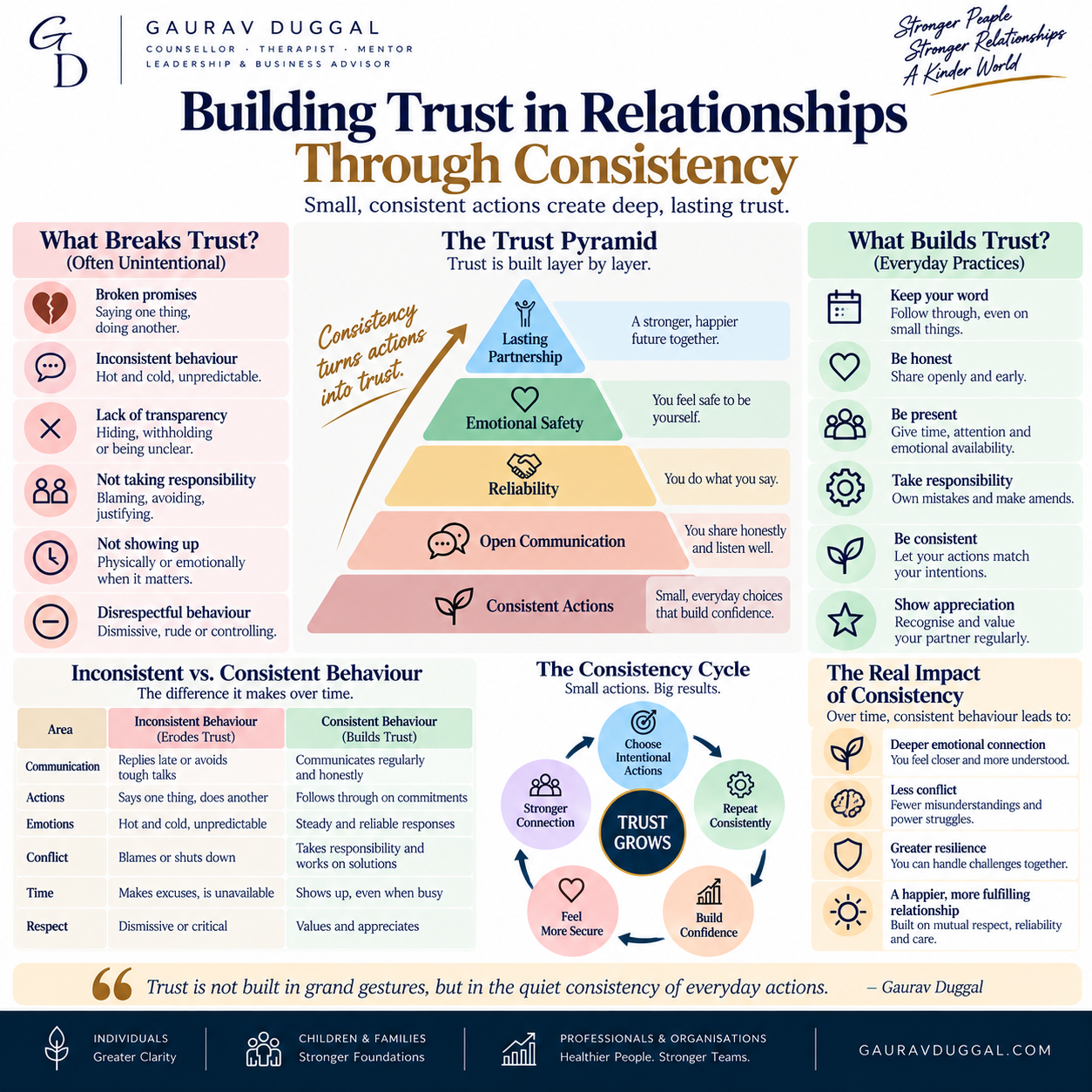
Building trust in relationships rarely happens through one dramatic promise. Trust is usually shaped through repeated experiences: whether words and actions match, whether commitments are kept, whether changes are communicated and whether both people know what they can reasonably expect from each other.
In my work across counselling, family systems and human behaviour, consistency is often one of the clearest places to look when a person says, “I care about my partner, but something still does not feel secure.” Affection matters. Reliability gives that affection a pattern the other person can experience.
Building Trust in Relationships Through Predictability
Predictability does not mean becoming rigid or never changing plans. Life is unpredictable. The more useful question is whether a partner communicates changes, follows through where possible and repairs the situation when something goes wrong.
The American Psychological Association highlights regular communication, constructive handling of disagreement and maintaining connection as important elements of healthy relationships.
Consistency Makes Words More Credible
Consider the difference between repeatedly saying “I will make more time” and actually protecting a regular period for the relationship. The promise may feel reassuring once. Repeated follow-through makes it believable.
Consistency can appear in ordinary actions: arriving when agreed, communicating delays, remembering important commitments, sharing responsibilities, respecting boundaries and returning to difficult conversations instead of abandoning them.
Five Practices for Building Trust in Relationships
Make realistic commitments. A smaller promise you can keep is more useful than a large promise you repeatedly break.
Match words with action. Let behaviour provide evidence for what you say matters.
Communicate changes early. Reliability includes telling the other person when circumstances change.
Repair lapses. Consistency does not require perfection; it requires responsibility when something goes wrong.
Repeat dependable behaviour. Trust develops through patterns, not isolated performances.
Consistency Does Not Mean Perfection
Everyone forgets, misjudges time, becomes overwhelmed or makes mistakes. Trust is not built by pretending mistakes will never happen. It is strengthened when a person can acknowledge a lapse, explain without avoiding responsibility and make a realistic correction.
This connects directly with relationship repair after conflict. A repair matters most when the apology is followed by behaviour that changes the pattern.
Clear Communication Supports Consistency
Partners cannot reliably meet expectations that have never been discussed. Clear couples communication helps turn vague expectations into understandable needs and workable agreements.
Research involving couples has also found links among daily communication, conflict resolution and marital quality. The longitudinal study is indexed in PubMed; its population and cultural context should be considered when applying the findings more broadly.
When Trust Has Already Been Damaged
When there has been repeated inconsistency, reassurance alone may no longer be enough. Rebuilding trust can require time, transparency, clearer agreements and repeated evidence that the new behaviour is sustainable. Some couples benefit from structured support to understand what damaged trust and what each person would need to see change.
Building trust in relationships becomes easier to observe when couples look at behaviour rather than intention alone. Once a week, each partner can identify one action that increased reliability and one small agreement that needs more consistent follow-through. Keep the conversation specific: what happened, what impact did it have, and what would be useful next time?
This is not a scorecard for judging a partner. It is a practical way to notice patterns before disappointment accumulates. When both people can discuss commitments, changes and repairs without defensiveness, trust becomes something they actively maintain rather than something they only discuss after it has been damaged.
Closing Perspective
Building trust in relationships is less about convincing someone to trust and more about becoming consistently trustworthy in the areas that matter. Small acts of reliability, repeated over time, make the relationship easier to understand and safer to depend on.
Scope note: This article is educational and supportive in nature. It does not replace assessment or treatment by an appropriately qualified healthcare professional when clinical care is required.
Follow Me for More Insights
Some Thoughts on Life, Growth, and Everything In-Between
Sometimes, all it takes is a little insight or a different perspective to get unstuck. This is my space to share some of my thoughts, provide a bit of guidance, and offer practical tips on mental health, relationships, and personal growth. Think of it as a place to gather some clarity before we even talk.
Expert Counselling, Therapy & Mentoring for Every Stage of Life
Providing a bridge between human understanding, multidisciplinary support and personal or professional growth. Whether you need counselling for emotional wellness and life transitions, therapy for mental health or neurodevelopmental disorders, or mentoring for academic and business success—I offer specialized support tailored to your unique journey. From special education to executive strategy, find the path that is right for you.
Collaborative Network | versatile advisor | Inclusive Care | Online & In-Person Sessions | Serving India & Globally
Not sure where to start?
Book an initial consultation to understand the right support for your situation.
I offer flexible session formats tailored to your schedule and location—providing online (video/audio), hybrid, and in-person sessions across India and internationally. As a tech-savvy and globally accessible practitioner, I work across all time zones and am available for urgent support when your situation requires immediate attention.
Select the format that works best for you and take the first step toward clarity, growth, and emotional wellbeing.
Get in
touch
today
Select a time in my calendar to book your session, or simply call me or send a message - I'll respond promptly, whichever feels easiest for you.
Please fill in the form below
Message Sent!
Thank you for reaching out. I'll get back to you as soon as possible.
Get in touch: Call /
WhatsApp / SMS
Ready to talk? A simple call is the quickest step toward clarity. Your conversation is always 100% confidential and pressure-free.