5 Powerful Emotional Regulation Skills for a Happier Life
November 20, 2026
Everyday stress does not always arrive as a crisis. It may appear as irritation during a conversation or impatience at work. We may worry before a decision or withdraw at home. Even a small problem can suddenly feel much bigger.
In my work across counselling, human behaviour, family systems and professional settings, I often see the value of emotional regulation skills in ordinary moments. The goal is not to suppress emotion. Instead, we can notice what is happening and create a pause. From there, we can choose a response and learn from what follows.
Emotions give us useful information. However, they do not always tell us what action to take. Stress can narrow our attention and create urgency. An interpretation may then begin to feel like a fact. A brief pause can help us see the situation more clearly before we respond.
What Are Emotional Regulation Skills?
Emotional regulation skills help us notice, understand and respond to emotions. First, we can recognise triggers and patterns. We can then separate what we observe from what we assume. Finally, we can choose an action that fits the situation.
This does not mean staying calm all the time. Anger, sadness, fear, frustration and disappointment are part of life. A more realistic goal is greater awareness. That awareness can help us respond instead of letting one strong feeling make every decision.
Why Everyday Stress Can Make Regulation Harder
Stress changes the context in which we make choices. For example, a person who is tired, under pressure or already worried may react differently to the same comment than they would on a calmer day.
That is why context matters. Rather than asking only, “Why did I react like that?”, it can be more useful to ask what happened before the reaction, what meaning I gave the situation, what I was already carrying and what helped or intensified it.
5 Emotional Regulation Skills for Everyday Stress
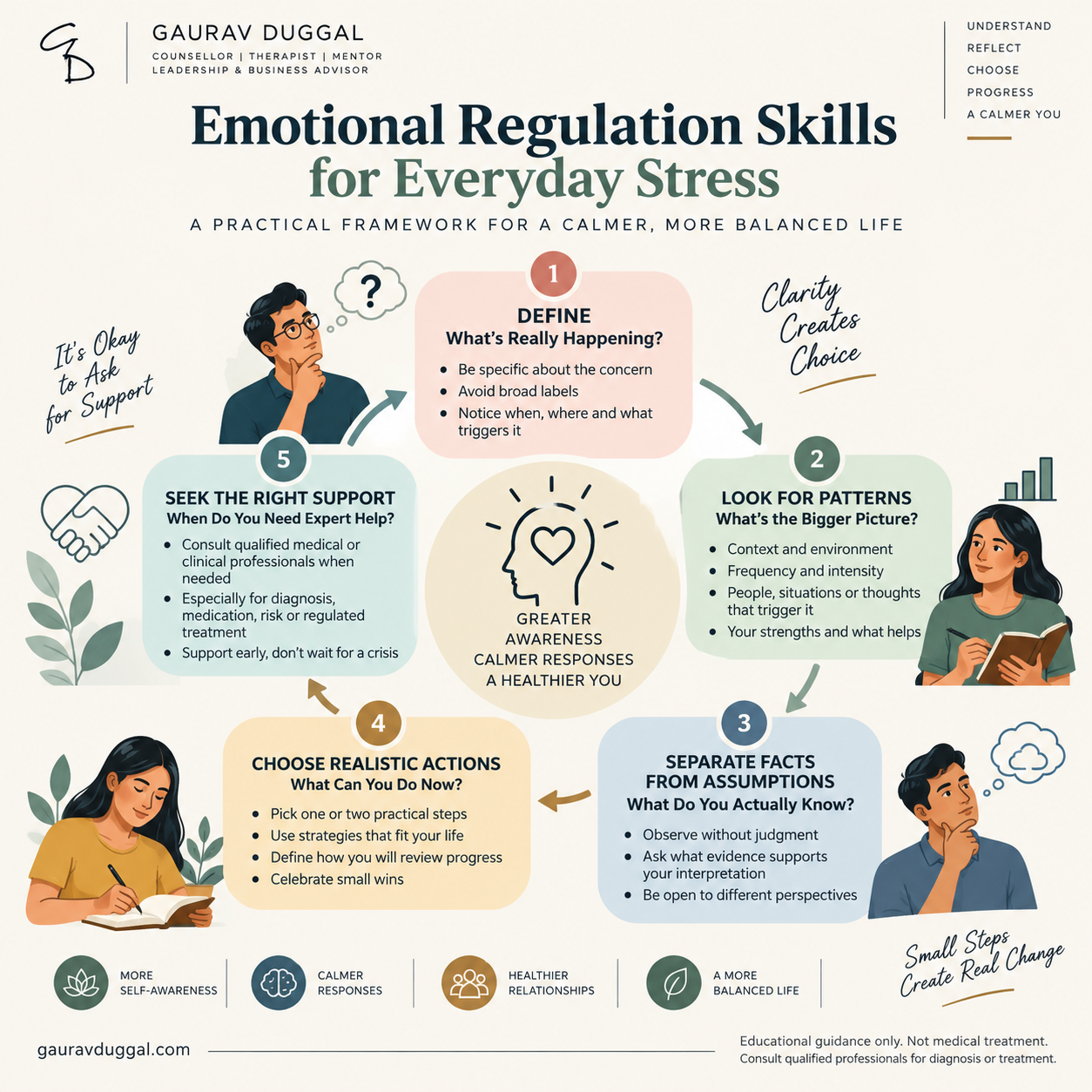
1. Define What Is Actually Happening
Begin with the concern itself. Be specific rather than relying on a broad label such as “everything is wrong” or “nobody understands me.” Ask what happened, when it happened and what part of the situation is creating the strongest response.
Specific language reduces emotional fog. It also gives us something practical to work with.
2. Look for Patterns, Not Just One Moment
Next, look at context, frequency and intensity. Notice the people, situations or thoughts that tend to trigger the response. At the same time, identify strengths and conditions that help you respond differently.
A pattern gives more useful information than an isolated incident. For instance, irritability that repeatedly appears after poor sleep tells us something different from anger linked to one specific disagreement.
3. Separate Facts From Assumptions
One of the most practical emotional regulation skills is separating what happened from what we think it means. Ask: What do I actually know? What am I interpreting? What evidence supports that interpretation?
This does not mean dismissing intuition or emotion. Instead, it creates room for another possibility. A delayed reply, for example, may feel like rejection without proving that rejection was intended.
4. Choose One or Two Realistic Actions
Once the situation is clearer, choose a small action that fits real life. You might pause before replying, ask a clarifying question, take a short break, write down what you want to communicate or postpone a difficult conversation until you can engage more constructively.
Then review what happened. Did the action reduce escalation? Did communication improve? What would you repeat or change next time? Regulation develops through practice and review, not perfection.
5. Know When the Right Support Is Needed
Self-regulation strategies are useful, but they are not a substitute for every kind of support. When emotional patterns repeatedly affect relationships, work, daily functioning or wellbeing, structured counselling can provide space to understand triggers, assumptions and practical alternatives.
When diagnosis, medication, significant risk or regulated treatment is required, appropriately qualified medical or clinical professionals should be involved. Seeking the right level of support is part of responsible decision-making.
Emotional Regulation in Relationships and Families
Emotional regulation is rarely an individual issue alone. In families and relationships, one person’s reaction can quickly become another person’s trigger. As a result, a small disagreement may turn into accusation, withdrawal, defensiveness or repeated conflict.
A useful shift is to move from “Who is wrong?” toward “What pattern are we creating together?” This does not remove accountability. Rather, it makes accountability more practical by identifying the point where somebody can respond differently.
Emotional Regulation at Work
These skills also matter at work. Feedback, deadlines and uncertainty can increase pressure. Tension with colleagues can add to it. However, an immediate reaction is not always an effective response.
A short pause can help us distinguish the task from the emotion surrounding it. We can then clarify what is within our control, what needs communication and what action is proportionate to the situation.
A Simple Daily Practice
When stress rises, pause and ask four questions: How am I feeling? What actually happened? Which meaning have I added? Is there one useful action I can take now?
The purpose is not to produce a perfect response. It is to create a little more space between emotion and action. Over time, that space can support greater self-awareness, calmer responses and healthier relationships.
When Emotional Regulation Skills Need More Support
If everyday stress is repeatedly affecting your decisions, relationships, family life or professional functioning, you can explore counselling support and consultation with Gaurav Duggal. The work can focus on understanding patterns, strengthening practical responses and identifying realistic next steps.
For general public information about stress and mental wellbeing, the World Health Organisation provides guidance on stress and when additional support may be useful.
Educational guidance only. This article is not medical treatment and does not replace assessment, diagnosis or treatment by appropriately qualified medical or clinical professionals.
Follow Me for More Insights
Some Thoughts on Life, Growth, and Everything In-Between
Sometimes, all it takes is a little insight or a different perspective to get unstuck. This is my space to share some of my thoughts, provide a bit of guidance, and offer practical tips on mental health, relationships, and personal growth. Think of it as a place to gather some clarity before we even talk.
Expert Counselling, Therapy & Mentoring for Every Stage of Life
Providing a bridge between human understanding, multidisciplinary support and personal or professional growth. Whether you need counselling for emotional wellness and life transitions, therapy for mental health or neurodevelopmental disorders, or mentoring for academic and business success—I offer specialized support tailored to your unique journey. From special education to executive strategy, find the path that is right for you.
Collaborative Network | versatile advisor | Inclusive Care | Online & In-Person Sessions | Serving India & Globally
Not sure where to start?
Book an initial consultation to understand the right support for your situation.
I offer flexible session formats tailored to your schedule and location—providing online (video/audio), hybrid, and in-person sessions across India and internationally. As a tech-savvy and globally accessible practitioner, I work across all time zones and am available for urgent support when your situation requires immediate attention.
Select the format that works best for you and take the first step toward clarity, growth, and emotional wellbeing.
Get in
touch
today
Select a time in my calendar to book your session, or simply call me or send a message - I'll respond promptly, whichever feels easiest for you.
Please fill in the form below
Message Sent!
Thank you for reaching out. I'll get back to you as soon as possible.
Get in touch: Call /
WhatsApp / SMS
Ready to talk? A simple call is the quickest step toward clarity. Your conversation is always 100% confidential and pressure-free.