How experienced professionals turn AI from a source of instant answers into a disciplined process of inquiry, decision-making and accountable implementation.
There is a difference between asking an AI system to produce something and knowing why that thing should be produced in the first place. A proposal may be fluent, an implementation plan may be comprehensive, and a dashboard may be neatly organised. None of those qualities, by themselves, demonstrates that the answer is appropriate for the people who must use it.
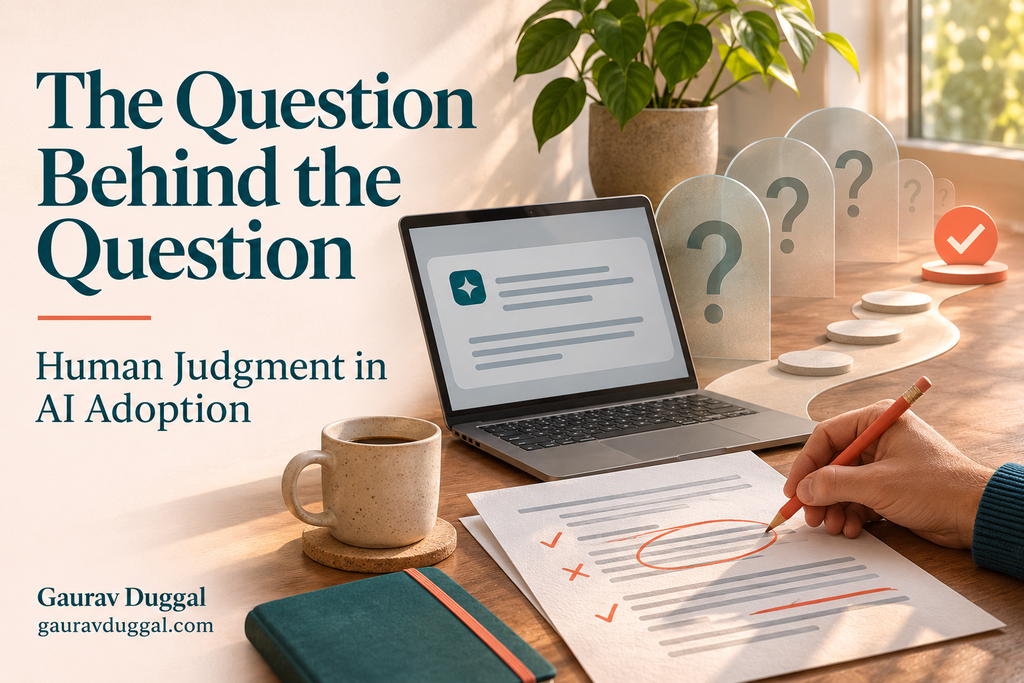
In my work across special education, leadership, business advisory and institutional administration, I have learned that the question often serves a larger purpose: it tests an assumption, exposes a possible route or helps determine what needs to be clarified next. I may ask for an initial response, examine its limitations, add context and then decide which actions actually merit attention. The first answer is not the destination. It is part of the inquiry.
A six-stage human-led AI workflow
- Ask: Frame an exploratory question or practical challenge.
- Test: Compare alternatives and examine assumptions, limitations and possible consequences.
- Contextualise: Consider the decision-maker, operating environment, resources, learning needs, time and constraints.
- Decide: Apply professional judgment to select, defer, adapt or reject the proposal.
- Act: Communicate, delegate or implement a defined step, with an accountable owner.
- Verify: Record what actually happened, gather feedback and distinguish an output from an outcome.
The sequence is iterative. Evidence from the final stage may require the original question to change. AI can assist across the stages, but responsibility for suitability, consent, risk and the final decision remains human.
What differentiated instruction can teach us about AI adoption
My academic and professional background in special education has shaped how I think about the design of learning and organisational change. A teaching method is not useful merely because it is technically correct. It must reach the learner at a pace and in a format that enables meaningful participation. The same principle applies when introducing AI into a business.
Consider two hypothetical organisations. One has specialist teams, a technical department and scheduled management reviews. The other is managed by a founder who handles clients, correspondence, operations and decisions independently. Giving both organisations the same lengthy AI transformation plan would overlook a crucial difference: implementation capacity.
The first organisation may be ready for coordinated workflows, documented ownership and integration. The second might benefit more from one reliable intake form, a clear approval rule and a weekly consolidated decision list. The objective is neither to hold back the first organisation nor overwhelm the second.
Capability is not the same as organisational capacity
A consultant may have the expertise to propose ten useful changes. A founder may have time to examine only two. Without an agreed cadence, the proposal becomes another burden. A practical readiness discussion should consider the number of people involved, decision authority, review time, preferred channels, available budget, implementation support and how delays will be handled.
I find three descriptive operating levels useful: Foundation establishes a few reliable, repeatable essentials; Development introduces delegated responsibility, defined review routines and dashboards; Advanced adds more integrated processes and structured cross-functional oversight. These are planning categories, not labels of personal intelligence or value. An organisation can be advanced in one domain and at the foundation stage in another.
Proof requires more than a generated document
A helpful evidence trail separates four things: inputs (what was known and requested), decisions (what was selected and why), verified actions (what was actually sent, approved, delivered or implemented) and observed outcomes (what changed, and how we know). A beautiful presentation or a long email trail demonstrates activity; it is not proof that a client benefited.
This distinction also protects collaborators. An invitation is not an acceptance. A scheduled post is not a published post. A researched opportunity is not a confirmed partnership. Good reporting preserves those differences instead of turning work in progress into inflated claims.
The importance of restraint
AI can accelerate production so much that it creates more decisions than a small team can reasonably process. Better productivity therefore requires a stopping rule. Before another document, message or meeting is generated, ask: Does this matter? Does it need action now? Who has authority to decide? Can existing work be consolidated? What is the appropriate pace for the recipient?
In this sense, thoughtful AI adoption is an exercise in professional judgment. Technology can help produce possibilities, prepare materials and organise evidence; people remain responsible for prioritisation, communication and the effects of their decisions.
The question worth asking
Instead of asking only “How much work can AI help us produce?” we can ask “How much of that work can the people involved understand, implement and genuinely benefit from?”
That question is relevant to educators, learning-and-development professionals, business leaders and independent consultants. It shifts our attention from prompt volume towards meaningful decisions, sustainable implementation and results that can be verified.
Gaurav Duggal is a principal consultant working across business advisory, learning and leadership development, special education, institutional advisory and responsible AI adoption. This essay develops a practical professional framework; it does not present a validated clinical or psychometric assessment.
For a practical follow-up, see my Training Industry article on how to assess whether AI training improves judgment. My writing and editorial portfolio brings together related published work. For help applying these ideas in an organisation, explore my business consulting and practical AI adoption services or see ways to work with me.