The Power of Mentor Leadership: Why Great Leaders Develop People, Not Just Performance
August 21, 2026
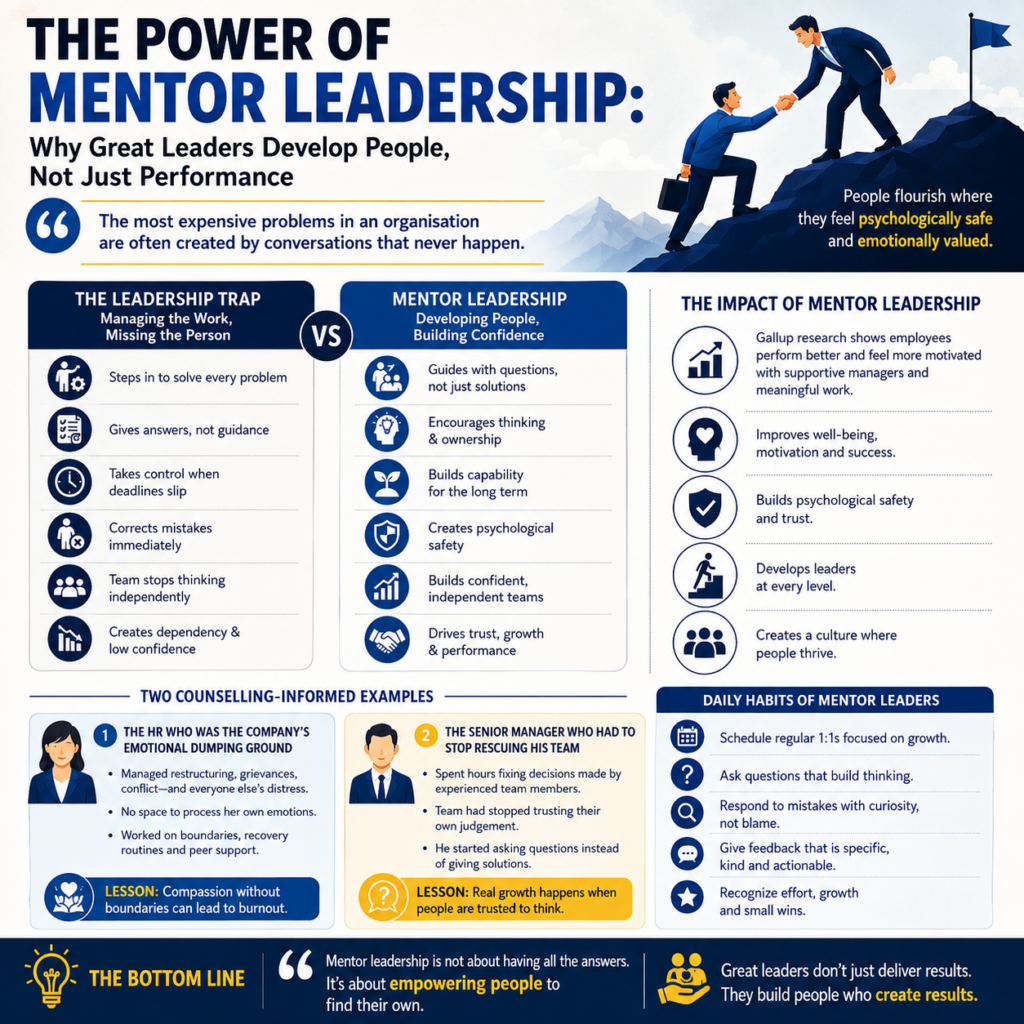
The most expensive problems in an organisation are often created by conversations that never happen.
After nearly two decades of counseling individuals, couples, families, educators, business owners, and corporate leaders, one recurring pattern has become impossible to ignore. Whether I am helping a couple rebuild trust, guiding parents through conflict with a teenager, or coaching an executive responsible for hundreds of employees, the underlying psychology remains remarkably similar: people flourish where they feel psychologically safe and emotionally valued.
A founder avoids discussing succession with a family member because it may create conflict. A senior executive keeps working through exhaustion because admitting burnout feels like weakness. A parent interprets a child’s withdrawal as defiance when the child is actually asking to be understood. A manager postpones difficult feedback until a performance problem becomes a trust problem. And sometimes, an employee stops asking questions because previous questions were met with criticism. The visible problem is rarely the whole problem. In my counselling sessions, I often begin with a simple question: “What conversation are we avoiding, and what is it costing us?” Mentorship in the workplace has become one of the most searched leadership topics today.
I’ve sat across from hundreds of burnt-out professionals over the 18 years of counseling and know that this pattern repeats itself constantly. The gap between a boss and a mentor often decides careers, with leading confidence and how a team actually feels to work in. That gap has a name: mentor leadership. And understanding it might change how you lead entirely.
The Leadership Trap: Managing the Work, Missing the Person
One regular practice I observe in executive coaching is that capable managers often become trapped in the role of experienced problem-solver. When something goes wrong, they step in. When an employee struggles, they provide the answer. When a deadline is missed, they take control. When a team member makes a mistake, they correct it immediately. Initially, this can look like strong leadership. Over time, however, something psychologically important can happen. The team stops thinking independently. The ability to understand and manage your own emotions as a supervisor and help lead your team to victory is the core foundation of mentor leadership.
This executive and leadership coaching style has been certified and reportedly used for the psychological safety of employees. Gallup’s research shows that employees perform better and feel more motivated when they have supportive managers and meaningful work, and even highlights how good leadership and mentoring improve well-being, motivation, and success.
How Coaching Rewires Human Psychology With Professionalism
The perfect guidance in work culture starts with daily behaviours in place of major policy shifts. Good leaders begin by scheduling regular one-on-one check-ins focused purely on growth. The conversations should explore challenges with strong goals and skills someone wants to develop. Psychological safety begins with how a leader responds when something goes wrong. If a manager reacts to every mistake with humiliation, anger, or blame, employees learn to protect themselves. If a manager responds with curiosity, “Help me understand what happened”, the conversation can move towards learning and accountability. That distinction is central to emotional intelligence in leadership.
Two Counselling-Informed Examples of Mentor Leadership
These are anonymised composites based on recurring patterns that I have encountered in counselling and executive coaching; identifying details have been changed.
1. The HR Who Was The Company’s Emotional Dumping Ground
An HR Leader spent months managing restructuring, employee grievances, conflict, and difficult conversations.
From the outside, she appeared highly capable. Privately, she was exhausted.
The issue was not simply workload. She had become the emotional container for everyone else’s distress while having no place to process her own.
We worked on boundaries, recovery routines, peer support, and recognising the difference between being available and being endlessly available.
The lesson for leaders is important:
Compassion without boundaries can eventually lead to burnout.
2. The Senior Manager Who Had to Stop Rescuing His Team
A senior manager was spending hours every week correcting decisions made by experienced team members.
He believed he was maintaining quality. During coaching, it became clear that his team had gradually stopped trusting their own judgement.
Instead of immediately providing solutions, he began asking:
“What options have you considered?”
and
“If I wasn’t available, what would you recommend?”
The result was not instant perfection.
It was something more valuable: increasing independence.
In a leadership enhancement session, I’ve noticed that most managers think they’re listening. In reality, they’re often waiting for their turn to respond. Employees notice the difference almost immediately. The ongoing exchange strengthens the parent-child relationship dynamic, often mirrored in workplace mentoring bonds.
What Is Mentor Leadership?
Mentor leadership is a leadership approach in which managers combine accountability for results with an active commitment to developing the people they lead. A mentor leader does not simply ask: “Did you complete the task?” They also ask:
What did you learn?
What made this difficult?
What would you do differently next time?
What skill would help you handle this independently?
Where do you need support?
What decision do you think we should make?
This changes the nature of the manager-employee relationship as the manager becomes a guide, sounding board, challenger, and developer of capability.
The Power of Leading Through Growth and Guidance
A lot of people search for “how to become a mentor leader” without realising they already show early signs. Curiosity about your team’s growth is often the starting point. Leadership coaching simply sharpens what many managers already feel instinctively. Organisations are shifting away from rigid hierarchy toward relationship-driven leadership models to create that safety through consistent presence and honest feedback. Most managers genuinely want to help, and this leads to solving every problem yourself. This concludes with the team stopping believing in any decisions independently because they’ve learned that the leader will always have the answer.
Leadership research consistently shows that coaching-based leadership increases employee engagement, trust, and psychological safety. In my executive coaching sessions, I often see these findings reflected in real workplace experiences. A senior manager I coached spent nearly eight hours each week correcting minor decisions made by the team. Once he shifted toward coaching conversations instead of constant supervision, his team’s confidence improved, and he gained back time for strategic work. Mentoring, oddly enough, is not.
What Family Counselling Has Taught Me About Workplace Leadership
This is probably the most distinctive perspective I bring to leadership work, which comes from family counselling. At first, a family disagreement and a workplace disagreement may appear completely different. But the emotional patterns can be surprisingly similar. In families, criticism can create defensiveness. At work, criticism can do the same. In families, people sometimes stop communicating because they expect the conversation to become an argument. At work, employees can stop speaking up because they expect their manager to dismiss their concerns. In families, trust grows when people feel heard. The same is true in teams. And in both settings, repeated small interactions often matter more than one dramatic conversation. A leader may believe, “My door is always open.” But employees remember what happened the last time they walked through it.
7 Practices of Effective Mentor Leadership
These are my top-shortlisted core ways to mentor and lead to achieve a systematic blend of traditional management with deep empathy, active listening, and a genuine commitment to developing other people’s strengths rather than just directing tasks.
● Listen Before Solving
● Ask Better Questions
● Create Psychological Safety
● Give Feedback Without Damaging Dignity
● Develop Independence
● Model Emotional Intelligence
● Have the Conversation You Are Avoiding
The Leadership Traits That Inspire the Team
One of the common mistakes the heads of a corporate space make is micromanaging and giving solutions instead of guidance. The real qualities show up consistently in the mentor leaders I’ve worked with over the years. Active listening comes first, and it’s harder than it sounds. Empathy matters just as much. So does a genuine coaching mindset, one that values questions over quick fixes. Adding constructive feedback with an ongoing mindset of growth can mark the real start of coaching-based leadership. Many such habits are things that leaders run over the year and can be built through practice and honesty.
The Benefits of Mentor Leadership
1) Better Employee Engagement that feels more coached than corrected. One manager I worked with noticed something unexpected. He noticed her weekly meetings became engaging conversations once she stopped correcting every small mistake and started asking questions.
2) Dependable trust grows when managers admit their unpredictability and ask for the team’s input. Ironically, vulnerability builds more authority than constant confidence ever could.
3) Improved Communication that also creates space for honest conversation instead of one-way instruction.
4) Stronger Emotional Intelligence that models empathy. Teams mirror their leaders over time, almost without realising it.
5) Employee Retention is one of the most underrated drivers of long-term higher team performance.
6) Innovation Through Safety builds a culture of trust, invites experimentation, and experimentation is where real innovation begins. What surprises me the most is that these qualities are what are often searched for in a manager or a team leader. But, on the contrary, this is what is lacking in the majority of corporate sectors. When should organisations invest in leadership coaching? Here are many early signals that should be recognised before a company loses its valuable asset, such as burnout and less engagement in meetings. These patterns rarely resolve through policy changes alone. They usually need a shift in how leaders actually think and behave.
Signs Your Organisation Needs Leadership Coaching
The most common signs that an organisation might deeply need mentor leadership and executive understanding coaching. From hints of high attrition to employee burnout. Meetings being one-sided with poor succession planning will always lead to low engagement. Look for patterns such as:
Rising employee turnover
Increasing burnout
Low participation in meetings
Repeated unresolved conflict
Managers escalating every decision upwards
Defensive responses to feedback
Strong employees becoming disengaged
Poor succession planning
Micromanagement
Employees avoiding difficult conversations
Sometimes the deeper intervention is behavioural. “How are managers communicating?” “How do they respond to disagreement? “What happens when someone makes a mistake?” “Do employees feel safe telling the truth?” “Are leaders developing independent thinkers or creating dependency?” “Those questions can reveal what conventional performance metrics cannot.”
The Unique Difference Of My Approach
My work sits at the intersection of psychology, counselling, mentoring, executive coaching, and leadership consulting. Over the past 18+ years, I have worked with people across different stages of life and responsibility: from students, parents, and couples to business owners, executives, educators, and leadership teams. That experience has taught me something simple: “Organisations are made of people, and people bring their emotional patterns with them to work.”
The way someone responds to criticism, handles conflict, seeks approval, manages pressure, builds trust, avoids difficult conversations, or reacts to authority does not suddenly disappear when they enter an office. This is why psychology matters in leadership. Whether the need is executive coaching, leadership development, emotional intelligence, conflict resolution, family-business counselling, or healthier workplace relationships, the objective is to help them become more self-aware, more effective, and more capable of developing the people around them.
Leadership Begins Where Authority Ends: Let’s Ensure a Healthy Mentoring Culture Across Teams
Every strong workplace begins with a leadership team willing to make a change. A mentoring culture is built from consistent training sessions and grows through consistent modelling, from the top down, across every layer of leadership. When senior leaders stop commanding, that’s the behaviour that trickles downward naturally. Organisations become extraordinary because they understand that producing outstanding employees and work cultures comes under their accountability. A trusted guide creates a workplace culture from the inside with every relationship through a coaching leadership style.
If you are an HR leader, CEO, founder, business owner, or senior executive looking to strengthen manager capability, improve workplace communication, develop emotionally intelligent leaders, or build a healthier organisational culture, leadership coaching can provide a structured space to examine these patterns and turn insight into action. The goal is to develop leaders who make the people around them better.
Explore leadership development and mentoring
Compare individual mentoring, manager development and team learning engagements.
Some Thoughts on Life, Growth, and Everything In-Between
Sometimes, all it takes is a little insight or a different perspective to get unstuck. This is my space to share some of my thoughts, provide a bit of guidance, and offer practical tips on mental health, relationships, and personal growth. Think of it as a place to gather some clarity before we even talk.
Expert Counselling, Therapy & Mentoring for Every Stage of Life
Providing a bridge between human understanding, multidisciplinary support and personal or professional growth. Whether you need counselling for emotional wellness and life transitions, therapy for mental health or neurodevelopmental disorders, or mentoring for academic and business success—I offer specialized support tailored to your unique journey. From special education to executive strategy, find the path that is right for you.
Collaborative Network | versatile advisor | Inclusive Care | Online & In-Person Sessions | Serving India & Globally
Not sure where to start?
Book an initial consultation to understand the right support for your situation.
I offer flexible session formats tailored to your schedule and location—providing online (video/audio), hybrid, and in-person sessions across India and internationally. As a tech-savvy and globally accessible practitioner, I work across all time zones and am available for urgent support when your situation requires immediate attention.
Select the format that works best for you and take the first step toward clarity, growth, and emotional wellbeing.
Get in
touch
today
Select a time in my calendar to book your session, or simply call me or send a message - I'll respond promptly, whichever feels easiest for you.
Please fill in the form below
Message Sent!
Thank you for reaching out. I'll get back to you as soon as possible.
Get in touch: Call /
WhatsApp / SMS
Ready to talk? A simple call is the quickest step toward clarity. Your conversation is always 100% confidential and pressure-free.