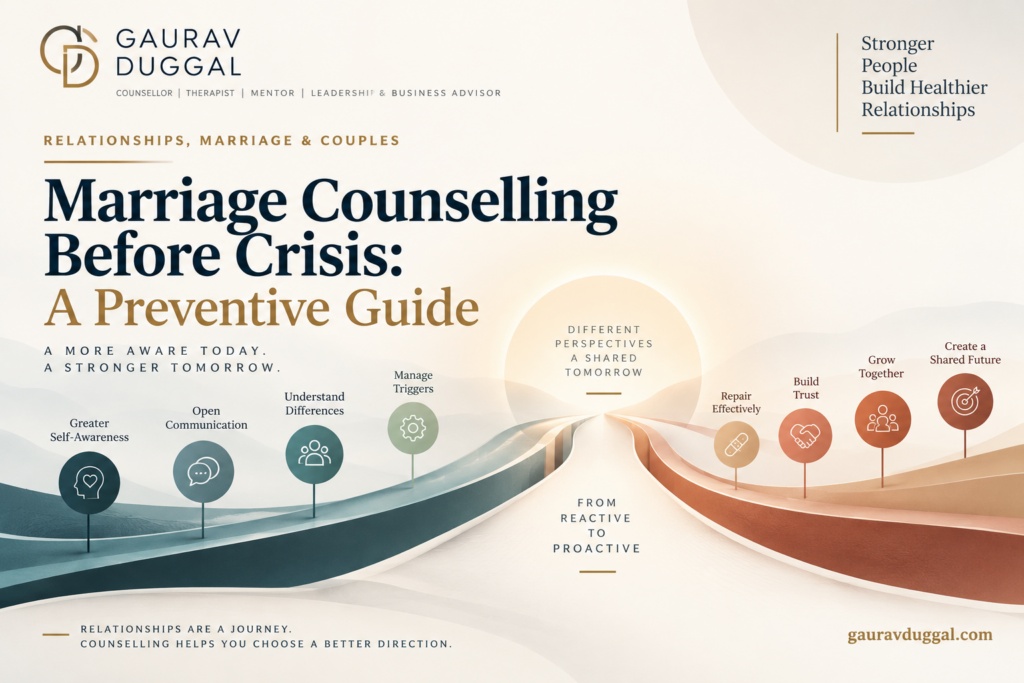
Marriage Counselling Before Crisis: A Preventive Guide
October 14, 2026
Marriage counselling does not have to begin only when a relationship is already in crisis. In many relationships, the more useful time to seek structured support is earlier—when recurring tension, avoidance, communication difficulties or unresolved concerns are beginning to affect everyday connection.
In my work across counselling, family systems, child development, human behaviour and organisational settings, I have found that the most useful starting point is often to understand context before rushing toward a label, judgment or solution.
A preventive approach to marriage counselling asks a practical question: What can we understand and address now, before a manageable pattern becomes a larger relationship crisis?
Understanding Marriage Counselling Before Crisis
Marriage counselling can look different across couples, families and circumstances. Useful support begins by understanding what is actually happening: when a concern occurs, what tends to come before it, what makes it better or worse, what has already been tried, and how much it is affecting everyday functioning.
This matters because the visible disagreement is not always the entire problem. A conflict about time, money, family responsibilities or communication may sit within a repeated pattern of assumptions, unmet expectations, avoidance, defensiveness or difficulty repairing after disagreement.
Looking at the wider context helps a couple move away from simply deciding who is right and toward understanding what keeps the difficulty going.
Why Consider Marriage Counselling Before Things Become Severe?
Couples sometimes postpone support because they believe counselling is appropriate only after trust has broken down or separation is being considered. Preventive work takes a different view.
If a pattern is repeatedly creating strain, it can be worth examining before it becomes deeply established. Early conversations can help couples identify what they are actually disagreeing about, distinguish observations from assumptions, communicate needs more clearly and decide what realistic change would look like.
The objective is not to create a problem where none exists. It is to respond thoughtfully when the same concern continues to return.
Patterns Worth Noticing in a Marriage
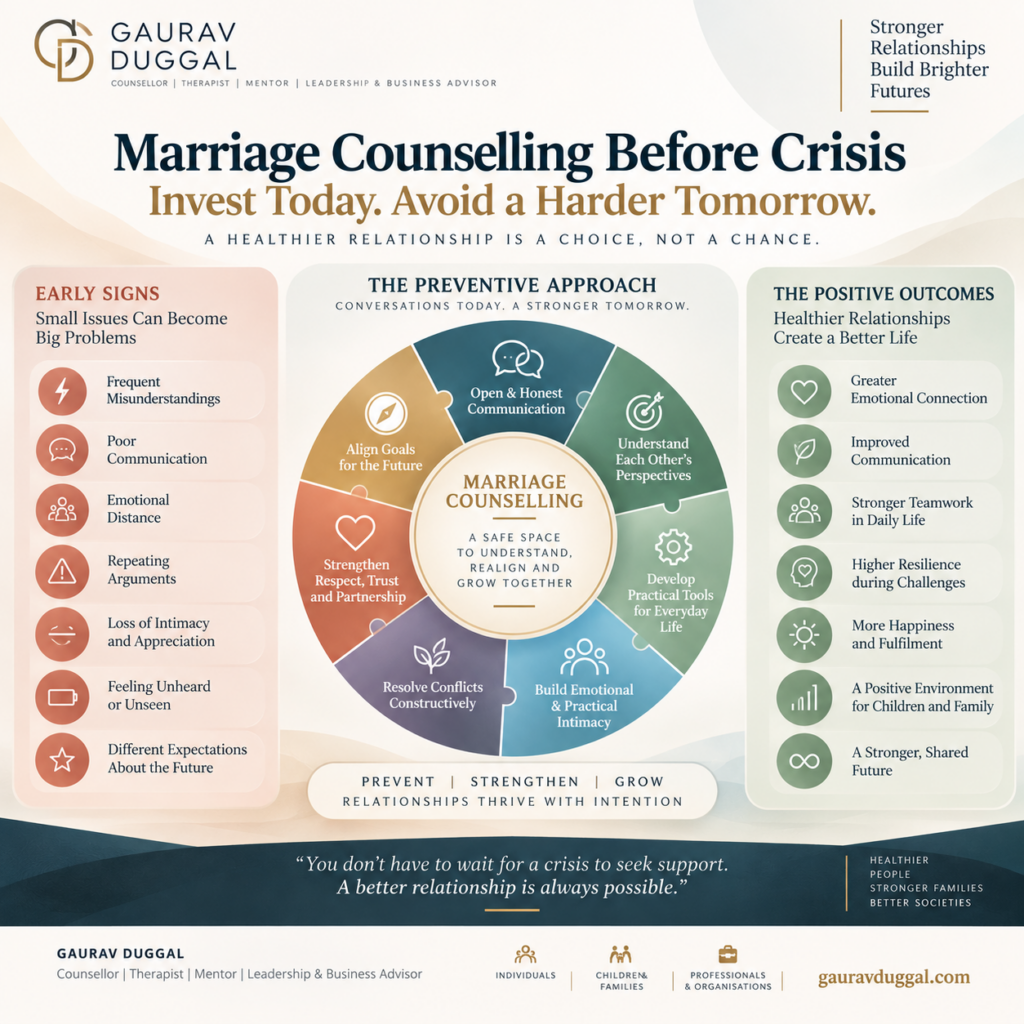
Repeated strain, avoidance, conflict, reduced follow-through, changes in routine, communication difficulty or a growing gap between intention and action may all deserve attention.
These patterns are information, not automatic diagnoses. One difficult week does not define a marriage, and every disagreement does not require counselling. What becomes more relevant is the pattern: its frequency, intensity, context, consequences and whether the couple is able to repair effectively afterward.
For example, a disagreement may appear to be about one partner arriving home late. But if the recurring cycle involves one person feeling disregarded, the other feeling controlled, escalating accusations and then several days of withdrawal, the useful focus is larger than punctuality. The cycle itself deserves attention.
A Practical Framework for Preventive Marriage Counselling
A structured approach can help turn a broad complaint into something a couple can actually work with.
1. Define the concern precisely
Replace broad labels such as “we have communication problems” with a clearer description of what happens. Which conversations become difficult? What is said or avoided? What happens immediately afterward?
2. Look for patterns and context
Consider frequency, triggers, strengths, exceptions and what changes the situation. Couples often discover that the difficulty is not constant; understanding when it improves can be as useful as understanding when it worsens.
3. Separate observation from assumption
There is an important difference between observing that a partner did not respond to a message and concluding that the partner does not care. Clarifying what is known and what has been interpreted can reduce unnecessary escalation.
4. Choose realistic actions and review progress
Trying to change everything at once usually creates frustration. One or two specific changes—followed by a defined review—can make progress easier to observe.
5. Know when another professional perspective is required
Marriage counselling has professional boundaries. Appropriately qualified medical or clinical professionals should be involved where diagnosis, medication, significant mental-health risk, medical concerns or regulated treatment are required. For general information about mental health and wellbeing, couples can also consult the World Health Organization mental health resources.
What Preventive Relationship Work Can Focus On
Preventive marriage counselling may explore communication habits, recurring conflict cycles, expectations, family boundaries, division of responsibilities, trust, emotional availability, decision-making and the ways partners attempt to repair after disagreement.
The emphasis should remain on the couple’s actual circumstances rather than forcing every relationship into a standard formula.
Sometimes the work is not about finding a dramatic root cause. It may involve helping two people slow down enough to understand what each is communicating, identify where meaning is being lost and agree on a more workable response.
Marriage Counselling Is Not About Assigning a Winner
A relationship conversation becomes less useful when counselling is treated as a courtroom in which one partner expects a professional to declare the other person wrong.
Accountability still matters. Harmful behaviour should not be minimised simply to create artificial balance. At the same time, many recurring relationship difficulties are better understood by examining interaction patterns, individual responsibilities and the consequences of each person’s response.
A useful question is often not merely, “Who started this?” but, “What happens between us once this pattern begins, and where can we interrupt it?”
When Structured Support May Help
Structured support may be useful when relationship difficulties begin to affect family functioning, work, sleep, parenting, everyday wellbeing or the ability to communicate without repeated escalation or withdrawal.
It can also be useful earlier—before the concern becomes a crisis.
Couples may consider seeking support when the same argument repeatedly returns without resolution, conversations are increasingly avoided, resentment is accumulating, trust has become difficult to discuss, or both partners
recognize
that their current attempts to solve the problem are not working.
What Progress Can Look Like
Progress does not necessarily mean that a couple never disagrees again. A more realistic measure may be whether disagreements become clearer, shorter, less destructive and easier to repair.
Other signs can include greater ability to state needs directly, less reliance on assumptions, improved follow-through on agreed actions, clearer boundaries and an increased capacity to discuss difficult subjects without immediately entering the old cycle.
Progress should therefore be observable rather than based only on the hope that things feel better.
A Preventive Perspective on Marriage Counselling
The goal is not to chase a perfect explanation for every relationship difficulty. It is to build a clearer understanding, make one useful change at a time and
recognize
when another professional perspective is appropriate.
Seeking support before crisis should not be interpreted as evidence that a marriage has failed. It can simply mean that two people have
recognized
a recurring difficulty and would rather examine it deliberately than wait for the consequences to become harder to manage.
When couples learn to define concerns more precisely, notice patterns, separate observations from assumptions and review realistic changes, counselling becomes less about crisis management and more about informed relationship maintenance.
Considering Marriage Counselling?
If recurring relationship patterns are becoming difficult to resolve independently, a structured consultation can help clarify the concern, understand the context and identify practical next steps.
Scope note: This article is educational and supportive in nature. It is not medical treatment and does not replace assessment or treatment by a psychiatrist, clinical psychologist, physician or other appropriately qualified healthcare professional.
Follow Me for More Insights
Some Thoughts on Life, Growth, and Everything In-Between
Sometimes, all it takes is a little insight or a different perspective to get unstuck. This is my space to share some of my thoughts, provide a bit of guidance, and offer practical tips on mental health, relationships, and personal growth. Think of it as a place to gather some clarity before we even talk.
Expert Counselling, Therapy & Mentoring for Every Stage of Life
Providing a bridge between human understanding, multidisciplinary support and personal or professional growth. Whether you need counselling for emotional wellness and life transitions, therapy for mental health or neurodevelopmental disorders, or mentoring for academic and business success—I offer specialized support tailored to your unique journey. From special education to executive strategy, find the path that is right for you.
Collaborative Network | versatile advisor | Inclusive Care | Online & In-Person Sessions | Serving India & Globally
Not sure where to start?
Book an initial consultation to understand the right support for your situation.
I offer flexible session formats tailored to your schedule and location—providing online (video/audio), hybrid, and in-person sessions across India and internationally. As a tech-savvy and globally accessible practitioner, I work across all time zones and am available for urgent support when your situation requires immediate attention.
Select the format that works best for you and take the first step toward clarity, growth, and emotional wellbeing.
Get in
touch
today
Select a time in my calendar to book your session, or simply call me or send a message - I'll respond promptly, whichever feels easiest for you.
Please fill in the form below
Message Sent!
Thank you for reaching out. I'll get back to you as soon as possible.
Get in touch: Call /
WhatsApp / SMS
Ready to talk? A simple call is the quickest step toward clarity. Your conversation is always 100% confidential and pressure-free.