How Parents Can Help a Child With ADHD: Practical Support and Parenting Strategies
September 11, 2026
Your child is just a simple child who’s active, excited and energetic about everything. Until it all starts with constantly forgetting their books every single morning, no matter how many reminders you give. Maybe getting through a meal without them jumping up is a battle. You go online looking for answers, clicking from one article to the next, and somewhere along the way you land on the word ADHD. For most parents in India, that moment sits somewhere between relief and complete overwhelm.
There is finally a name for what you have been seeing. But now what? That is what this blog is not to replace professional guidance, but to give you something solid to hold onto while you find your footing. You will get a clear look at what ADHD is, what it tends to look like day-to-day, practical things you can start doing at home, and some honest guidance on when it makes sense to bring in support.
What Is ADHD in Children?
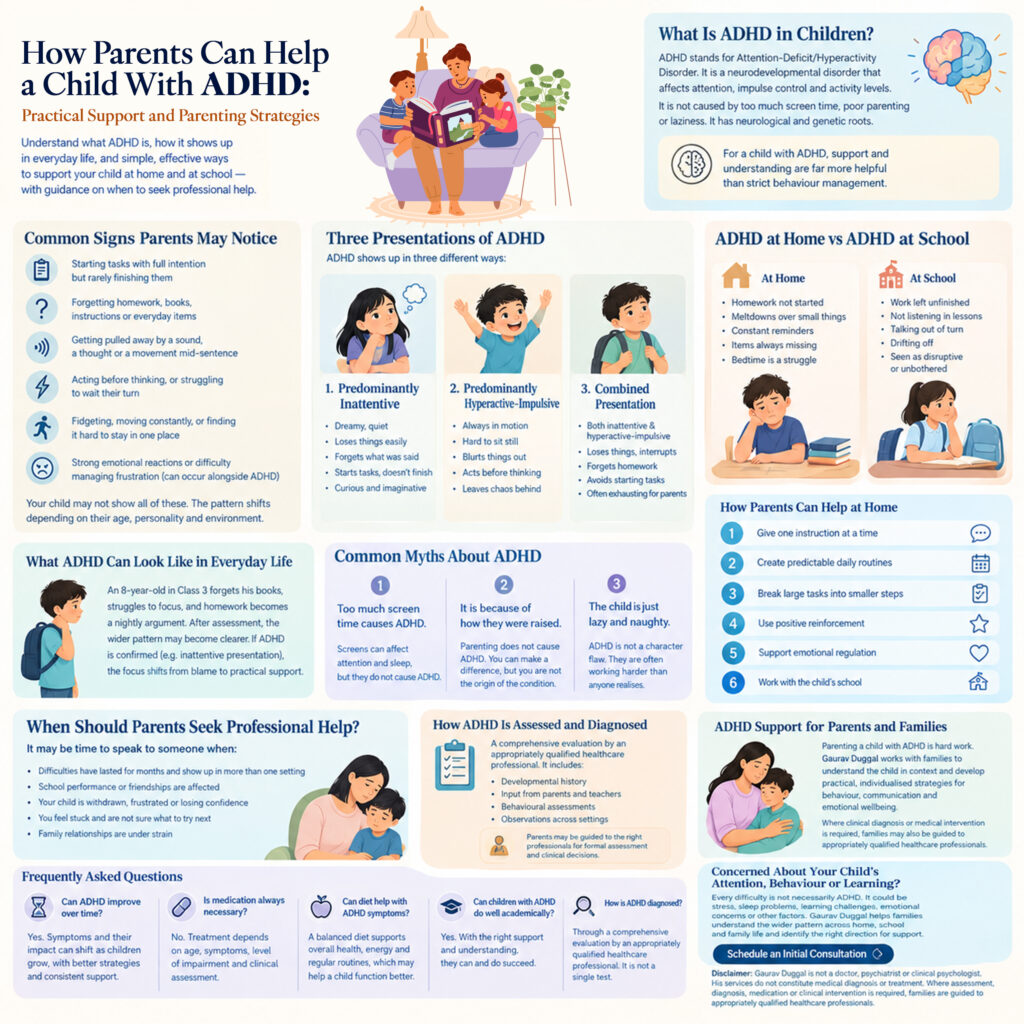
ADHD stands for Attention-Deficit/Hyperactivity Disorder. It is a neurodevelopmental disorder, which means it has to do with how a child’s brain develops and works. Specifically, the parts that handle attention, impulse control and activity levels. It is neither caused by too much screen time nor by how you raised them. It is not laziness, a bad attitude or a phase they will grow out of if you are just firm enough. ADHD has solid neurological and genetic roots for a child who’s struggling with ADHD, managing everyday tasks is really difficult. This condition is mostly linked to differences in brain development and functioning. For a child dealing with this, support is more useful and recommended by experts like Gaurav Duggal than strict behaviour management.
One of the things Gaurav Duggal, a counsellor, hears more often from parents is some version of the same sentence “I kept thinking it was something I was doing wrong.” That is a heavy thing to carry. And it almost always turns out to be untrue. The shift that tends to matter most is when a parent stops asking “why won’t my child just listen?” and starts asking “what does my child need?” That one change in framing opens up a lot.
Common Signs of ADHD Parents May Notice
ADHD does not look the same in every child. Some kids are loud, restless, bouncing off the walls. Others are quiet and seem to live somewhere inside their own heads.
Both can be ADHD. Here are some of the things parents tend to notice
Starting tasks with full intention but rarely finishing them
Forgetting homework, books, instructions or everyday items constantly
Getting pulled away by a sound, a thought or a movement mid-sentence
Acting before thinking, or struggling to wait their turn
Fidgeting, moving constantly, or finding it hard to stay in one place
Strong emotional reactions or difficulty managing frustration, which can occur alongside ADHD but are not unique to it
Your child will not show all of these. The pattern shifts depending on their age, their personality and the setting they are in.
Three Presentations of ADHD
ADHD is not one thing. It shows up in three different ways, and knowing which one fits your child can change how you understand their behaviour and what kind of support helps.
1. Predominantly Inattentive Presentation
This is the one that often goes unnoticed for years. Children with a predominantly inattentive presentation may be less visibly disruptive, which can cause their difficulties to be overlooked.. They are dreamy, quiet, forever losing things, forgetting what was just said, starting tasks they never finish. They can be curious and imaginative and genuinely interested in the world around them. The problem is not that they do not care.
This is the type most people picture when they hear ADHD. These children are in motion almost constantly. Sitting still is hard. Playing quietly is hard. Waiting their turn is hard. They blurt things out, act before they think, and often leave a trail of chaos behind them, not out of bad intent, but because they may have difficulty pausing before acting, managing impulses or regulating their activity..
3. Combined Presentation
This is when both sets of difficulties show up together, which is the most common presentation. The same child might lose their water bottle, interrupt you three times during one sentence, forget what homework was assigned and spend forty minutes avoiding starting it. Parents of children with combined ADHD often describe the experience as exhausting, because just when you think you have figured out the pattern, it changes.
ADHD at Home vs ADHD at School
One of the most confusing things for parents is how differently their child can behave depending on where they are. Some children hold themselves together at school and completely fall apart the moment they walk through the front door. Others manage fine at home but struggle significantly once they are in a structured classroom. At home, you might be seeing homework that never gets started, meltdowns over small things, constant reminders that go nowhere, items that are always missing, bedtime that turns into a whole production every single night.
At school, it tends to show up differently work left unfinished, not listening during lessons, talking out of turn, drifting off, falling behind, and sometimes being written off as disruptive or unbothered, even when the child is genuinely trying.
In his work as a counsellor, therapist and mentor, Gaurav Duggal looks at both home and school experiences together when helping families understand a child’s difficulties.
What ADHD Can Look Like in Everyday Life
Consider a hypothetical example of an eight-year-old child in Class 3. His parents are at their wit’s end. He forgets his books almost every day. Homework is a nightly argument. His teacher reports that he struggles to remain seated and focus during lessons. His parents have tried several approaches and have started wondering whether he is doing it intentionally. They reduce distractions, use a reward chart, and sit with him during homework. Nothing seems to stick. These difficulties alone do not mean he has ADHD. After a thorough assessment by an appropriately qualified healthcare professional, however, the wider pattern may become clearer. If the assessment confirms ADHD, predominantly inattentive presentation, the focus can shift from blame to practical support.
Common Myths About ADHD
There is still a lot of misinformation floating around about ADHD, especially in India where awareness is catching up. Here are three myths worth putting to rest.
Myth 1: Too much screen time causes ADHD
Screens can affect attention and sleep, yes. But they do not cause ADHD. The condition has deep neurological and genetic roots that have nothing to do with how many hours your child spends on a tablet.
Myth 2: It is because of how they were raised
Parenting does not cause ADHD. Your approach as a parent can make a real difference to how well your child copes, but you are not the origin of the condition. Parents who spend years blaming themselves are often parents who would be far better served by getting practical support instead.
Myth 3: The child is just lazy and naughty
This one does the most damage. ADHD is not a character flaw. Children with ADHD are often working harder than anyone around them realises. What looks like laziness or defiance from the outside is frequently exhaustion from the inside.
How Parents Can Help a Child With ADHD at Home
There is no one approach that works for every child. Every family’s situation is different. But the six strategies below are the kind of practical, day-to-day guidance that forms part of Gaurav Duggal’s work aligns with families managing ADHD at home things that make a difference when applied with patience and some consistency.
Give One Instruction at a Time
“Go wash your hands, put your bag away, change your uniform and come for lunch.” That is four things, delivered in one go.
For a child with ADHD, working memory is often a weak spot. By the time you finish the sentence, they may genuinely have lost the beginning of it. One instruction. Wait. Then the next one. It feels slow at first.
Create Predictable Daily Routines
Children with ADHD often find transitions and unstructured time genuinely hard to manage. Not knowing what comes next can tip a child into anxiety quickly.
A predictable routine, same wake time, meals at regular hours, a fixed homework window, a consistent bedtime, removes a lot of that daily friction.
Break Large Tasks Into Smaller Steps
“Do your homework” is not an instruction for a child with ADHD. It is a wall. There is no clear entry point, no visible end, and no way to feel any sense of progress.
Break it into pieces. “Open your maths book. Do the first two questions. Then take a break.” Each small step that gets done is a win. Small wins build actual momentum.
Use Positive Reinforcement
Children with ADHD hear a disproportionate amount of correction throughout their day. At home, at school, sometimes everywhere they go. Over time, they start to believe the story that keeps being told about them that they are the problem.
When you notice what they did right and name it specifically, that changes. “You stayed at the table for the whole meal, I noticed that.” “You packed your bag yourself today, that is a big thing.” Specific praise lands differently from general encouragement.
Support Emotional Regulation
Difficulty managing emotions can occur alongside ADHD, although emotional dysregulation is not a defining diagnostic symptom. Some children may become frustrated quickly or have strong reactions, which can be difficult for families to manage. The most useful thing you can do in those moments is stay calm yourself.
Matching their intensity makes it worse. A steady voice and waiting for the storm to pass before you try to problem-solve together, that work much better. Over time, with consistent practice, children can start to build their own coping strategies, naming what they feel, stepping away, breathing through it.
Work With the Child’s School
Support can be more useful when home and school are working in the same direction. If school is a daily struggle, parents can speak with the teacher, share relevant context, and discuss whether reasonable classroom adjustments may help, depending on the child’s needs and the school’s support framework. Examples may include seating closer to the teacher, brief check-ins, or additional time for written work where appropriate. When a teacher understands the child’s difficulties, they can become an important part of the support system rather than another source of pressure.
When Should Parents Seek Professional Help?
There is a lot of general information available, and some of it is genuinely useful. But at some point, what you are dealing with is not a general situation. It is your specific child, your specific family, and a specific set of difficulties that may need more than an article can offer.
It may be time to speak to someone when
● The difficulties have been going on for months and show up in more than one setting
● School performance or friendships are being affected
● Your child is becoming withdrawn, frustrated or losing confidence in themselves
● You feel stuck and are not sure what to try next
● Family relationships are under real strain because of your child’s behaviour
How ADHD Is Assessed and Diagnosed
ADHD diagnosis is not a quick checklist. It requires a comprehensive evaluation by an appropriately qualified healthcare professional. That typically includes a detailed look at the child’s developmental history, input from both parents and teachers, behavioural assessments and observations across different settings. Parents working with Gaurav Duggal are often guided to connect with appropriately qualified healthcare professionals for formal assessment and clinical decisions. His role is to support the family in understanding what is happening, building practical strategies and navigating the process, not to diagnose.
ADHD Support for Parents and Families
Parenting a child with ADHD is genuinely hard work. It is tiring in ways that are difficult to explain to people who have not lived it. And yet most of the focus tends to land on the child. ADHD support for parents matters too, because you cannot keep showing up the way your child needs if you are running on empty. Gaurav Duggal is one of the professionals with extensive experience working across child development, special education, human behaviour and family systems.
His work with parents focuses on understanding the child in context, at home, at school and within the family, and developing practical, individualised strategies for everyday functioning, behaviour, communication and emotional wellbeing. Where clinical diagnosis or medical intervention is required, parents may also be guided to coordinate with appropriately qualified healthcare professionals.
When should I seek professional help for my child’s attention or behaviour concerns?
If the difficulties have been going on for several months, are showing up in more than one place and are affecting your child’s learning, friendships or sense of self, it is worth speaking to someone.
Concerned About Your Child’s Attention, Behaviour or Learning?
Every difficulty with attention, behaviour, or school performance is not necessarily ADHD. Similar difficulties can be linked to stress, sleep problems, learning challenges, emotional concerns, or other factors. Understanding what is happening, and why, is an important first step.
Gaurav Duggal, as a Counsellor, therapist and mentor, works with children, parents and families to understand concerns across home, school, behaviour, learning and family dynamics, and to develop an individualised direction for support.
If you are concerned about your child’s attention, behaviour, learning or everyday functioning, you may schedule an initial consultation with Gaurav Duggal to understand the wider pattern across home, school and family life and identify an appropriate direction for support.Disclaimer: Gaurav Duggal is not a doctor, psychiatrist or clinical psychologist. His services do not constitute medical diagnosis or medical treatment. Where assessment, diagnosis, medication or clinical intervention is required, families are guided to appropriately qualified healthcare professionals
Frequently Asked Questions
Can ADHD improve over time?
It can. ADHD symptoms and their impact do shift as children grow, and for many, certain things become easier to manage with age, better strategies and consistent support.
Is medication always necessary for managing ADHD?
No. Medication is not automatically required for every child. Treatment decisions depend on the child’s age, symptoms, level of impairment, overall needs, and clinical assessment.
Can diet help with ADHD symptoms?
A balanced diet supports overall health, energy, and regular routines, which may help a child function better day-to-day.
Can children with ADHD do well academically?
Yes, many do. With the right support and the right understanding from the adults around them, children with ADHD can and do succeed at school.
How is ADHD diagnosed?
Through a comprehensive evaluation by an appropriately qualified healthcare professional. It is not a single test.
Follow Me for More Insights
Some Thoughts on Life, Growth, and Everything In-Between
Sometimes, all it takes is a little insight or a different perspective to get unstuck. This is my space to share some of my thoughts, provide a bit of guidance, and offer practical tips on mental health, relationships, and personal growth. Think of it as a place to gather some clarity before we even talk.
Expert Counselling, Therapy & Mentoring for Every Stage of Life
Providing a bridge between human understanding, multidisciplinary support and personal or professional growth. Whether you need counselling for emotional wellness and life transitions, therapy for mental health or neurodevelopmental disorders, or mentoring for academic and business success—I offer specialized support tailored to your unique journey. From special education to executive strategy, find the path that is right for you.
Collaborative Network | versatile advisor | Inclusive Care | Online & In-Person Sessions | Serving India & Globally
Not sure where to start?
Book an initial consultation to understand the right support for your situation.
I offer flexible session formats tailored to your schedule and location—providing online (video/audio), hybrid, and in-person sessions across India and internationally. As a tech-savvy and globally accessible practitioner, I work across all time zones and am available for urgent support when your situation requires immediate attention.
Select the format that works best for you and take the first step toward clarity, growth, and emotional wellbeing.
Get in
touch
today
Select a time in my calendar to book your session, or simply call me or send a message - I'll respond promptly, whichever feels easiest for you.
Please fill in the form below
Message Sent!
Thank you for reaching out. I'll get back to you as soon as possible.
Get in touch: Call /
WhatsApp / SMS
Ready to talk? A simple call is the quickest step toward clarity. Your conversation is always 100% confidential and pressure-free.