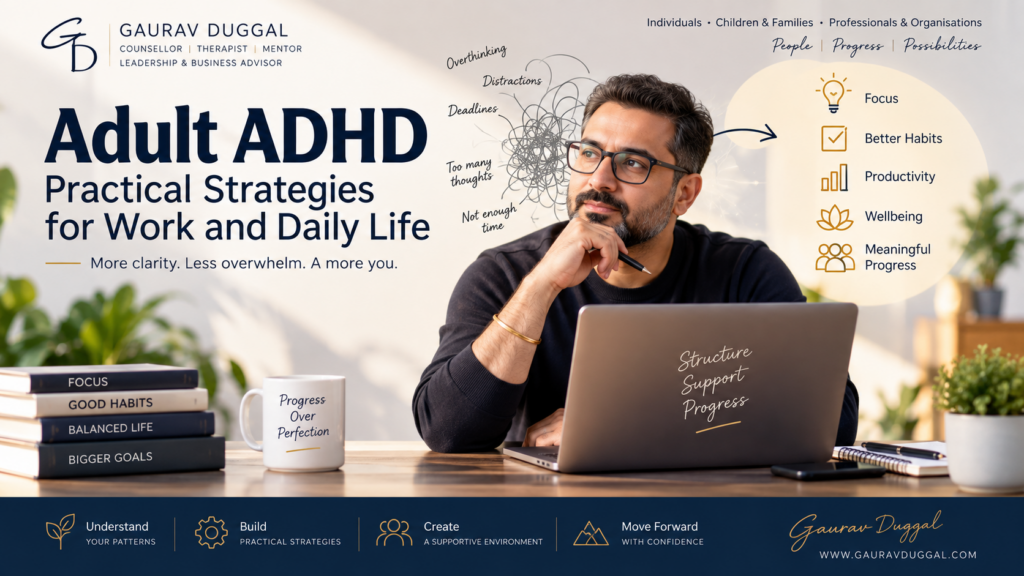
Adult ADHD strategies can help make everyday demands at work and home more visible and manageable. Adult ADHD can affect far more than concentration. For some adults, the everyday challenge is starting a task, deciding what deserves attention first, estimating how long something will take, remembering what needs to happen next, shifting between activities, or completing something that was started with genuine intention.
From my work across special education, child development, counselling, human behaviour, family systems and organisational settings, I have learned that it is often more useful to understand how a person functions within their environment than to reduce every difficulty to motivation, discipline or willpower.
This is where practical adult ADHD strategies can help. They do not replace professional assessment or treatment. Their purpose is to make everyday demands more visible, manageable and structured.
Adult ADHD Strategies for Everyday Challenges
ADHD does not look identical in every adult. Difficulties involving attention, organization, time management, task completion, restlessness or impulsivity can affect work, relationships and daily responsibilities in different ways.
One person may repeatedly miss deadlines despite working hard. Another may begin several projects but struggle to complete them. Someone else may function well in highly stimulating situations yet find routine administrative work unusually difficult.
The important question is not simply, “Why can’t I concentrate?” A better starting point may be: What is happening, when does it happen, what makes it harder, and what helps me function better?
That shift—from judgment to observation—can itself be useful.
Adult ADHD Strategies Start With Understanding the Pattern
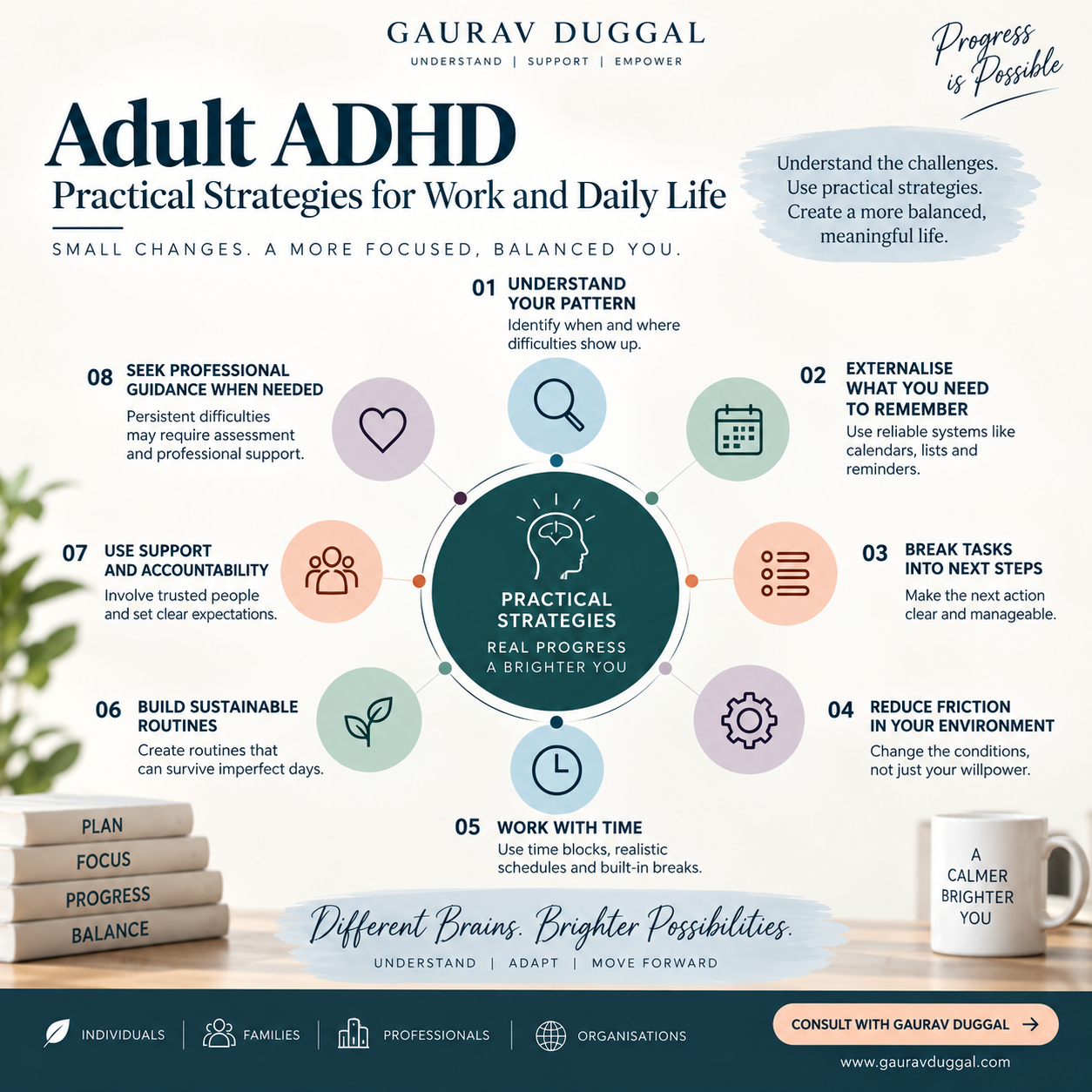
Before trying another productivity system, identify the actual point where things begin to break down.
remembering the task?
getting started?
deciding what comes first?
estimating time?
remaining engaged?
managing interruptions?
returning after an interruption?
completing the final 10%?
keeping track of several responsibilities simultaneously?
“Be more organized” is too broad to act upon. “Every morning I spend 30 minutes deciding what to start” gives us something concrete to work with.
1. Externalize What You Need to Remember
Trying to keep every appointment, deadline, idea and responsibility mentally available creates unnecessary cognitive load.
Use external systems deliberately: calendars, reminders, written lists, visual schedules or one consistent digital task system. The objective is not to create more tools. It is to reduce the amount of information that must continuously be remembered.
If five different systems are competing for attention, simplify. A reliable system that is actually used is more valuable than a sophisticated system that is repeatedly abandoned.
2. Break Large Tasks Into Visible Next Steps
“Complete the presentation” may feel like one task, but it contains many smaller actions.
A more workable sequence could be: Open presentation → review brief → create headings → draft three slides → find supporting material → revise → submit.
Smaller actions reduce ambiguity. This principle can apply beyond work. Instead of “organize the house,” identify one drawer, one shelf or one 15-minute activity.
The aim is not to make life artificially simple. It is to make the next action visible enough to begin.
3. Reduce Friction Before Asking for More Willpower
People often try to solve recurring difficulties by demanding greater discipline from themselves. Sometimes changing the environment is more effective.
If your phone repeatedly interrupts concentrated work, move it away rather than spending an hour resisting it. If important documents are frequently misplaced, create one consistent location. If mornings repeatedly become chaotic, prepare essential items the previous evening.
This is a principle I frequently return to in my work: change the conditions surrounding a behaviour where possible instead of relying exclusively on repeated self-control.
4. Work With Time, Not Just To-Do Lists
A long task list tells you what needs doing. It does not necessarily tell you when it will happen.
Assign important activities to realistic periods of time. For example: 10:00–10:25 — respond to priority emails; 10:30–11:15 — proposal draft; 11:15–11:25 — break and reset.
Timers, calendar blocks and visible deadlines can make otherwise abstract time more concrete. But avoid filling every minute. A schedule that allows no interruptions, transitions or recovery time is unlikely to survive an ordinary working day.
5. Build Routines That Can Survive Imperfect Days
An effective routine should not collapse because one morning went badly. Instead of designing the perfect routine, establish a few dependable anchors.
a consistent place for essential items;
a short morning planning routine;
one system for appointments;
a defined work-start ritual;
a brief end-of-day review.
Consistency matters more than complexity. When the system fails, review why it failed rather than immediately concluding that you lack discipline.
6. Use Support and Accountability Purposefully
Some adults function better when expectations are visible to another person. That could involve a colleague, partner, mentor, counselor or another appropriate professional.
Useful accountability is not surveillance. It may simply mean agreeing: What am I doing? By when? How will we know it is complete? When will we review it?
At work, appropriate communication and reasonable organisational support can sometimes prevent repeated misunderstandings about priorities, deadlines and expectations.
Within families and relationships, it can also help to distinguish between unwillingness and genuine difficulty with organization, attention or follow-through—without using ADHD as an explanation for every behaviour.
When Practical Strategies Are Not Enough
Difficulty concentrating or organizing does not automatically mean that someone has ADHD. For a clinical overview of how ADHD may present in adulthood, see the CDC guidance on ADHD in adults.
Sleep problems, stress, anxiety, depression, substance use, medical conditions and other factors can sometimes produce overlapping difficulties. ADHD assessment therefore requires an appropriately qualified professional and consideration of a person’s broader history and functioning.
If difficulties are persistent, significantly affecting everyday life, or raising concerns involving mental health, medication, substance use or safety, practical strategies alone should not substitute for professional assessment.
Diagnosis, medication and regulated clinical treatment belong with appropriately qualified healthcare professionals.
A Practical Perspective
The goal is not to create a perfectly organized person. It is to understand where functioning repeatedly becomes difficult and then build practical supports around those points.
Start small. Identify one recurring difficulty. Observe when it happens. Change one part of the environment or routine. Define what improvement would actually look like. Then review the result.
That process is often more useful than attempting to transform an entire life through one new productivity system.
For individuals and families looking for structured counselling, mentoring or practical support around everyday functioning, consult with Gaurav Duggal.
Scope Note
This article is educational and supportive in nature. It is not medical treatment and does not replace diagnosis, assessment or treatment by a psychiatrist, clinical psychologist, physician or other appropriately qualified healthcare professional.
Follow Me for More Insights
Some Thoughts on Life, Growth, and Everything In-Between
Sometimes, all it takes is a little insight or a different perspective to get unstuck. This is my space to share some of my thoughts, provide a bit of guidance, and offer practical tips on mental health, relationships, and personal growth. Think of it as a place to gather some clarity before we even talk.
Expert Counselling, Therapy & Mentoring for Every Stage of Life
Providing a bridge between human understanding, multidisciplinary support and personal or professional growth. Whether you need counselling for emotional wellness and life transitions, therapy for mental health or neurodevelopmental disorders, or mentoring for academic and business success—I offer specialized support tailored to your unique journey. From special education to executive strategy, find the path that is right for you.
Collaborative Network | versatile advisor | Inclusive Care | Online & In-Person Sessions | Serving India & Globally
Not sure where to start?
Book an initial consultation to understand the right support for your situation.
I offer flexible session formats tailored to your schedule and location—providing online (video/audio), hybrid, and in-person sessions across India and internationally. As a tech-savvy and globally accessible practitioner, I work across all time zones and am available for urgent support when your situation requires immediate attention.
Select the format that works best for you and take the first step toward clarity, growth, and emotional wellbeing.
Get in
touch
today
Select a time in my calendar to book your session, or simply call me or send a message - I'll respond promptly, whichever feels easiest for you.
Please fill in the form below
Message Sent!
Thank you for reaching out. I'll get back to you as soon as possible.
Get in touch: Call /
WhatsApp / SMS
Ready to talk? A simple call is the quickest step toward clarity. Your conversation is always 100% confidential and pressure-free.