Workplace Stress Versus Burnout: 7 Warning Signs You Should Know
October 21, 2026
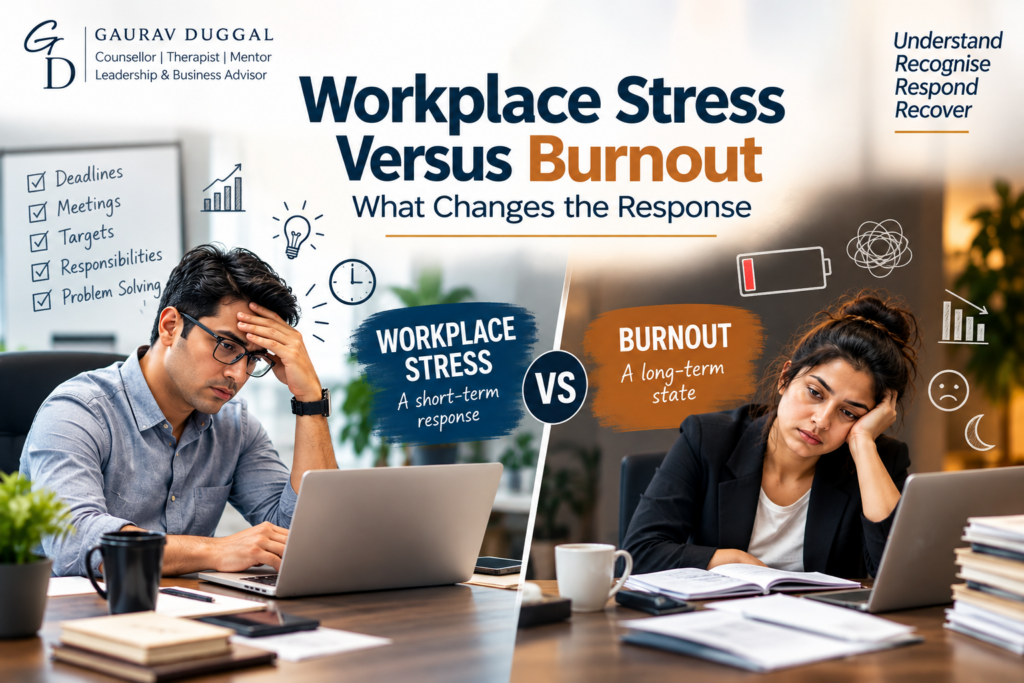
Workplace stress and burnout are often used as if they mean the same thing. They can overlap, but the distinction matters because the response to a demanding week is not necessarily the same as the response to months of exhaustion, detachment and declining effectiveness.
The purpose of noticing the difference is not to diagnose yourself from a checklist. It is to understand patterns, context, duration and impact so that the next step becomes more appropriate.
Workplace Stress Versus Burnout: Start With the Pattern
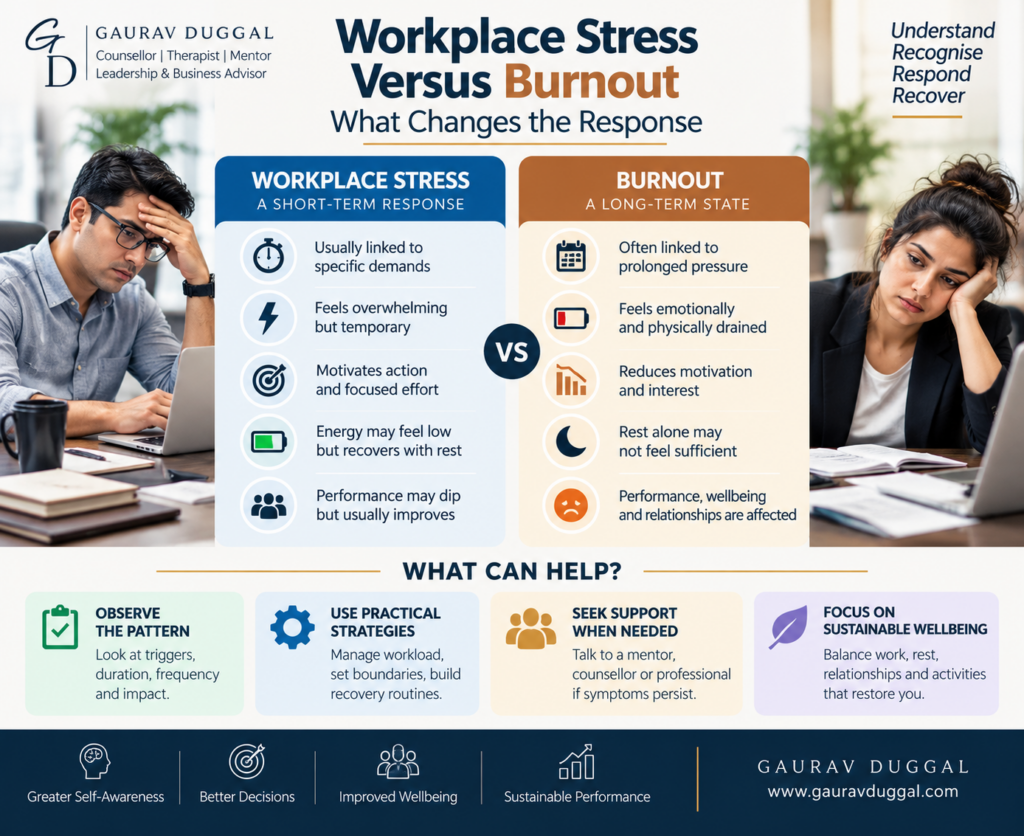
Stress often rises when demands feel greater than the resources available to meet them. A deadline, conflict, new responsibility or temporary workload can create tension and fatigue. When the pressure reduces, recovery may follow.
Burnout is commonly discussed as a work-related pattern involving exhaustion, increased mental distance or cynicism toward work, and reduced professional efficacy. The World Health Organization describes burnout as an occupational phenomenon rather than a medical condition. That distinction is important: similar symptoms can also occur with physical or mental health conditions that require qualified assessment.
Pattern 1: Does Recovery Still Happen?
Ask what happens after genuine rest. If a difficult week improves after sleep, time away, support and reduced pressure, the pattern may be more consistent with temporary stress. If exhaustion and detachment persist despite reasonable opportunities to recover, the situation deserves closer attention.
Pattern 2: Is the Pressure Temporary or Chronic?
A short project surge is different from an environment in which overload has become normal. Look at the previous several weeks or months. Are demands repeatedly exceeding time, staffing, clarity or control? Chronic conditions require structural responses, not only better personal coping.
Pattern 3: What Is Happening to Your Relationship With Work?
Stress can make people feel hurried and worried while they remain engaged with the work itself. Burnout may involve increasing emotional distance, irritability, cynicism or a sense that effort no longer matters. Observe the change rather than applying a label too quickly.
Pattern 4: Is Effectiveness Changing?
Notice concentration, decision-making, follow-through, mistakes and the ability to complete ordinary tasks. A decline may indicate that the current demands are no longer sustainable. It can also have many other causes, so significant or persistent changes deserve appropriate professional assessment.
Pattern 5: Is Work the Only Context?
Burnout is specifically associated with the occupational context. If low mood, exhaustion, sleep disturbance, loss of interest or other symptoms extend broadly across life, do not assume that work is the only explanation. Medical or mental-health assessment may be appropriate.
A Five-Step Response Framework
When Workplace Stress Versus Burnout Requires Closer Attention
1. Map the demands
Write down what is actually creating pressure: volume, deadlines, role ambiguity, interpersonal conflict, lack of control, values conflict, constant availability or insufficient resources.
2. Map the impact
Look at sleep, concentration, mood, physical energy, relationships, work quality and recovery. Patterns are more informative than a single bad day.
3. Identify what can change
Separate individual actions from organisational actions. Personal routines may help, but staffing, priorities, role clarity and workload often require management decisions.
4. Make one concrete adjustment
Examples include clarifying priorities, renegotiating a deadline, protecting a recovery period, reducing unnecessary availability or discussing workload with the appropriate manager.
5. Review the response
Set a reasonable review point. If nothing changes despite genuine adjustments, the next response may need to be stronger rather than simply repeating the same coping strategy.
Why “Just Be More Resilient” Can Miss the Point
Resilience can be valuable, but it should not become a way of asking individuals to absorb permanently unhealthy conditions. If the system repeatedly creates overload, unclear expectations or lack of recovery, organisational changes may be necessary.
What Leaders Can Observe
Leaders should pay attention to patterns such as sustained overload, withdrawal, rising errors, conflict, absenteeism, presenteeism and reduced participation. The objective is not to diagnose employees. It is to create conditions in which concerns can be discussed early and practical changes can be considered.
Workplace Stress Versus Burnout: When Structured Support May Help
Consider professional support when work-related strain is persistent, affecting relationships or functioning, or difficult to change despite reasonable efforts. Counselling or mentoring may help with boundaries, communication, decision-making and recurring behavioural patterns.
Recognising workplace stress versus burnout requires looking at duration, recovery, emotional impact and changes in everyday functioning.Seek appropriately qualified medical or clinical support when there are significant symptoms, safety concerns, severe sleep disruption, persistent low mood, panic, substance-related concerns, or when diagnosis, medication or regulated treatment may be required.
Frequently Asked Questions
Is burnout a medical diagnosis?
The World Health Organization classifies burnout in ICD-11 as an occupational phenomenon, not a medical condition. Individual symptoms may still require medical or mental-health assessment.
Can a holiday fix burnout?
Time away may provide temporary relief, but if the underlying work conditions remain unchanged, the same pattern may return. Recovery and structural changes may both matter.
Can stress be useful?
Some short-term pressure can increase focus or mobilisation. The concern is when demands become excessive, chronic or begin to impair recovery and functioning.
Should I resign if I feel burned out?
That decision depends on your circumstances. Before making a major decision, it can help to clarify the causes, what can realistically change, financial and personal considerations, and whether health support is needed.
When Workplace Stress Versus Burnout Requires Closer Attention.
Choose the Response That Matches the Pattern
The most useful question is not simply “Am I stressed or burned out?” Ask what has been happening, for how long, what changes with rest, what conditions are driving it and what level of response is now required.
Educational guidance only. This article is not medical treatment, diagnosis, psychiatric care or clinical psychology services. Where diagnosis, medication, risk assessment or regulated treatment is required, consult an appropriately qualified professional.
Understanding workplace stress versus burnout can help you choose a response that matches the duration, intensity and impact of what you are experiencing.
Follow Me for More Insights
Some Thoughts on Life, Growth, and Everything In-Between
Sometimes, all it takes is a little insight or a different perspective to get unstuck. This is my space to share some of my thoughts, provide a bit of guidance, and offer practical tips on mental health, relationships, and personal growth. Think of it as a place to gather some clarity before we even talk.
Expert Counselling, Therapy & Mentoring for Every Stage of Life
Providing a bridge between human understanding, multidisciplinary support and personal or professional growth. Whether you need counselling for emotional wellness and life transitions, therapy for mental health or neurodevelopmental disorders, or mentoring for academic and business success—I offer specialized support tailored to your unique journey. From special education to executive strategy, find the path that is right for you.
Collaborative Network | versatile advisor | Inclusive Care | Online & In-Person Sessions | Serving India & Globally
Not sure where to start?
Book an initial consultation to understand the right support for your situation.
I offer flexible session formats tailored to your schedule and location—providing online (video/audio), hybrid, and in-person sessions across India and internationally. As a tech-savvy and globally accessible practitioner, I work across all time zones and am available for urgent support when your situation requires immediate attention.
Select the format that works best for you and take the first step toward clarity, growth, and emotional wellbeing.
Get in
touch
today
Select a time in my calendar to book your session, or simply call me or send a message - I'll respond promptly, whichever feels easiest for you.
Please fill in the form below
Message Sent!
Thank you for reaching out. I'll get back to you as soon as possible.
Get in touch: Call /
WhatsApp / SMS
Ready to talk? A simple call is the quickest step toward clarity. Your conversation is always 100% confidential and pressure-free.