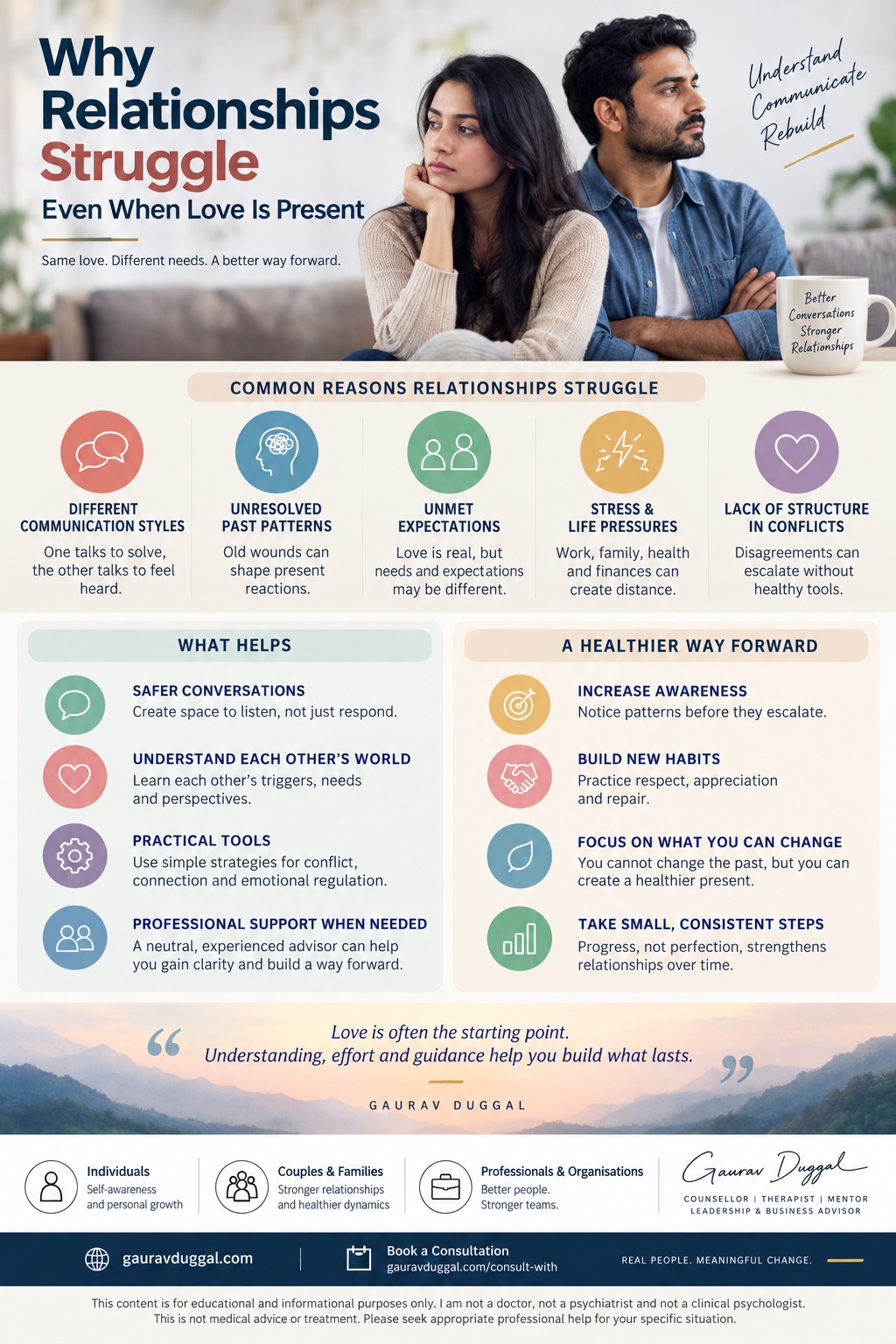
Understanding why relationships struggle even when love is present requires looking beyond whether two people care for each other. In my work with individuals, couples and families, I often see that the problem is not simply whether two people care for each other. The difficulty is how that care is expressed, understood and sustained when expectations, stress, communication styles and emotional needs differ.
A relationship can therefore contain genuine affection alongside repeated conflict. Understanding that distinction can move a couple away from the question, do we still love each other?’ and toward a more useful question: what happens between us when life becomes difficult?’
Why Relationships Struggle Despite Genuine Love
Love is an emotion and a bond. A workable relationship also requires skills: listening, communicating clearly, repairing after conflict, respecting boundaries, sharing responsibility and responding to change. People may care deeply for one another while struggling with one or more of these areas.
This is why repeated disagreement should not automatically be interpreted as absence of love. At the same time, love should not be used to excuse patterns that repeatedly cause harm, disrespect or fear.
Why Good Intentions Can Still Lead to Conflict
Two people can enter the same conversation with good intentions and leave feeling misunderstood. One may want immediate discussion while the other needs time before responding. One may interpret frequent contact as care, while the other experiences it as pressure. Expectations around family, money, work, intimacy, privacy and social life can also differ significantly.
Over time, couples can stop responding only to the present issue. They begin reacting to the history attached to it. A small disagreement may then carry the emotional weight of many earlier disappointments.
One reason why relationships struggle is that affection alone cannot resolve differences in communication, expectations, emotional needs and conflict patterns.
The Pattern Often Matters More Than the Topic
Couples may believe they are repeatedly fighting about time, relatives, messages, household responsibilities or finances. However, the recurring pattern underneath can be more important than the surface topic.
For example, one partner raises a concern, the other becomes defensive, the first partner increases the intensity, and the second withdraws. Both then feel unheard. Unless the interaction pattern changes, a different topic can produce the same conflict.
Stress Changes How Partners Relate
Relationships do not operate separately from the rest of life. Career pressure, parenting, care giving, financial uncertainty, relocation, health concerns and extended-family expectations can reduce emotional capacity. A person who is already overwhelmed may have less patience, flexibility or energy for difficult conversations.
Recognizing context does not remove personal responsibility. It does, however, help a couple understand why a previously manageable difference may suddenly feel much harder.
Repair Matters More Than Never Disagreeing
A healthy relationship is not necessarily conflict-free. What matters is whether both people can return to the conversation, acknowledge impact, clarify misunderstandings and make practical changes. Repair may include an apology, but meaningful repair also requires different behaviour when the same situation arises again.
Couples can begin by slowing the cycle down. Instead of proving who is right, each person can identify what they experienced, what they needed and what they can do differently next time.
When Relationship Support Can Help
Relationship counselling or structured relationship support can be useful when the same conflicts repeat despite sincere attempts to resolve them. The purpose is not to decide which partner is the problem. It is to understand the interaction, clarify expectations and develop more workable ways of communicating and responding.
Sometimes individual work is also important. Personal history, stress responses, family experiences and learned relationship patterns can influence how someone reacts within a partnership.
A More Useful Question for Couples
Instead of asking only whether love remains, ask whether the relationship currently has the communication, respect, boundaries, responsibility and repair needed for that love to function well.
Love can be an important foundation. Yet relationships are also built through repeated everyday actions. When couples learn to understand the pattern rather than merely fight over the latest incident, change becomes more practical and measurable.
If you would like structured support for a relationship or family concern, you can learn more about my approach and consult with me. For additional evidence-informed relationship education, the American Psychological Association also provides resources on relationships and family well being.
Professional note: My work is counselling, therapy, mentoring and advisory support. I am not a doctor, psychiatrist or clinical psychologist, and this article is educational information rather than medical treatment or diagnosis.