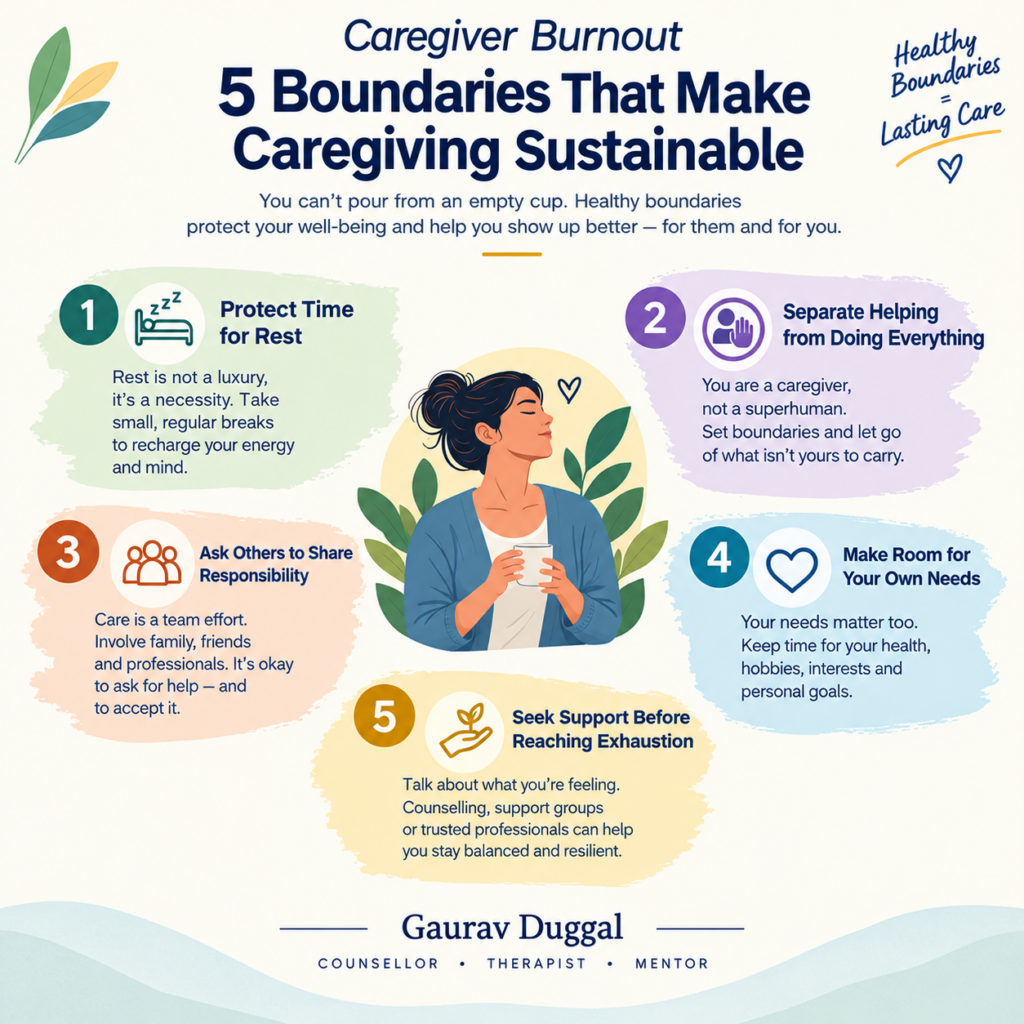
Caregiver Burnout: 5 Powerful Boundaries That Bring Relief
September 19, 2026
Caregiver burnout can build slowly. It may begin with tiredness, irritability or the feeling that there is never enough time. When care for another person becomes constant, your own needs can quietly move to the bottom of the list.
In my work across counselling, family systems and human behaviour, I often see a difficult tension: people want to care well, yet they may feel guilty when they need rest, privacy or help. Healthy boundaries are not a withdrawal of care. They can make care more sustainable.
What Is Caregiver Burnout?
Caregiver burnout is a state of physical, emotional and mental exhaustion linked with ongoing caring demands. It can affect family caregivers, parents, spouses, adult children and others who regularly support someone with significant needs.
Burnout does not mean that you do not care. Often, it develops because responsibility has continued for too long without enough recovery, shared support or realistic limits.
Common Signs of Caregiver Burnout
Signs vary from person to person. You may notice ongoing fatigue, reduced patience, poor sleep, difficulty concentrating or less interest in things you once enjoyed. Some caregivers also begin to feel isolated, resentful or constantly worried.
One difficult day does not define burnout. Look instead for patterns: how often the strain appears, how long it lasts, what triggers it and whether rest actually restores you.
Why Boundaries Can Feel Like Guilt
Caregiving often carries strong beliefs about duty, love and responsibility. In families, these expectations may also be shaped by culture, relationships and practical realities. Saying no can therefore feel selfish even when the request is unreasonable or the caregiver is exhausted.
A useful question is not simply, “Am I doing enough?” Ask instead, “What level of care can I provide consistently without damaging my own functioning?” This shifts the focus from guilt to sustainability.
5 Practical Boundaries for Caregiver Burnout
1. Define the real concern
Avoid broad labels such as “I cannot cope.” Identify what is actually difficult. Is it interrupted sleep, constant phone calls, physical care, financial pressure or being the only person available? A precise problem is easier to address.
2. Look for patterns
Notice context, frequency and triggers. Also notice what improves the situation. A difficult evening may need a different solution from months of continuous exhaustion.
3. Separate observation from assumption
You may think, “If I ask for help, my family will think I am failing.” That is an interpretation, not necessarily a fact. Ask what evidence supports it and whether another explanation is possible.
4. Choose one realistic action
Large changes can feel impossible when you are already tired. Start with one or two actions. You might protect one uninterrupted hour, share one recurring task or ask another family member to cover a specific responsibility.
5. Know when the issue needs professional support
Some concerns go beyond everyday self-management. If there are questions about diagnosis, medication, significant health changes, safety or regulated treatment, involve appropriately qualified medical or clinical professionals.
How to Set Boundaries Without Abandoning Care
A boundary works best when it is clear and practical. Instead of saying, “I need more space,” define what that means. You might say that you are unavailable for non-urgent calls after a certain time or that another person needs to manage one weekly appointment.
Boundaries may need repetition. Other people may need time to adjust, especially if you have previously taken responsibility for almost everything. Consistency matters more than a long explanation.
Caregiver Burnout and Family Systems
Caregiving rarely happens in isolation. When one person changes a routine, the wider family system may react. This does not automatically mean the boundary is wrong. It may simply reveal how much the family had come to depend on one person’s availability.
Where possible, discuss roles before a crisis. Decide who can handle appointments, finances, transport, meals, communication or respite. Shared responsibility can reduce pressure and make expectations clearer.
A Simple Caregiver Check-In
Ask yourself four questions: What is draining me most? What can another person reasonably share? Which limit would protect my functioning this week? How will I know whether the change is helping?
The aim is not perfect balance. Caregiving can remain demanding even with good boundaries. The goal is to make responsibility clearer, reduce avoidable strain and preserve enough capacity to continue caring in a healthier way.
When Caregiver Burnout Needs More Support
If caregiving stress is repeatedly affecting your relationships, decisions, work or daily functioning, you can explore counselling support and consultation with Gaurav Duggal. The work can focus on understanding patterns, family roles, practical boundaries and realistic next steps.
Educational guidance only. This article is not medical treatment and does not replace assessment, diagnosis or treatment by appropriately qualified medical or clinical professionals.
Follow Me for More Insights
Some Thoughts on Life, Growth, and Everything In-Between
Sometimes, all it takes is a little insight or a different perspective to get unstuck. This is my space to share some of my thoughts, provide a bit of guidance, and offer practical tips on mental health, relationships, and personal growth. Think of it as a place to gather some clarity before we even talk.
Expert Counselling, Therapy & Mentoring for Every Stage of Life
Providing a bridge between human understanding, multidisciplinary support and personal or professional growth. Whether you need counselling for emotional wellness and life transitions, therapy for mental health or neurodevelopmental disorders, or mentoring for academic and business success—I offer specialized support tailored to your unique journey. From special education to executive strategy, find the path that is right for you.
Collaborative Network | versatile advisor | Inclusive Care | Online & In-Person Sessions | Serving India & Globally
Not sure where to start?
Book an initial consultation to understand the right support for your situation.
I offer flexible session formats tailored to your schedule and location—providing online (video/audio), hybrid, and in-person sessions across India and internationally. As a tech-savvy and globally accessible practitioner, I work across all time zones and am available for urgent support when your situation requires immediate attention.
Select the format that works best for you and take the first step toward clarity, growth, and emotional wellbeing.
Get in
touch
today
Select a time in my calendar to book your session, or simply call me or send a message - I'll respond promptly, whichever feels easiest for you.
Please fill in the form below
Message Sent!
Thank you for reaching out. I'll get back to you as soon as possible.
Get in touch: Call /
WhatsApp / SMS
Ready to talk? A simple call is the quickest step toward clarity. Your conversation is always 100% confidential and pressure-free.