Benefits of Couples Therapy and How It Can Help Relationships
September 10, 2026
Nobody wakes up one morning and decides, out of nowhere, to book couples counseling. It builds slowly, the same argument on repeat, a quiet distance neither of you named out loud, or just the sense that you and your partner used to understand each other and somehow don’t right now. Most people think of couples therapy as an option something you do when things are already breaking down. In my opinion it is more helpful when it happens before that. This article talks about what couples therapy provides when it might be a good idea, how it can make a difference and when another type of help might be better for you.
What Is Couples Therapy?
Couples therapy, couples counselling, relationship counselling and marriage counselling all refer to a process. Two partners. Not sit down with a trained counsellor to work through whatever is straining the relationship. The term “marriage counselling” is used when the couple is married. The work remains almost the same either way. Couples therapy is not psychiatric treatment. Couples therapy is a guided conversation: a place where both partners are listened to as they explain what is happening. They decide how to move forward.
When Should You Go to Couples Therapy?
You don’t have to wait for a crisis to justify walking in. Some of the more common reasons couples end up considering therapy:
● Recurring arguments that never seem to resolve
● Communication that feels blocked or misunderstood
● Emotional distance grows. Emotional distance feels like drifting
● Trust concerns are real. Honesty concerns are real. Reassurance concerns are real.
● Disagreements about parenting are tough. Parenting disagreements are tough.
● Pressure from my family is strong. Pressure from in-laws is strong.
● Stress from work spills into the relationship. Stress from education spills into the relationship. Stress from finances spills into the relationship.
● Major life transitions that is a new baby, relocation, a career change, or illness
● Uncertainty about the relationship’s direction
● Considering separation, where structured support may help navigate the decision
If the same pattern keeps showing up no matter how hard you’re both trying, that’s reason enough on its own to look into counselling, not proof that the relationship is broken.
How Does Couples Therapy Help?
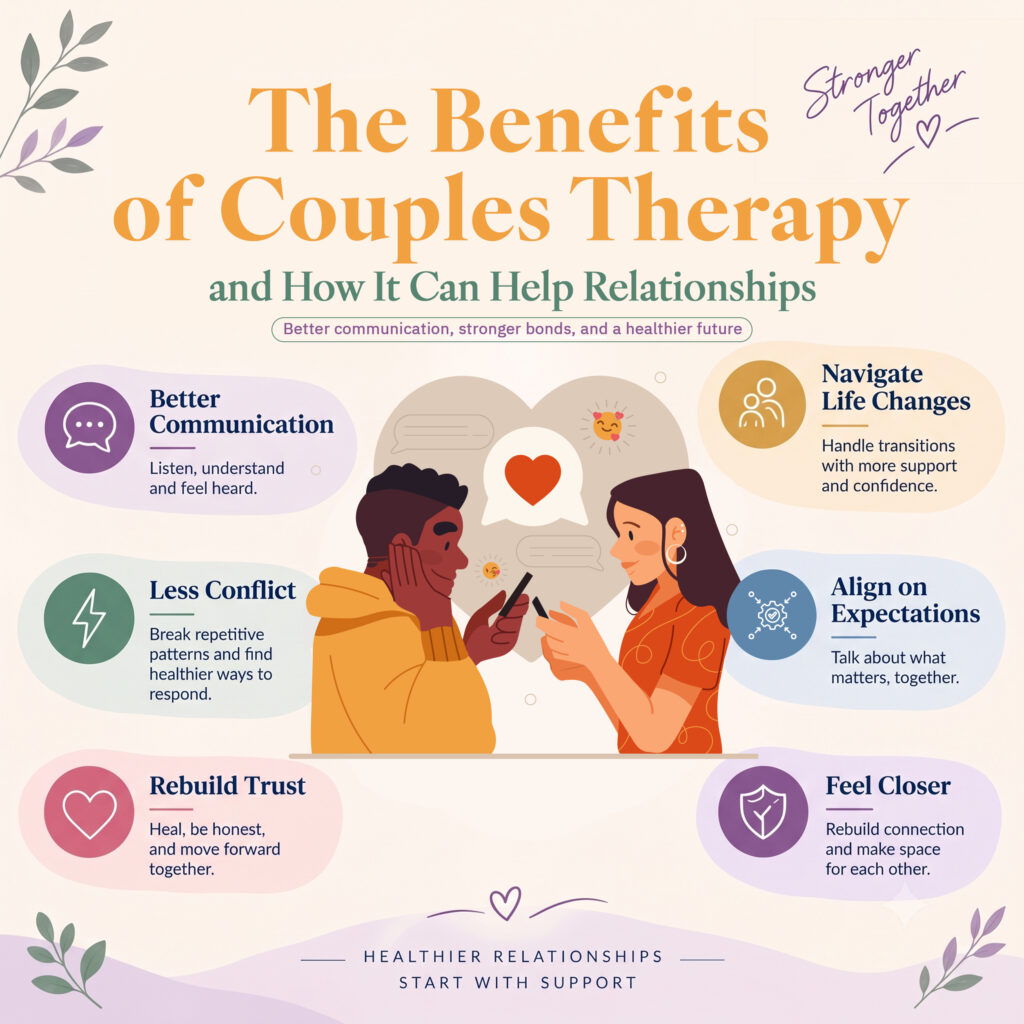
Communication
Most couples don’t struggle because they can’t talk. They get stuck in conversations that quickly turn into arguments when tensions rise. The moment things feel heated the same old points come up again and again. A counsellor helps slow that down. It’s about giving each person space to be heard. Not just to repeat fights but to really listen and understand what the other is saying.
Recurring Conflict
Rather than picking apart the argument itself again, therapy tends to zoom out to what sets it off, how each person reacts, and what keeps the cycle running. That shift in focus is often more useful than anything said in the middle of an argument.
Emotional Distance
Some things are genuinely hard to bring up at the kitchen table. Withdrawal, or drifting apart without either partner quite deciding to.. a counselling room can be a less loaded place to put that into words
Trust
Where trust has been affected, therapy can offer a structured space to talk through what happened and what each partner needs going forward. Trust does not fix itself automatically. Trust needs both partners to want it and the details of their situation.
Expectations
Most fights come from expectations about money, chores, family or closeness that no one talked about. Naming those expectations out can be more than half the solution.
Parenting and Family Pressures
This is often where couples get help aligning on parenting approaches, or working out how to manage pressure from extended family without one partner feeling caught in the middle.
Major Life Transitions
A new baby, a move, a job loss, an illness; all these can reshape a relationship quickly, sometimes faster than either partner can process alone. Counselling helps people make changes together.
Relationship difficulties are rarely about talking. The sections above show that the same basic process can help with different worries. In all cases the truth is that results can differ. Therapy can help the process; it cannot decide where the process will finish.
What Are the Realistic Benefits of Relationship Counselling?
No one can honestly promise a result. What therapy tends to make possible is this:
● Greater awareness of recurring relationship patterns
● Improved ability to communicate about difficult topics
● A clearer understanding of each partner’s perspective
● More constructive ways of managing disagreement
● Clarity on where the couple is compatible and where they aren’t
● Better-defined expectations going forward
● A more informed basis for deciding what comes next, whether that’s staying together, working through specific issues, or separating
Some couples come out of therapy closer than when they started. Others come out with clarity that separating is the right decision. Both can reflect the process working as they’re simply different endings.
Relationships Do Not Exist in Isolation
The relationship can be easily boxed as a communication problem. Take a couple stuck in the same argument every week. Dig a little and it’s often not really about the argument as it may be one partner’s work stress, an unspoken family obligation, or a life stage (a new baby, an ageing parent, a career shift) quietly reshaping the household. Looking only at “how the couple talks” can miss what’s actually driving the tension. This is an educational way of looking at relationship concerns, as it is a lens, not a diagnostic or clinically validated instrument.
Couples Therapy in the Indian Context
For couples decisions about their relationship do not happen alone. Family plays a role. Extended family members often get involved. There are expectations passed down from generations about how marriage should be. People feel pressure to show an image to relatives. This can create stress that is not easy to see.
There is also hesitation when it comes to seeking counselling. Privacy is a concern. Many people worry about who might find out. There is still some stigma around therapy. Some believe it means something is wrong with the couple. Others think very serious problems need help. These thoughts make it harder for couples to reach out.
None of this makes the underlying issues different in kind as the same core questions about communication, trust, and expectations still apply. What changes is context. Naming the family pressures the weight the work demands and the challenges that come with them often helps counseling feel more real and connected. It makes the process more meaningful than looking at the couple as if they live separately from the people and situations around them.
Couples Counselling vs Individual Counselling
Couples counselling focuses on the relationship itself. Both partners are in the room working together to understand what happens between them. The main goal is to improve how they connect and communicate. Individual counselling on the other hand focuses on one person at a time. It looks at thoughts, feelings and experiences.
Each approach has its purpose. Couples counseling helps two people grow together. Individual counselling helps a person grow within themselves. Individual counselling focuses on one person’s own experience and wellbeing, which may or may not directly involve the relationship.
Sometimes one is clearly more relevant. Often, both matter at different points just like individual work on something personal, alongside or followed by couples work on how that is showing up between you. Deciding which to start with depends on the circumstances. Deciding which to start with is often worth discussing with a qualified professional instead of guessing.
When Individual or Specialist Support May Be Appropriate
Couples therapy isn’t always the right starting point. Depending on the circumstances, individual counselling or assessment by another appropriately qualified professional may be appropriate alongside or before couples work.
For example, where a partner is dealing with significant anxiety, depression, unresolved trauma, or concerns around substance use, or where symptoms suggest a psychiatric or medical evaluation would be worthwhile. Couples counselling is not a substitute for these, and it is not a diagnostic process as it does not identify or confirm a mental-health condition.
When Couples Therapy May Not Be the First or Only Step
Couples counselling generally assumes both partners can speak relatively freely and safely in the room. That assumption doesn’t hold in every relationship. Where there is abuse, violence, coercive control, threats, or fear of one partner by the other, joint counselling is not automatically the appropriate first step, and in some circumstances it can increase risk rather than reduce it. If this applies to you or someone you know, safety-focused individual support and including from specialist services trained in this area should generally come first. A responsible therapist would assess these concerns before proceeding with joint sessions.
What happens during couples therapy?
Approaches vary between therapists. A general educational sequence often includes:
Understanding what each partner sees as the main concerns
Exploring recurring relationship patterns
Identifying the cycles behind repeated conflicts
Discussing communication styles and underlying expectations
Working on specific, agreed areas between sessions
Reviewing progress and deciding on steps
Not every therapist follows this exact order. The pace of the session depends on what the couple brings into the room on a given day.
Questions Couples Can Reflect On Before Seeking Support
This is an educational reflection tool, not a diagnostic test or validated clinical instrument. It isn’t meant to score your relationship, just to help you think before a first session, if you decide to have one.
● What problem keeps repeating, no matter how we try to fix it?
● What topics do we find hardest to talk about?
● What expectations have changed since we started this relationship?
● Are outside pressures such as work, family, parenting, lifestyle affecting how we relate to each other?
● What would we like to understand or work on together?
Gaurav Duggal’s Perspective
Years working across counselling, special education, and human development have left me with one strong bias: I rarely see a relationship difficulty as a single problem to solve. More often, it’s a pattern which is shaped by someone’s history, the family around them, and the stage of life they’re in. A couple who’s had the same fight every week for a year usually isn’t fighting about that thing anymore. They’re responding to something underneath it and a transition, an unnamed expectation, a need that’s gone unmet for too long. The couples work I find most useful spends real time on that underlying layer, not just the surface argument.
When Is It Worth Considering Couples Therapy?
If something keeps resurfacing despite your own efforts, or you and your partner would simply value a neutral space to talk through the harder things, it’s generally worth exploring. You don’t need a crisis as your reason to go, you need clarity. Sooner rather than later is often the more useful outcome.
Frequently Asked Questions
When should you go to couples therapy?
Whenever recurring conflict, communication difficulties, distance, or uncertainty about the relationship persist despite your own efforts to resolve them and not only once things feel critical.
How does couples therapy help relationships?
It can offer a neutral space to explore relationship patterns communicate more directly and clarify expectations. It may support the process though outcomes depend on both partners and the specific circumstances.
What are the benefits of relationship counselling?
Possible benefits include self-awareness, improved communication, more constructive conflict management and a clearer more informed basis for relationship decisions. Results vary from couple to couple.
Is couples counseling for married couples?
No. It can be relevant for dating, engaged or long-term partners regardless of status.
Can couples therapy help communication problems?
It may help couples build tools and space to communicate constructively though this depends on both partners’ engagement in the process. It isn’t guaranteed.
Can couples counselling help rebuild trust?
It can offer a setting to work through trust concerns but whether trust is rebuilt depends on the specific circumstances and both partners’ willingness. This isn’t something therapy can promise.
Should I choose couples counseling or individual counseling?
It depends on whether the concern’s primarily relational, primarily personal or both. A professional can help you assess which is more appropriate for your situation.
What happens during couples therapy?
Sessions generally involve understanding each partner’s concerns exploring patterns and working on areas together though the exact process varies by therapist and approach.
When is couples therapy not appropriate?
Where there is abuse, violence, coercive control or other safety concerns joint counselling is not appropriate and individual safety-focused support should generally be considered first.
Considering Your Options
If you’re not sure whether your situation calls for couples counselling, individual counselling, or another form of professional support, that’s a reasonable thing to bring to a consultation rather than work out alone. You can find out more atgauravduggal.com. No particular outcome can be promised as a consultation simply helps clarify what kind of support may fit where you are right now.
Authoritative References
The general claims in this article about the nature and possible outcomes of couples therapy are consistent with publicly available information from the following organisations. This article does not cite specific statistics from these sources; they are provided for readers who want to explore the underlying evidence base further.
● American Psychological Association (APA) – general information on couple and family psychology as a recognised specialty area.apa.org
● American Association for Marriage and Family Therapy (AAMFT) – professional body information on marriage and family therapy practice.aamft.org
● Relate (UK) / NHS-linked relationship counselling services – public information on relationship counselling, including that it is available at any relationship stage, not only in crisis.relate.org.uk
Follow Me for More Insights
Some Thoughts on Life, Growth, and Everything In-Between
Sometimes, all it takes is a little insight or a different perspective to get unstuck. This is my space to share some of my thoughts, provide a bit of guidance, and offer practical tips on mental health, relationships, and personal growth. Think of it as a place to gather some clarity before we even talk.
Expert Counselling, Therapy & Mentoring for Every Stage of Life
Providing a bridge between human understanding, multidisciplinary support and personal or professional growth. Whether you need counselling for emotional wellness and life transitions, therapy for mental health or neurodevelopmental disorders, or mentoring for academic and business success—I offer specialized support tailored to your unique journey. From special education to executive strategy, find the path that is right for you.
Collaborative Network | versatile advisor | Inclusive Care | Online & In-Person Sessions | Serving India & Globally
Not sure where to start?
Book an initial consultation to understand the right support for your situation.
I offer flexible session formats tailored to your schedule and location—providing online (video/audio), hybrid, and in-person sessions across India and internationally. As a tech-savvy and globally accessible practitioner, I work across all time zones and am available for urgent support when your situation requires immediate attention.
Select the format that works best for you and take the first step toward clarity, growth, and emotional wellbeing.
Get in
touch
today
Select a time in my calendar to book your session, or simply call me or send a message - I'll respond promptly, whichever feels easiest for you.
Please fill in the form below
Message Sent!
Thank you for reaching out. I'll get back to you as soon as possible.
Get in touch: Call /
WhatsApp / SMS
Ready to talk? A simple call is the quickest step toward clarity. Your conversation is always 100% confidential and pressure-free.