Understanding Bipolar Depression And When It’s Time to Get Help
September 12, 2026
As humans, we all experience a low time in our lives. This can be a really tough week, insomnia, stress or other factors. People think that the low mood that they experience is just a phase that will get better. Unfortunately, for many of us, it is a recurring phase.
If you are also dealing with mood swings that feel way out of proportion, and your energy shifts make no sense no matter how much you rest, that’s exactly when it stops being a bad week and starts being something worth paying attention to. In this blog, you will understand what bipolar depression looks like, how it differs from depression, and when it’s high time to seek professional help for bipolar depression, with an expert like Gaurav Duggal, who has discussions on mental health that focus on comprehending actions before applying labels.
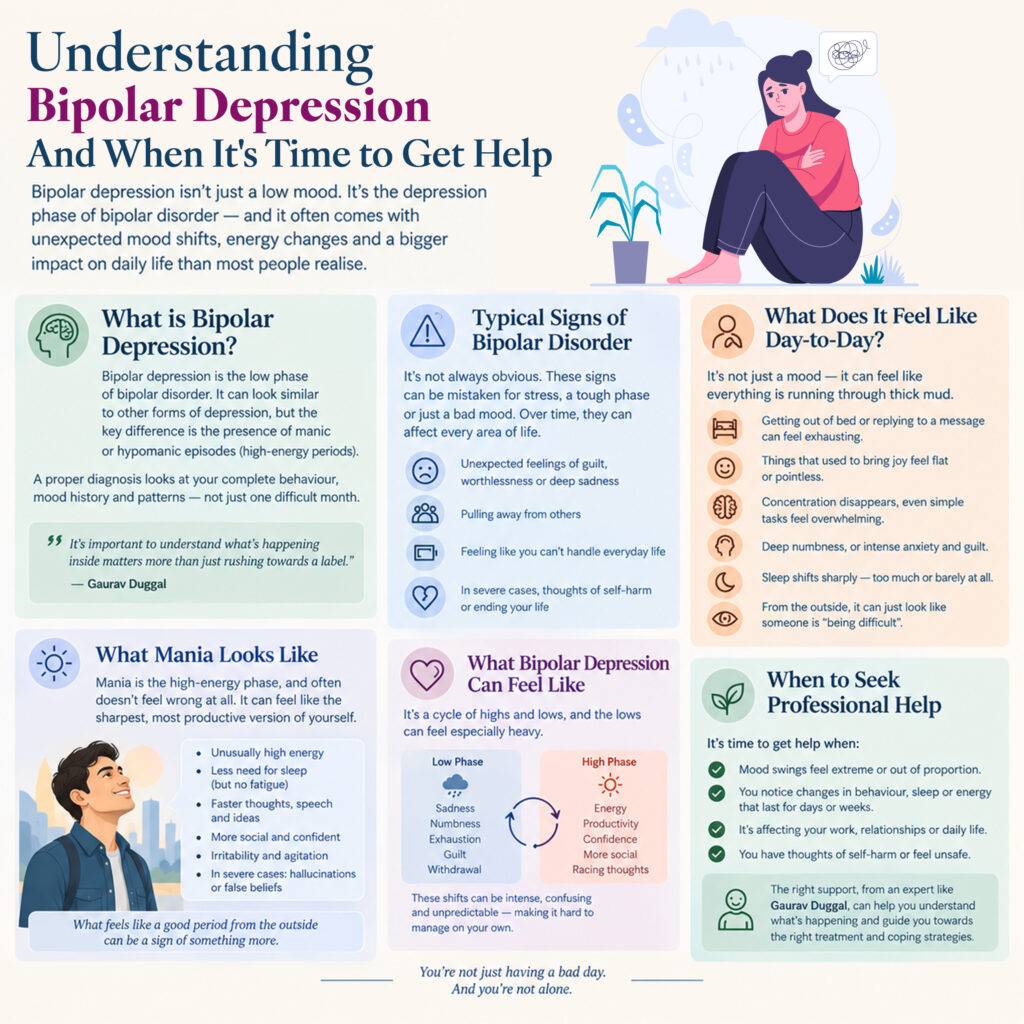
What is Bipolar Depression?
Bipolar depression is more than just a low feeling. It is the depression phase of bipolar disorder that can be similar to other forms of depression. The main difference between bipolar and typical depression is that a person with bipolar disorder experiences periods of manic or hypomanic episodes. While these high-energy episodes can be very opposite to a person’s regular behaviour, labelling someone bipolar can be tricky.
Doctors need to examine one’s complete behaviour, mood swings, continuous pattern and more to diagnose it. The broader mood history matters far more than any single episode, and one difficult month alone can’t confirm or rule anything out. Gaurav Duggal is one of the renowned experts with years of experience working across psychology, counselling and human behaviour, and often makes this point: “It’s important to understand what’s happening inside matters more than just rushing towards a label.”
What are the Typical Signs of Bipolar Disorder
It’s not that easy to diagnose if one is dealing with bipolar disorder or not, as this can seem like a common mood swing, tough phase or just a bad mood. At first, these can be easily attributed to stress, but as they continue and affect every area of a person’s life, the full extent of changes can become apparent. Most people are unaware of these subtle changes affecting their daily lives. And because these changes are in themselves, most people tend to “get on with it” and “carry on” for weeks, even months, unaware of a pattern developing.
People start seeing odd changes in how their loved ones act. These changes don’t feel like a major change in life or personality, but these are the major symptoms that get ignored. Feelings of guilt, worthlessness, or deep sadness can pop up unexpectedly. Because of all this, people tend to pull away from others. They feel like they can’t handle everyday life anymore, and in really bad cases, they might even start thinking about hurting themselves or ending their lives.
What Does It Feel Like Day-to-Day?
Symptoms on a list look clean. Real life doesn’t. Bipolar depression can feel like everything’s running through thick mud; tasks that used to be automatic suddenly take enormous effort. Some days it’s numbness.
Other days it’s guilt that makes no sense. Sleep either disappears or takes over completely. This is what makes it hard to explain to someone who hasn’t felt it.
Getting out of bed or replying to a message can feel genuinely exhausting.
Things that used to bring enjoyment feel flat or pointless.
Concentration disappears even simple tasks feel overwhelming.
Most of us feel deeply numb; others feel intense anxiety or guilt.
Sleep shifts sharply in one direction: too much or barely at all.
From the outside, it can just look like someone is “being difficult”.
What Mania Looks Like
This is where bipolar disorder gets misunderstood most often. People usually seek help when something feels wrong. But mania the high-energy phase, often doesn’t feel wrong at all. It can feel like the sharpest, most productive version of yourself. You’re full of ideas, needing less sleep, more social, more confident and things feel possible in a way they don’t usually. That’s exactly why it goes unnoticed for so long. During a manic episode, energy is unusually high, the need for sleep drops significantly but fatigue doesn’t follow thoughts, race and speech becomes fast or excessive. Irritability and agitation can appear even during what looks like a good period from the outside. When mania gets bad, it can make people see or hear things that aren’t there, believe things that aren’t true, or get very confused. This needs immediate medical help. Often, friends or family notice these changes before the person does, so what they say is important when doctors are trying to figure things out.
Hypomania
Hypomania sits just below full mania. It’s easier to miss because it doesn’t feel like a problem; it feels like a productive stretch. You’re sleeping less but feel fine. You’re social, energetic, confident.
From the inside, everything seems fine. From the outside, something’s shifted. And what follows a hypo manic period often makes the pattern obvious.
Less sleep but no fatigue feels like increased efficiency.
More talkative more social moving quickly between ideas.
Others notice a clear personality shift even when the person doesn’t.
Can lead to impulsive choices with consequences that show up later.
Often followed by a depressive episode the crashes after the high.
Worth mentioning to a professional even if it felt positive at the time.
Bipolar Depression Vs Depression
On paper, these two can look almost identical. Both involve low mood, exhaustion, poor concentration and loss of interest in daily life. Someone going through bipolar depression and someone going through a major depressive episode can describe their experience in almost the same words. The key difference is whether mania or hypomania has ever occurred, but even that isn’t always simple to identify. Other mental health conditions can produce overlapping symptoms.
Physical health issues can affect mood and energy. Medication and substance use may play a role too. A qualified professional considers all of these factors together not just what’s happening right now but across different periods of a person’s life. That broader way of looking at things is what separates a proper assessment from an online checklist. Rushing toward a label without that full history doesn’t help anyone and it can make things harder to understand later on.
Bipolar Depression Support
One of the quieter truths about bipolar depression is that support doesn’t have to wait until things are bad. It can start with something small a conversation, a journal, a GP appointment. The earlier you reach out the more options you have. Waiting until you’re overwhelmed just makes everything harder. Support exists and it looks different for different people.
Start by describing what’s changed in sleep energy, mood, and behaviour to a doctor or therapist.
Track patterns over time; even rough notes on mood and sleep can help a professional see the bigger picture.
Family members and close people benefit from learning the condition too.
Peer support groups, in person or online, can reduce the isolation that comes with this.
You don’t need a diagnosis before you seek support, just a description of what’s happening.
When to seek help for bipolar depression
A lot of people wait until things are falling apart. Some wait because they’re not sure what they’re experiencing. Some wait because they think it’ll pass.
But professional support isn’t only for concern points it’s for when life is getting harder to manage, and you can’t quite work out why. These aren’t diagnostic criteria. They’re simply reasons to stop waiting.
Depressive symptoms have lasted weeks and aren’t lifting.
Low moods keep returning in cycles.
Mood changes are affecting relationships or work.
You’ve had periods of unusually high energy or very little sleep.
You simply don’t know what’s happening that alone is reason enough.
Mental Health Is More Than a Label
You cannot understand how serious your condition is until you get a complete professional diagnosis. Bipolar disorder plays out across months and years through relationships, sleep patterns, life events, and behaviour that shifts in ways that aren’t always obvious in the moment. One hard month doesn’t tell the whole story. One unusually energetic week doesn’t either.
Professionals don’t think or evaluate a medical condition in the same way ordinary people do. They don’t rely on Google or internet information they go through all patterns and symptoms before landing on Self-diagnosis from symptom lists can mislead more than it helps, and rushing toward the quickest explanation often misses what’s happening. Gaurav Duggal’s work in psychology and counselling reflects this broader, human-first view consistently the goal is always to understand the person, not just the symptoms they present with.
Final Thoughts
Bipolar is not just a constant feeling of mood swings, bad mood or just not feeling like doing anything. It’s more serious than that and can be tough for normal people to understand, even the person dealing with it might get confused sometimes. From the outside, it might feel like a regular depressing phase or depression, but inside it’s more than that. The major difference between these two is that people with bipolar disorder struggle every day with episodes of mania or hypomania. It is a high-energy state that sits on the complete opposite end of the scale.
Without looking at both sides of that pattern, the full picture stays incomplete. Gaurav Duggal, an experienced expert, has spent many years working across psychology, counselling and human behaviour, and Gaurav Duggal often reminds us that understanding what is happening matters far more than rushing toward a label.
Disclaimer: This article is for educational purposes. It is not intended to be used for accurate diagnosis, treatment of a medical condition or clinical advice. If a person is experiencing suicidal thoughts, seek immediate professional help instead of self-diagnosing. Only a qualified and experienced health care professional can properly diagnose bipolar disorder.
Frequently Asked Questions
How to beat bipolar depression?
You can beat bipolar depression by going through a professional medical treatment plan that combines prescribed medications, therapy and a balanced routine.
Can someone with bipolar be normal?
Yes, a person with bipolar can live a normal life with balanced medication, a change in routine and proper treatment.
Is it possible to manage bipolar disorder without medication?
Yes, managing bipolar disorder without medication is possible for some people, but not on a large scale. For most of them, it requires a complete medication course.
What are bipolar low episodes?
Bipolar low episodes, also known as major depressive episodes, are extended periods of severe low mood, extreme fatigue, and deep hopelessness that occur as part of Bipolar Disorder.
How long does bipolar depression last?
A bipolar depressive episode typically lasts a median of 14 weeks (about 3 months), but can range from several weeks to six months or longer.
Follow Me for More Insights
Some Thoughts on Life, Growth, and Everything In-Between
Sometimes, all it takes is a little insight or a different perspective to get unstuck. This is my space to share some of my thoughts, provide a bit of guidance, and offer practical tips on mental health, relationships, and personal growth. Think of it as a place to gather some clarity before we even talk.
Expert Counselling, Therapy & Mentoring for Every Stage of Life
Providing a bridge between human understanding, multidisciplinary support and personal or professional growth. Whether you need counselling for emotional wellness and life transitions, therapy for mental health or neurodevelopmental disorders, or mentoring for academic and business success—I offer specialized support tailored to your unique journey. From special education to executive strategy, find the path that is right for you.
Collaborative Network | versatile advisor | Inclusive Care | Online & In-Person Sessions | Serving India & Globally
Not sure where to start?
Book an initial consultation to understand the right support for your situation.
I offer flexible session formats tailored to your schedule and location—providing online (video/audio), hybrid, and in-person sessions across India and internationally. As a tech-savvy and globally accessible practitioner, I work across all time zones and am available for urgent support when your situation requires immediate attention.
Select the format that works best for you and take the first step toward clarity, growth, and emotional wellbeing.
Get in
touch
today
Select a time in my calendar to book your session, or simply call me or send a message - I'll respond promptly, whichever feels easiest for you.
Please fill in the form below
Message Sent!
Thank you for reaching out. I'll get back to you as soon as possible.
Get in touch: Call /
WhatsApp / SMS
Ready to talk? A simple call is the quickest step toward clarity. Your conversation is always 100% confidential and pressure-free.