Why One Therapy Doesn’t Fit All: Choosing the Right Therapeutic Approach
May 25, 2026
When it comes to mental health, one size absolutely does not fit all.
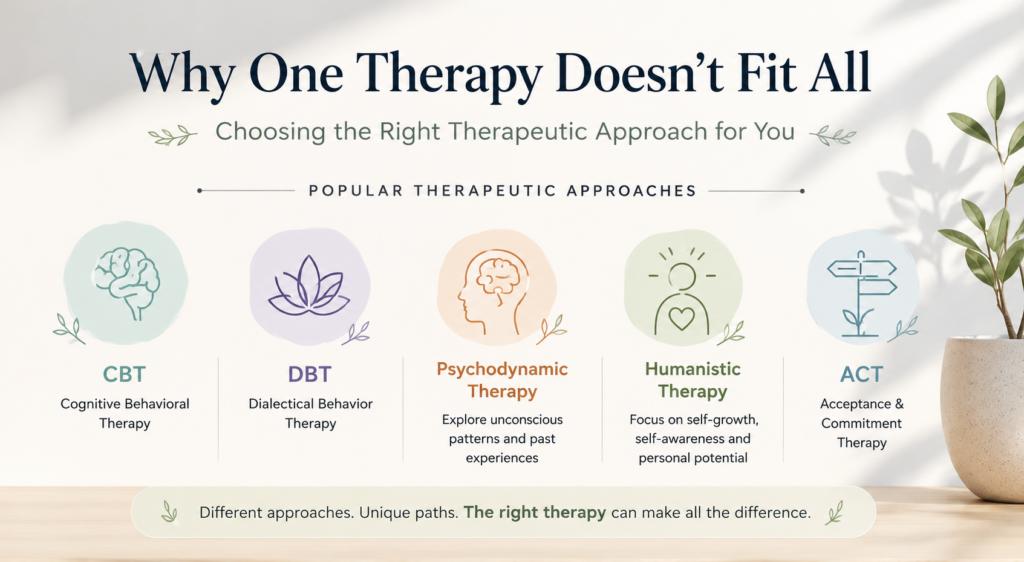
The world of therapy is vast and diverse, offering multiple therapeutic approaches designed to address different emotional, psychological, and behavioral needs. From Cognitive Behavioral Therapy (CBT) to Dialectical Behavior Therapy (DBT) and other evidence-based models, each approach offers a different lens for healing.
Understanding these differences in counselling modalities can help you make more informed decisions about your mental health journey and find the therapy that actually fits you, not just what is most commonly known.
Why Choosing the Right Therapy Matters
Therapy is not a fixed formula. It is a deeply personal process shaped by your emotions, experiences, and thought patterns.
The effectiveness of therapy depends heavily on alignment—between your needs and the approach being used. Some therapies are designed for structured symptom relief, while others focus on emotional exploration or long-term behavioral change.
Different concerns require different tools. Anxiety, depression, trauma, emotional regulation challenges, and relationship difficulties often respond better to specific types of therapy. This is why understanding your options becomes essential.
Another important factor is therapist specialization. Most therapists are trained in specific modalities, and knowing what you’re looking for increases the chances of finding the right professional match. When the approach fits, engagement improves and so does progress.
Overview of Major Therapeutic Approaches
The field of mental health includes several well-researched and widely practiced therapeutic approaches, each with its own philosophy and methods.
1. Cognitive Behavioral Therapy (CBT)
Cognitive Behavioral Therapy (CBT) is one of the most widely used and researched forms of therapy. It is based on the idea that thoughts, emotions, and behaviors are interconnected, and that changing unhelpful thought patterns can lead to healthier emotional responses and actions.
CBT is commonly used for anxiety disorders, depression, OCD, phobias, and stress-related concerns. It is structured, goal-oriented, and typically short-term in nature.
Key techniques include cognitive restructuring, where negative thought patterns are identified and challenged; behavioral activation, which encourages positive action; and exposure-based strategies for overcoming fears. CBT also involves practical exercises between sessions, making it highly action-driven and skill-focused.
2. Dialectical Behavior Therapy (DBT)
Dialectical Behavior Therapy (DBT) was originally developed for borderline personality disorder but is now widely used for emotional regulation difficulties and intense psychological distress. It combines cognitive-behavioral techniques with mindfulness practices.
DBT focuses on balancing acceptance and change. It is particularly effective for individuals experiencing overwhelming emotions, self-destructive behaviors, or unstable interpersonal relationships.
The core components of DBT include mindfulness, emotional regulation skills, distress tolerance techniques, and interpersonal effectiveness. Unlike many traditional therapies, DBT often includes a structured combination of individual sessions, group skills training, and real-time support methods.
3. Psychodynamic Therapy
Psychodynamic therapy is rooted in psychoanalytic theory and focuses on uncovering unconscious patterns shaped by early life experiences. It helps individuals understand how past relationships and unresolved emotional conflicts influence current behavior and emotional responses.
This approach is especially useful for individuals who want deeper self-exploration or who struggle with long-standing emotional or relational patterns.
Rather than focusing only on symptoms, psychodynamic therapy explores underlying emotional themes, defense mechanisms, and recurring relational dynamics. It is typically a longer-term and more reflective process compared to structured therapies like CBT.
4. Humanistic Therapy
Humanistic therapy centers on personal growth, self-awareness, and the belief that individuals have the innate capacity for healing and self-actualization. It emphasizes empathy, authenticity, and unconditional positive regard from the therapist.
This approach is often helpful for individuals dealing with self-esteem issues, identity concerns, or major life transitions. It creates a supportive, non-judgmental environment where clients can explore their feelings freely and develop a stronger sense of self.
Unlike structured models, humanistic therapy focuses less on techniques and more on the therapeutic relationship and emotional experience.
5. Acceptance and Commitment Therapy (ACT)
Acceptance and Commitment Therapy (ACT) is a mindfulness-based behavioral approach that encourages individuals to accept difficult thoughts and feelings rather than trying to eliminate them. At the same time, it emphasizes committed action aligned with personal values.
ACT is commonly used for anxiety, depression, chronic stress, and avoidance-based behaviors. It helps individuals build psychological flexibility—the ability to stay present and take meaningful action even in the presence of discomfort.
Core techniques include mindfulness, cognitive defusion (learning to detach from unhelpful thoughts), and values clarification, which helps guide long-term behavioral change.
CBT vs DBT: Understanding the Difference
Although both come from cognitive-behavioral roots, CBT and DBT serve different purposes.
Aspect
CBT
DBT
Focus
Changing thoughts & behaviors
Emotional regulation + acceptance
Best For
Anxiety, depression, OCD
Intense emotions, self-harm, instability
Structure
Structured, short-term
Skills training + therapy + coaching
Core Tools
Cognitive restructuring
Mindfulness + distress tolerance
Emotional Focus
Thought-driven
Emotion-driven
Simple way to understand it:
CBT = Change how you think
DBT = Manage how you feel
How to Choose the Right Therapy for You
Choosing the right therapy approach begins with understanding your own needs. Are you looking for symptom relief, emotional regulation, deeper self-awareness, or relationship improvement? Your answer will often point toward a suitable modality.
It also helps to understand your learning style. Some people prefer structured tools and exercises, while others benefit more from open-ended exploration and reflective conversation. Therapy is most effective when it aligns with both emotional needs and personal preference.
In many cases, the process is not linear. You may start with one approach and gradually integrate or shift to another as your needs evolve. Many therapists also use integrative methods that combine multiple modalities.
How Online Counselling Expands Therapy Options
With the rise of online counselling, access to different counselling modalities has become significantly easier. You are no longer limited by geography when choosing a therapist or therapeutic approach.
This means you can connect with specialists in CBT, DBT, ACT, psychodynamic therapy, or other approaches regardless of your location. Online therapy also offers flexibility in scheduling, continuity across time zones, and the comfort of attending sessions from a familiar environment.
This accessibility allows you to focus less on availability and more on finding the right therapeutic fit for your needs.
Conclusion: The Right Therapy Makes the Difference
Mental health care is not one-dimensional. Each person’s emotional world is shaped by different experiences, challenges, and coping patterns and therapy must reflect that diversity.
Understanding the different types of therapyhelps you move beyond a one-size-fits-all mindset and choose an approach that aligns with your goals.
Whether it is CBT, DBT, psychodynamic, humanistic, or ACT, the most effective therapy is the one that resonates with you and supports meaningful, sustainable change.
Follow Me for More Insights
Some Thoughts on Life, Growth, and Everything In-Between
Sometimes, all it takes is a little insight or a different perspective to get unstuck. This is my space to share some of my thoughts, provide a bit of guidance, and offer practical tips on mental health, relationships, and personal growth. Think of it as a place to gather some clarity before we even talk.
Expert Counselling, Therapy & Mentoring for Every Stage of Life
Providing a bridge between human understanding, multidisciplinary support and personal or professional growth. Whether you need counselling for emotional wellness and life transitions, therapy for mental health or neurodevelopmental disorders, or mentoring for academic and business success—I offer specialized support tailored to your unique journey. From special education to executive strategy, find the path that is right for you.
Collaborative Network | versatile advisor | Inclusive Care | Online & In-Person Sessions | Serving India & Globally
Not sure where to start?
Book an initial consultation to understand the right support for your situation.
I offer flexible session formats tailored to your schedule and location—providing online (video/audio), hybrid, and in-person sessions across India and internationally. As a tech-savvy and globally accessible practitioner, I work across all time zones and am available for urgent support when your situation requires immediate attention.
Select the format that works best for you and take the first step toward clarity, growth, and emotional wellbeing.
Get in
touch
today
Select a time in my calendar to book your session, or simply call me or send a message - I'll respond promptly, whichever feels easiest for you.
Please fill in the form below
Message Sent!
Thank you for reaching out. I'll get back to you as soon as possible.
Get in touch: Call /
WhatsApp / SMS
Ready to talk? A simple call is the quickest step toward clarity. Your conversation is always 100% confidential and pressure-free.